Posted by: Sandy Steinman | April 13, 2018

Yosemite Flood Video

Yosemite National Park published a video of the recent flooding in the park at Yosemite Flood: April 7, 2018

Heavy rain and melting snow flooded Yosemite Valley last weekend, covering some roads with four feet of water. Visitors were evacuated in advance. Turn up the volume and enjoy this once-in-a-lifetime experience!

Posted by: Sandy Steinman | April 13, 2018

Southern California Wildflower Summary 4/13/18

Theodore Payne report below. To see photos go to http://theodorepayne.org/wp-content/uploads/2013/11/April-13-WHR-text.pdf

First, near the Theodore Payne Foundation, in the middle and upper La Tuna Canyon, the north sides of the hills sport patches of gorgeous, deep blue wild Canterbury bells (Phacelia minor). Careful drivers can spot the post-fire regeneration, though it’s best to pull off the road to look.

We received our first report this season from Figueroa Mountain in Los Padres National Forest. This is a very popular area for wildflower viewing without much hiking. There are frequent turn outs along the road. Please be sure to use them and for safety, do not just stop along the road. Figueroa Mt. had a very dry winter, but rain in March has generated April wildflowers. It’s uncertain what the extent orduration of the wildflowers this late in the season, but let’s enjoy them while theylast. Starting at the first cattle guard and continuing to the tree canopy area, glistening yellow buttercups (Ranuculus californicus), wild hyacinth (Dichelostemma capitatum), beautiful fiesta flowers (Pholistoma auritum), milk maids (Cardamine californica), fiddlenecks (Amsinckia sp.), Johnny jump-ups (Viola pedunculata), andminer’s lettuce (Claytonia sp.) are in bloom. Right before the tree canopy area, look to your right and find a charming little field of shooting stars (Primula clevelandii) and popcorn flower (Cryptantha sp.).

Read More…

Posted by: Sandy Steinman | April 13, 2018

Antelope Valley Wildflowers 4/11/18

There are poppies at the reserve but not like last year. You can spot them along the trails and they are now starting to bloom among the goldfields. Other plants to look for are: fiddleneck, filaree, forget-me-nots, milkvetch, blue dick, grape soda lupine, combs bur, fringe pod, wild cucumber, lacy phacelia and the beaver-tail cactus has flower buds and will be blooming soon.
Do look for birds as several have been spotted, including: horned larks, loggerhead shrikes, turkey vultures, house finches, ravens, red-tailed hawks, roadrunner, and white-crowned sparrows.
Posted by: Sandy Steinman | April 13, 2018

Death Valley Wildflower Saved From Extinction

republished from Lonely Planet News

A beautiful wildflower in California’s Death Valley has been saved from extinction

Out of the sand dunes of California’s Death Valley grows a beautiful flower – one that will continue to bloom after conservation efforts saved it from extinction.

The Eureka Valley evening primrose is no longer endangered, following combined efforts from Death Valley National Park, the U.S. Fish and Wildlife Service and the Bureau of Land Management. The announcement came as another species, the Eureka Valley dune grass, was reclassified from endangered to threatened.

The Eureka Valley is in Death Valley National Park, California. Image by USFWS/Connie Rutherford
The evening primrose only grows in the Eureka Valley, located within the national park, and was listed as endangered back in 1978. That launched efforts to protect the flower, which included the designation of the Eureka Valley as a wilderness area to protect the lands by reducing the impact of recreation and limiting off-road vehicles. The park also worked on educating people about accessing the dunes without harming the flowers, by taking measures like camping away from the base of the dunes where the plants grow and keeping vehicles on established roadways.

Though Death Valley’s name implies a desolate place, it is actually home to many species that have adapted to the dry environment. In fact, back in 2016, the park even saw a rare super bloom of wildflowers that attracted many visitors. The incredible display is something to behold, but there are necessary efforts to that traveller must make to not destroy the delicate plants that grow there. According to the Death Valley National Park website, wildflowers this year have been sparse, but you can learn more about the best time to find them each year here.

Posted by: Sandy Steinman | April 12, 2018

Homestead Valley Land Trust Wildflowers 4/12/18

Homestead Valley Land Trust  has a new report for April 12.  See map and photos at Homestead Valley Land Trust

NEW
– Cow parsnip with its large white umbel is blooming in meadows and oak woodlands.
– Cowbag clover is a tiny purple bloom in the meadow grasses.
– Fringe cups has lovely lobed foliage with its fringed flowers on a tall stalk.
– Herb robert, native of the United Kingdom, is blooming purple with a golden center is blooming along trails and in disturbed areas.
– Owl clover is a purple tuft in meadows.
– Redwood sorrel is blooming near the redwood in the sliver of Land Trust between 435 and 441 Laverne.
– Striped coral root, an orchid, is larger than the more common Spotted coral root that is found throughout Homestead.
– Wood rose blooms bright on rangy rose bushes in the forests.

Read More…

Posted by: Sandy Steinman | April 12, 2018

Henry Coe Wildflower Update 4/12/18

Henry Coe State Park has a new wildflower bloom report  for April 12, 2018 at the Pine Ridge Association website with photos and a list of flowers now in bloom at: Henry W. Coe – Wildflower Guide.

Posted by: Sandy Steinman | April 12, 2018

Upcoming Bay Area Wildflower & Other Nature Events

Bay Nature‘s List of Wildflower and Nature Activities

PENINSULA: HALF MOON BAY

Coastal Wildflower Day

Sat April 14, 10am – 4pm

Celebrate coastal wildflowers and wildlife on the Peninsula. This annual kid-friendly festival hosted by Coastside State Parks includes native plant and shorebird walks, plant sales, plenty of live music, and a coloring contest!

NORTH BAY: GUERNEVILLE

The Wildflowers of Austin Creek

Sun April 15, 9am – 3:30pm

Join ecologist Peter Warner on an informative hike to view and identify the wildflowers of Austin Creek. Expect to see 150 species or more, including 60-80 flowering plant species in bloom!

EAST BAY: CLAYTON

Curry Canyon Ranch Loop Hike

Sat April 21, 9am – 2pm

Take in the beauty of Curry Canyon on one of Mount Diablo’s most challenging trails. See a diversity of habitat types, wildflowers, and wind caves. This 7-mile hike with a 2,000-foot elevation gain leads to spectacular views.

NORTH BAY: NOVATO

Wildflowers at Mount Burdell

Sun April 15, 10am – 2pm

Celebrate Native Plant Week at one of the best wildflower spots in Marin County. The flora of this preserve is incredibly diverse and includes a number of rare plants.

And don’t miss:

EAST BAY: BERKELEY

Berkeley Bay Festival

Sat April 14, 11am – 4pm

Join Bay Nature at this event that celebrates San Francisco Bay and meet the groups that help protect it. Free sailboat rides, dragon boat paddles, and more!

BAY AREA-WIDE

State Parks Earth Day Events

Sun April 21, 9am – 1pm

Volunteers are needed at 36 parks statewide to participate in park improvement projects, including Sonoma County’s Jack London State Historic Park, which was deeply impacted by the Sonoma wildfires. Click for details

Save The Date: April 27-30

City Nature Challenge

It’s on! Join this three-day bioblitz competition co-founded by Cal Academy to find the most species in over 50 cities.

Posted by: Sandy Steinman | April 12, 2018

Sierra Foothills Wildflowers 4/9/18

report and photos submitted by Pierre Stephens

Merced River Trail, Hite Cove Trail,  Table Mountain above New Melones, and Red Hills Road

Hiked the Merced River Trail downstream of Briceburg and then 2 miles up the North Fork (10mi return) on Monday (2 photos). Nice variety of flowers, with larger displays of poppies, Lupine sp, goldfields, Collinsia, Triteleia laxa, and Triteleia ixoides. Nice hillsides in bloom the first 1/2 mile up North Fork in the burn area, with many Calochortus Alba and twining Brodiaea just beginning to bloom beyond that. Continued another mile past a large cascade on the North Fork but trail becomes very overgrown with brush. Buckbrush (Ceanothus cuneatus) in heavy bloom along Merced River railroad grade, and many newts in the early morning. Access road from Briceburg to Railroad Flat trailhead was cleared and open.

This slideshow requires JavaScript.

Also hiked a few miles up the Hite Cove trail. Nice display and mix of species in bloom. As with elsewhere in the canyon, individual blooms are smaller than usual, so not as showy yet as some years, but lots of blooms. While some poppies were just starting to form seedpods, the ground was saturated, so I’d expect the bloom to continue and quite possibly increase for at least several weeks.

The Merced River was flowing very strongly after last week’s storms, and the redbud was in peak bloom. Brush including poison oak that survived the fires and recent dry years was bursting into growth.

In the foothills, I went on short hikes on 4/8/18 at Table Mountain above New Melones (some flowers, but much less than at Oroville’s Table Mountain) and Red Hills near Chinese Camp (nice variety, with showy displays on private land along Red Hills Road and lots of small fish (Red Hills Roach?) in the creek along Serpentine Loop Rd North – 2 photos).

Posted by: Sandy Steinman | April 12, 2018

75% of Earth’s Land Areas Are Degraded

National Geographic reports

More than 75 percent of Earth’s land areas are substantially degraded, undermining the well-being of 3.2 billion people, according to the world’s first comprehensive, evidence-based assessment. These lands that have either become deserts, are polluted, or have been deforestedand converted to agricultural production are also the main causes of species extinctions.

Read full article at 75% of Earth’s Land Areas Are Degraded

Posted by: Sandy Steinman | April 11, 2018

Marin County Wildflowers: Mt. Burdell 4/9/18

The Marin CNPS Facebook page has a new post for the Mt. Burdell Open Space Preserve. Flowers shown in bloom included Castilleja densiflora – owl’s clover, Castilleja attenuata – valley tassels,Triphysaria versicolor ssp. faucibarbata – butter-and-eggs, Phacelia distans – white annual phacelia, Platystemon californicus – cream-cups, Lewisia rediviva – bitterroot, Leptosiphon parviflorus – variable Linanthus, Layia chrysanthemoides – smooth Tidy-tips, Delphinium variegatum – royal larkspur, Eschscholzia californica – California Poppy

See photos for above post and older posts at Marin Native Plants.

Posted by: Sandy Steinman | April 11, 2018

Southern California Wildflower Updates

The Press Enterprise has an article about this year’s wildflower bloom and where to see wildflowers this year in southern California at The 2018 Southern California wildflower show’s a disappointing sequel to 2017 – Press Enterprise

Posted by: Sandy Steinman | April 11, 2018

PLEASE DON’T PICK THE WILDFLOWERS!!!

A recent post from Redwood National and State Parks (NPS)

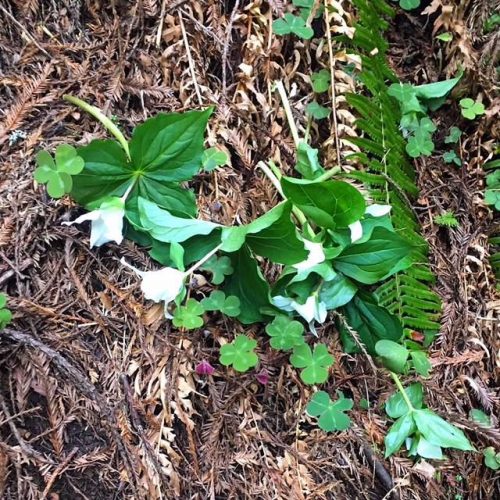
Please don’t pick the wildflowers!

Some flowers, such as these trillium, take up to seven years to bloom. Picking them restarts this long process and could irreparably damage the plant. Plus, it ensures that people who hike the trails afterwards don’t get to enjoy these beautiful flowers.

Photo: S. Chambers [Image description: Several picked trillium plants lay on the duff.]

Posted by: Sandy Steinman | April 11, 2018

Anza-Borrego Wildflowers 4/8/18

Borrego Wildflowers has a number of recent reports

04/8/2018 Golden Queen mine lake loop – Time to head to higher elevation and find a wetter place.
The pond showing on the satellite images looks perfect.
Temperature turned out to be optimal for a hike. The planned route worked great, just a few short stretched of scrubs.
Even here it’s rather dry, a good thing that the drainages are still wet at a couple of places.
As expected we added a good number of plants that we’ve never seen before.
Species in bloom above 3000 feet: 29.

04/7/2018 Salt creek – This is a very contradicting hike, last time we mentioned, germination and green. Now the feeling is dry and no abundant germination.
That said, a lot of scattered annuals, many very small and in low numbers, but they do add to the bloom count.
Unbelievable that the bloom count is this high in an area that feels this dry.
Species in bloom below 3000 feet: 93.

04/5/2018 San Felipe Valley Wildlife area loop – What a difference a month makes, this is unrecognizable green.
The most abundant bloomer in the area right now is Angel’s gilia, Gilia angelensis.
A detour towards a yellow hill, that turned out to be a hot spot of annuals, with Ground pink, Linanthus dianthiflorus and Common goldfields, Lasthenia gracilis.
Germination is good, but with a good amount of nonnatives.
Species in bloom below 3000 feet: 68.

04/4/2018 Sheep Canyon – The creek is still running close to the trail head.
We tried to stay as close to the water and plants as possible.
One of our goals was to find Stream orchid, Epipactis gigantea and Velvet ash, Fraxinus velutina in bloom and we found them both in good bloom.
The bloom count has gone up considerably since our last visit just over a month ago. There are still a couple of must see plants not that far from bloom, so we have to return in a couple of weeks.
Unfortunately Sahara mustard;Asian mustard, Brassica tournefortii in present in very high (999+) numbers.
Species in bloom below 3000 feet: 88.


See photos and older reports at Borrego Wildflowers

The UC Berkeley News reports on a study that shows

Rising sea levels are predicted to submerge many coastal areas around San Francisco Bay by 2100, but a new study warns that sinking land — primarily the compaction of landfill in places such as Treasure Island and Foster City — will make flooding even worse.

Read full article at Sinking land will exacerbate flooding from sea level rise in Bay Area | Berkeley News

Posted by: Sandy Steinman | April 10, 2018

Hite Cove Wildflowers – updated w/photos 4/10/18

report and photos submitted by Jan Cohen

Hite Cove is looking good today, April 10. Lots of mixed blooms from this warm weather the last few days. It’s time to go and enjoy!

This slideshow requires JavaScript.

Posted by: Sandy Steinman | April 10, 2018

Anza-Borrego Wildflowers 4/9/18

Anza Borrego Desert Natural History Association reports

4/9/18 Several species of cactus now blooming in the ABDNHA Garden. 

4/7/18 We are finally getting some color in Anza-Borrego and around Borrego Springs! Shades of ocotillo red, palo verde yellow, apricot mallow, and magenta of cactus blossoms. 

See photos at Anza Borrego Desert Natural History.


Posted by: Sandy Steinman | April 10, 2018

Rancho Del Oso Wildflowers 4/7/18

submitted by Erika Perloff

List of plants seen on a volunteer training hike last weekend on the Rancho Del Oso Skyline to the Sea Bypass trail.

RDO BY-PASS TRAIL APRIL 7, 2018

NATIVE’S DONE BLOOMING

Giant Trillium, Trillium chloropetalum (or angustipetalum?)

NATIVES IN BLOOM

Bee Plant, Schrophularia CA (“yellow-flowered” form is occasional)

Bleeding Heart, Dicentra formosa

Blue Blossom, Ceanothus thrysiflorus

Blue Dicks, Dichelostemma capitatum

CA Blackberry, Rubus ursinus

Canyon Gooseberry, Ribes menziesii

Read More…

Posted by: Sandy Steinman | April 10, 2018

Antelope Valley Wildflowers 4/6/18

Antelope Valley reports

If we continue to have very warm days, we may see the poppies peak soon. This week and next week may be the best times to see the few scattered poppies that we have, along with beautiful blooms of goldfields and lupines!

See new photos a t https://www.facebook.com/PoppyReserve/

Posted by: Sandy Steinman | April 10, 2018

Marin County Wildflowers: Homestead Trail 4/9/18

The Marin CNPS Facebook page has a new post for the Homestead Trail

The Homestead Trailoff Panoramic was a bit bust in late March, but is blooming today a short way in with lupin, poppies, checkerblooms and owl’s clover.

Around the “triangle’ (where the Ridgewood Trail meets other trails) – there were lots of iris, a few columbines and one Fritillaria. C. umbellatus was found in large numbers on the first trail that heads west from there ( back to Panoramic).

 See photos for above post and older posts at Marin Native Plants.
Posted by: Sandy Steinman | April 10, 2018

Sierra Foothills Wildflowers: Electra Rd.

Where to Photograph in California  has new wildflower report

Electra Road is a wildflower spot on Highway 49 where it crosses North Fork of the Mokelumne River. Right now is a great time to go to see hillsides of Foothill Poppies (Eschscholzia caespitosa). The best are just a few hundred yards up the road from the highway. Note that this is a very narrow road.

There also are very good displays on the hillsides around the area, including along the highway, right around Electra Road. Unfortunately, these other displays (which can be seen from several miles away as you approach from the south) are far up in the hills, viewable only from a distance. But the color is gorgeous.

These are best viewed midday to mid afternoon, when the poppies are open and he sun hits these west and southwest facing hills

Posted by: Sandy Steinman | April 10, 2018

Pacheco Park Wildflowers 4/9/18

Where to Photograph in California  has new wildflower reports

Pacheco Park The bloom is currently good, and very satisfying for a wildflower junkie, but I wouldn’t call it great for colorful landscape photography. While there are a lot of blooms, they’re mostly not dense and showy on a large scale. What’s in now: goldfields (a few nice brush strokes of them here and there), fiddlenecks, buttercups, violets, poppies, checkerbloom, popcorn flower, elderberry, blue dicks, some tomcat clover, blow wives, Q-tips and others in the minority.

It’s very green, and while the oaks are further along in leafing out, they’re still a nice vivid green as well, which is a nice combination with flowers and lichen. In some areas the grass remains on the short side, in others it has gotten taller and is starting to smother the wildflowers.


Posted by: Sandy Steinman | April 10, 2018

Napa CNPS Native Plant Sale & Wildflower Show April 14 & 15

Posted by: Sandy Steinman | April 9, 2018

Tehachapi, Carrizo Plain and Wind River Wildflowers 4/8/18

Where to Photograph in California  has new wildflower reports

Tehachapi the northern edge of the Tehachapi’s on Sunday, just south of Arvin, CA near the Granite Construction facility photographing a large fields of mostly lupine but there where a few areas with poppies, owl’s clover and loco weed.  Here are a few photos for that shoot. http://www.gregclurephotography.com/new-images#ha7c457c2 

Carrizo Plain  there are a few areas with daisies and goldfields on the valley floor, but while the plants are in full bloom they are very short and stunted and do not get above the bushy remains from last year’s bloom. While you can see them when you get on top of them, the view from a distance is mostly brown/grey brush.  I don’t believe it will get any better now with heat is on down here in So.Cal.  Soda Lake is almost dried up.  No blooms in the the mountains. It is a very poor years for the Carrizo Plain.
I did not go up the grade as a few of the people I spoke to said it was not as good as the location I mentioned below.

Wind Wolves very few blooms and very short plants at this location.

Posted by: Sandy Steinman | April 9, 2018

Hungry Valley/ Gorman Wildflowers 4/8/18

Hungry Valley OHV has a new wildflower report for 4/8/18

The flowers are beginning to bloom! Along Gorman Post Road you can spot the yellow Coreopsis scattered amongst the Gorman Hills. Mixed in, some spots of bright orange as bunches of California Poppies begin to pop up.

Near the South entrance to the park, patches of blue are beginning to show. You can find the Blue Dick flower finding its way through the bushes, adding tasteful color to the everyday greens and browns here at Hungry Valley.

We have Fiddleneck and Bladderpod starting to bloom all over the park. However, the most excitement can be found in the Yucca flats, located between Aliklik and Lane Ranch campground. The common Muilla, Goldfields, Blazing Star, and Tidy Tips are creating a beautifully constructed array of yellow, with Fiddleneck and a few patches of Poppies providing a complimentary touch of orange.

On your way into the park from the North entrance, Goldenbush is making its way into sight. All along the sides of the roads, the radiant glow of yellow can be seen. The further along you go toward Spaghetti Pass, the Lupine are coming in strong as blotches of purple begin to decorate the hills. Also, look carefully for the tiny Baby Blue Eyes peeking from amongst the bushes along Spaghetti Pass.

The warm weather that has brought out the flowers has also brought out the snakes. Though rattlesnakes are rarely deadly, they are dangerous and should be avoided; they will defend themselves if they feel threatened. Please remember to watch for snakes as you are looking at the wildflowers.


Posted by: Sandy Steinman | April 9, 2018

Oregon Wildflowers 4/8/2018

Oregon Wildflowers  has the following new reports


Mitchell Point the following are blooming at/near the point: Grass widows, glacier lily, chocolate lily, and balsamroot. Also watch for tiny Calypso orchids (Calypso bulbosa) blooming under the trees. 4/8/2018

Mount Pisgah  the following are blooming Fragaria, Cardamine nuttallii, Nemophila, Oregon fawn lily, Trillium albidum, Shooting Star, Common Camas, and Cynoglossum grande. 4/7/2018

Rowena Plateau Balsamroot is starting to open. Also blooming here are: Upland Larkspur, Yellow Bell, Western Buttercup, Paintbrush, and Columbia Desert Parsley. There are also still some glacier lilies in bloom.  4/8/2018

Upper Table Rock many wildflowers are blooming at this location, including: Oregon fawn lily, Forktooth ookow (Dichelostemma congestum), Spring Gold (Lomatium utriculatum), and Upland Larkspur (Delphinium nuttallianum) 4/8/2018

Posted by: Sandy Steinman | April 9, 2018

New Interior Dept. Appoiontee Opposed Species Protections

Alt National Park Service   Facebook page reports

A new political appointee picked by Trump to oversee wildlife and parks at the Interior Department has a history of opposing endangered species protections. Susan Combs, who was recently appointed by Trump as acting assistant secretary for fish, wildlife and parks, has in the past compared the endangered species listings to “incoming Scud missiles.” In her previous post as Texas comptroller, Combs played a key role in wresting control of the endangered species program from the state’s Parks and Wildlife Department. While leading the office, Combs viewed endangered species protections as federal overreach and vowed to protect business interests thwarted by certain endangered species listings.
Posted by: Sandy Steinman | April 8, 2018

Sugarloaf Ridge State Park Wildflowers 4/8/18

Today I went on walk in Sugarloaf Ridge State Park with the Sonoma County chapter of the California Native Plants Society. It was through landscapes burned in the October fires, including grasslands, woodlands, chaparral and serpentine areas. We did a loop going up the Stern or Bald Mt. trail and returned on the Lower Bald Mt. trail. About 80% of Sugarloaf burned. We were looking for evidence of post-fire recovery in trees and shrubs as well as wildflowers.

This slideshow requires JavaScript.

Click read more to see a list of some of today’s wildflowers in bloom. You can see a more complete plant list for Sugarloaf Ridge State Park at https://milobaker.cnps.org/images/plant_lists/Sugarloaf-Ridge-SP.2018-01_Warner.pdf Read More…

Posted by: Sandy Steinman | April 8, 2018

EPA Removing Stream & Wetland Protections

Public Employees for Environmental Responsibility News Release

PRUITT HIJACKS NATIONAL STREAM AND WETLANDS PROTECTIONS

Pruitt Strips EPA Offices of Decision Power on Pebble Mine and Other Big Projects

In a memo dated March 30, 2018 citing the need to “restore regulatory certainty,” Pruitt directed EPA regional offices to cede their Clean Water Act determinations to him:

“With this revised delegation, authority previously delegated to regional administrators to make final determinations of geographic jurisdiction shall be retained by the Administrator…As part of effectuating this revision, I ask that you involve the Administrator’s Office early on in the process of developing geographic determinations”

Among other changes, this new directive –

  • Eliminates the role of locally-based EPA scientists and specialists in reviewing projects and making wetland determinations or other clean water-related calls;
  • Imposes a one size fits all scenario in which regional differences in wetlands, wildlife, precipitation, and other variations are not recognized; and
  • Removes any role by EPA regional offices to essentially “veto” an Army Corps of Engineers dredge and fill permit.

Read More…

Posted by: Sandy Steinman | April 7, 2018

Marin County Wildflowers: Carson Falls 4/7/18

The Marin CNPS Facebook page has a new post for the Carson Falls area that includes twenty six photos of wildflowers and waterfalls seen. See photos and older posts at Marin Native Plants.

Posted by: Sandy Steinman | April 7, 2018

Antelope Valley Wildflowers 4/6/18

Antelope Valley reports

As of April 6th, there is a beautiful display of goldfields with a handful of scattered poppies blooming throughout the South Loop Trail, Tehachapi Vista Point and the Poppy Trail North Loop! There are also some fragrant grape soda lupines on the Tehachapi Vista Point and some great smelling popcorn flowers on the Vista Point to the east. We are predicting the peak of the poppy bloom to happen within a week or so, which will be small but lovely.

See photos at https://www.facebook.com/PoppyReserve/

« Newer Posts - Older Posts »

Categories