Posted by: Sandy Steinman | July 16, 2019

Yosemite To Restore Historic Names

National Park Service Press Release

Lawsuit Settled Between National Park Service, DNC Parks and Resorts, and Yosemite Hospitality, LLC Over Trademarks and Service Marks

DNC Parks and Resorts at Yosemite, Inc. (Delaware North), the United States of America, and Yosemite Hospitality, LLC (Aramark) have settled the lawsuit filed by Delaware North related to Delaware North’s former concession contract at Yosemite with the National Park Service.

The settlement involves the transfer of trademarks and service marks at issue in the lawsuit from Delaware North to Aramark. Under Aramark’s Yosemite concession contract with the National Park Service, those trademarks and service marks will transfer at no cost to the National Park Service upon the expiration or termination of Aramark’s contract. The settlement also involves Delaware North’s transfer of various types of tangible assets (not previously purchased by Aramark) to Aramark and the National Park Service. Finally, the settlement provides for payments to Delaware North from Aramark and the United States to resolve any and all contractual disputes among the three parties arising from Delaware North’s departure as a concessioner at Yosemite, and Aramark’s assumption of its Yosemite concession contract.

The National Park Service looks forward to the restoration of some of the previous names of the properties at Yosemite, including the Ahwahnee hotel, and the resumed use of other trademarks in connection with concessioner activities at Yosemite. Any changes to the current names of properties at Yosemite National Park following this settlement will be based upon a schedule to be determined by Aramark and the National Park Service.
California Native Plant Society (CNPS) News Release

In the wake of May’s alarming United Nations (UN) report on global extinction, California’s new budget provides important funding to protect the state’s biological diversity against loss by extinction. With Gov. Gavin Newsom’s signature, the 2019-20 state budget allocates more than $18 million to advance biodiversity-focused projects like seed-banking rare plants and conservation genomics, effective July 1.

“California will not stand by and just watch our world grow more ecologically impoverished by the moment,” said California Secretary for Natural Resources Wade Crowfoot. “California is one of the most diverse places on Earth. We have both the choice and the ability to preserve that legacy.”

Read More…

Posted by: Sandy Steinman | July 15, 2019

Daffodil Hill is closed indefinitely

The San Francisco Chronicle reports

Daffodil Hill in Amador County has closed indefinitely because the area’s infrastructure can’t keep up with its overwhelming popularity, the owners announced Monday.

Read full article at Daffodil Hill is closed indefinitely, owners say – SFGate

Posted by: Sandy Steinman | July 15, 2019

Yosemite’s Shrinking Glacier

The California Sunday Magazine  has a detailed and illustrated article about studying the shrinkage and eventual disappearance of Yosemite’s Lyell Glacier

What the death of Yosemite’s Lyell Glacier can teach us about climate change.

Source: What Remains — The California Sunday Magazine

Posted by: Sandy Steinman | July 14, 2019

Yosemite High Country Wildflowers 7/13/19

There were many more flowers in bloom than when we drove through Yosemite nine days ago. Heading up towards Tioga Pass from Lee Vining we saw

  • Prickly Poppy/Argemone kunitz
  • Frosted or Sulphur Buckwheat/Eriogonum umbellatum
  • Blazing Star/Mentzelia laevicaulis
  • Desert Evening Primrose/Oenothera caespitosa
  • Mountain Pride / Penstemon newberryi
  • Monkey-flower/Erythranthe guttata
  • Naked Buckwheat/Eriognonum nudum
  • Paintbrush/Castilleja sp.
  • White Rein-orchid/Plantathera dilatata var. leucostachys
  • Jacob’s Ladder/Polemonium californicum
  • a matted roadside Lupine that was very abundant
  • Western Wallflower/Erysimum capitatum var. capitatum (both yellow and orange varieties)
  • Single-Stemmed Butterweed/Senecio integerrimus

There was still plenty of snow in the mountains making for nice landscapes.

Tuolumne Meadows still was wet and didn’t have lots of species but did have some nice Shooting Stars.

  • Alpine Shooting Star/Primula alpinum
  • Pussy-toes/Antennaria corymbosa
  • Meadow or Whorled Penstemon/Penstemon heterodoxus
  • Gayophytum


Mountain Heather/Phyllodoce brewer

Read More…

Posted by: Sandy Steinman | July 14, 2019

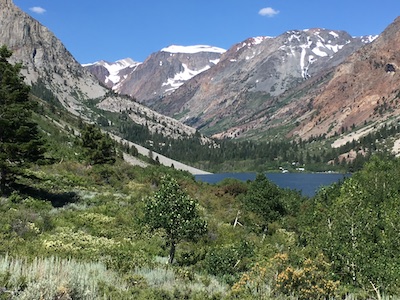
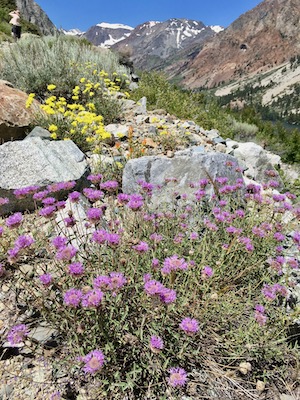
Lundy Canyon Wildflowers: Lake Trail 7/12/19

Lundy Lake

We walked the Lake Trail about a mile in and saw many species in bloom including three penstemon species, lots of Calochortus bruneaunis, two species of Paintbrush plus many Orthocarpus cuspidatus which is a species of flowering plant in the broomrape family known by the several common names Short-flowered Owl’s Clover, Copeland’s owl’s clover, Siskiyou Mountains orthocarpus, and toothed owl’s-clover.

Coyote Mint and Sulphur Buckwheat


Click Read more to see today’s plant list

Read More…

Posted by: Sandy Steinman | July 14, 2019

Henry Coe Wildflower Update 7/12/19

Henry Coe State Park has updated its wildflower bloom report at the Pine Ridge Association website with photos and a list of flowers now in bloom at: Henry W. Coe – Wildflower Guide.

New Website Link: Henry Coe has updated its website and changed the wildflower link. The new link is https://coepark.net/blooming 


Posted by: Sandy Steinman | July 14, 2019

How Will These Long-Lived Trees Adapt To Climate Change?

Science Friday  has a great video discussing how Bristlecone Pines and Limber Pines adapt and are impacted by climate change at How Will These Long-Lived Trees Adapt To Climate Change?

Posted by: Sandy Steinman | July 13, 2019

Why Are There Thousands of Orchids?

The New York Times reports on the great diversity of orchid species

Orchids Bloom in Thousands of Forms. But Why? Each species of orchid is designed to attract a specific pollinator. The genes that make that possible are highly adaptable, scientists say.

Read more at  Orchids Bloom in Thousands of Forms. But Why? – The New York Times

Posted by: Sandy Steinman | July 12, 2019

Few of Trump’s environmental claims stand up to scrutiny

The LA Times reports

President Trump boasted Monday of his administration’s environmental achievements, but few of his claims stand up to scrutiny.

Read story at  Few of Trump’s environmental claims stand up to scrutiny

Posted by: Sandy Steinman | July 12, 2019

Carson Pass Wildflowers: Schneider Cow Camp Trail 7/11/19

California Wildflower Hikes reports

One of the lesser traveled trails in the Carson Pass area is the Schneider Cow Camp trail. An energetic climb starting at about 8300′ and climbing to 9100′ in just a mile and a half (roughly). But it is pretty much clear of snow and the wildflowers are starting to explode! We found almost 50 different species of wildflowers in bloom. Masses of mules ears and balsamroot higher up the trail.

Read more and see photos at  California Wildflower Hikes – Home

Posted by: Sandy Steinman | July 12, 2019

Mt. Rainier Wildflowers 7/12/19

Mt. Rainier National Park reports

Currently Blooming

July has been unusually mild and wet so far, but the foggy weather has a way of making colors pop. Patches of scarlet paintbrush (Castilleja miniata) are blooming along roadsides in the Paradise area. Scarlet paintbrush can be bright red, but can range in color to orange or even yellow in rare cases! Peak bloom in the meadows is probably still a few weeks off, but a driving tour of the park is a good way to view wildflowers.

Please Note: As snow melts away, it may be tempting to skirt remaining patches of snow that are covering trails. However, by going off trail you are walking on and damaging the wildflowers that you may be coming to see! It is better to stay on trail even if that means crossing snow, particularly in the high-visitation meadows around Paradise and Sunrise.

Wildflower Reports

  • Paradise (7/11) – scarlet paintbrush, partridgefoot, Cusick’s speedwell, rosy spirea (early), avalanche lily, cinquefoil, bear grass, lupine, sitka valerian, broadleaf arnica, subalpine daisy, pink mountain heather, glacier lily, Jeffrey’s shooting star, sitka mountain ash
  • Sunrise (7/4)- pale agusens, smooth mountain dandelion, Cascade blueberry, cinquefoil; early: lupine, Jacob’s ladder, Cusick’s speedwell, small-flowered penstemon, false hellebore, subalpine daisy, sitka valerian, Lyall’s rockcress, magenta paintbrush; late: phlox, pasqueflower, glacier lily
  • Longmire-Paradise Road (7/11) – goat’s beard, ocean spray, tiger lily, paintbrush, rock penstemon, lupine, broadleaf arnica, sitka valerian, sitka mountain ash, subalpine daisyWildflower Photos
    The photos featured here are usually taken by park staff and volunteers from all over the park. Share your own wildflower photos in the Mount Rainier Flickr group! Higher resolution versions of wildflower photos are available on Mount Rainier’s Flickr page.

Plan Your Visit
Paradise
and
Sunrise are two of the main visitor center areas at Mount Rainier National Park. Both areas are well known for their impressive wildflower meadows. The park also maintains dozens of trails perfect for wildflower viewing.

Posted by: Sandy Steinman | July 12, 2019

How can we REALLY prevent birds from flying into our windows? 

BirdLife Magazine reports

Why do birds collide with windows, and how can we help? We explore the science behind bird collisions and dispel some common myths about how to prevent them, shining a spotlight on exciting projects across the world that are making a real difference. And you can join in!

Read article at  How can we REALLY prevent birds from flying into our windows? | BirdLife

Posted by: Sandy Steinman | July 12, 2019

How Mosquitoes Sniff Out Your Sweat 

The New York Times  reports on “How Mosquitoes Sniff Out Your Sweat”

Scientists have isolated a receptor that helps the bloodthirsty insects find you.

Read story at How Mosquitoes Sniff Out Your Sweat 

Posted by: Sandy Steinman | July 11, 2019

Bishop Creek Wildflowers 7/10/19

The day was spent exploring the wildflowers along Bishop Creek (following on Rte. 168) in the Eastern Sierra Nevada. We drove from 395 in Bishop to South Lake (approx. 22 miles). Like other areas this year, the wildflower bloom is behind what I typically see. More flowers are blooming in the lower areas (starting at 7000 feet) than ‘normal’ and others have just started to bloom at the higher elevations. 

The very short hike at the  wildflower “garden”, which is a short spur to left of the main trail at South Lake, just above the parking area, which is often a highlight has only a few species in bloom.

Our favorite flower today was Heavenly Blue or Blue Mantle/ Eriastrum densifolium, which is the first flower we saw blooming in large numbers. Usually by this time of year it is mostly way past its peak. 

Heavenly Blue or Blue Mantle/ Eriastrum densifolium

As in many other areas visited this year, we saw good numbers of Bruneau’s Mariposa Lily.

click read more to see a complete plant list of what was seen today

Read More…

Posted by: Sandy Steinman | July 11, 2019

Rock Creek Wildflowers 7/9/19

We spent a good part of the day on Rock Creek Rd. Much like the other areas we have been to the lower areas have a lot of bloom but the higher elevations are behind due to the longer winter snow/rain.

The Prickly Poppy area near the beginning of the road had less Poppy plants in bloom than usual for this time of year but more Sulphur Buckwheat. A little further along the Sulphur Buckwheat Hillside was exploding with bright yellow flowers.

Other plants we saw in bloom included Prickly Phlox, Dogbane, Paintbrush and Gayophytum. The Mountain Mahogany were already in fruit.

This slideshow requires JavaScript.

When we reached the usually lush roadside areas around 8500 feet there were flowers in bloom but not any where near as much as we usually see this time of year. We saw White Rein-orchids, Common Monkeyflower, Scarlet Penstemon, Western Columbine, Paintbrush, Kelly’s Lily (just a few) and Wild Rose.

One of the best spots was the Mt. Pride across the street from Rock Creek Lake Resort.

Mosquito Flat did not have much in bloom. Mainly a Cinquefoil.

We just briefly checked the beginning of trail and again although there were flowers, the number of species and plants in bloom was significantly less than other years. We did see Paintbrush, Wild Strawberry, Single-stemmed Groundsel, Meadow or Whorled Penstemon, and Western Columbine. The Creek was full and running strong.

The high elevation bloom should only get better the next couple of weeks.

Posted by: Sandy Steinman | July 11, 2019

Nonnative pear trees are showing up in US forests

ScienceDaily reports

Nonnative pear trees are showing up in US forests: Once a suburban favorite, Callery pear trees are now outcompeting many local trees

Callery or Bradford pear trees are starting to show up in many eastern forests. Once established, the invasive trees are hard to eradicate, a biologist warns.

Read full article at  Nonnative pear trees are showing up in US forests: Once a suburban favorite, Callery pear trees are now outcompeting many local trees, a biologist warns — ScienceDaily

Posted by: Sandy Steinman | July 10, 2019

White Mountain Wildflowers 7/8/19

We spent the whole day in the White Mts. between Big Pine and about two miles past Schulman Grove. The flower bloom is almost the opposite of last year at this time. Flowers the whole way up and stopping once you are about a mile above Schulman Grove. Last year the flowers didn’t really start until we were near Schulman Grove.

The first mile where there is usually milkweed has been mowed. However, we did get to see a Greater Road Runner run across the road.  At 1.3  miles there were nice blooms of Yellow Spider Plant/Cleome lutea. We also found our first Skeleton Plant and wire lettuce plants.  

At. 3.2 miles we found Prince’s Plume, which was in bloom for several miles. Also in bloom are Brittlebush, Eriastrum, Indigo Bush, Buckwheat/Eriogonum ovalifolium and Inflated Buckwheat. 

Continuing up the road we passed Evening Primrose, Prickly Poppy, probably Penstemon palmeri and Panamint Penstemon (a large pink plant P. floridus).

This slideshow requires JavaScript.

As we continued we saw bright Red Scarlet Penstemon, bright yellow Sulphur Buckwheat, Bolander’s Locoweed, Calochortus bruneaunis (lots), Red Paintbrush, Lupine  and a large shrubby White Buckwheat.

Further along we found yet two more Buckwheats (one yellow and one with tiny foliage), Prickly Pear Cactus in flower, Erigeron and a lot more Calochortus. Displays of a small pink mimulus. There was  the purple  Westgard Penstemon that we first found along the Nature Trail and then in very large numbers at Grandview  Campground. Also on the nature trail were an Erigeron and Heller’s Bird’s Beak/Cordylanthus kingii spp. kingii. 

At the Schulman  Grove  and very beginning of unpaved road there was a lot of Cushion Phlox/Phlox  condensata, Blue Flax,  Sulphur-throated Forget-me-not/Cryptantha flavoculata, and Lemmon’s Goldflower/Hymenoxys lemmonii. Also seen were Beadpod/Lesquerella kingii,  and Ruby Buckwheat.

Posted by: Sandy Steinman | July 10, 2019

Butterfly returns after nearly half a century

The BBC reports

The UK’s second largest butterfly has “officially” returned to Norfolk after nearly half a century, experts have confirmed.

Read article and see video at  Butterfly returns after nearly half a century – BBC News

Posted by: Sandy Steinman | July 9, 2019

Great Hummingbird Documentary

Male Black-chinned Hummingbird

Male Black-chinned Hummingbird Image via Wikipedia

PBS  did a documentary about hummingbirds in 2010 called Hummingbirds: Magic in the Air

It was well photographed, including slower action, so you are better able  to watch the hummingbirds, and tiny cameras placed inside of flowers that gave a great point of view of the birds’ approach. Segments included hummingbird behavior, dominance “dogfights”, hummingbird research, and  why the Black-chinned Hummingbird prefers to nest near Coopers HawksThe video was very informational. Some interesting facts about Hummingbirds:

  • 800o Flowers are pollinated by Hummingbirds
  • The Swordbill Hummingbird has a 4 inch beak
  • Hummingbirds are evolutionary related to swifts and excellent at catching insects
  • Hummingbirds heartbeats are 600 to 1200 beats per minute
  • Hummingbird Color i not due to pigments but  cells breaking down
  • Hummingbirds go into a torpor at night to conserve energy reducing their heart rate to 30 beats per minute

To see the video on line go to: Hummingbirds: Magic in the Air

Posted by: Sandy Steinman | July 9, 2019

Climate change limits forest recovery after wildfires 

ScienceDaily reports

New research suggests climate change makes it increasingly difficult for tree seedlings to regenerate following wildfires in low-elevation forests, which could contribute to abrupt forest loss.

Read story at  Climate change limits forest recovery after wildfires — ScienceDaily

Posted by: Sandy Steinman | July 8, 2019

The State of Canada’s Birds

The North American Bird Conservation Initiative (NABCI) has just released a new report on the state of Canada’s birds. It’s the second comprehensive assessment of the conservation status of birdlife in Canada. The new report highlights the challenges of bird conservation as well as past and current successes of conservation actions. It also draws attention to actions that all Canadians can take to help conserve bird populations.

Read more at: A New Report on the State of Canada’s Birds- Bird Studies Canada

Posted by: Sandy Steinman | July 8, 2019

Why Are Frogs Such Skilled Jumpers?

The New York Times report on how frogs jump

Frogs are terrific jumpers…
ones that jump do so with power and accuracy.

Read story at What a Frog Needs to Make That Leap

Posted by: Sandy Steinman | July 7, 2019

McGee Creek Wildflowers July 7, 2019

We went to McGee Creek and found the flowers to be very good. We didn’t get much more than a mile is as there was a lot to see and we took many photos. Favorite flowers were Panamint Beardtongue/ Penstemon floridus var. floridus and Mojave Prickly Pear. There was lots of vibrant Sulphur Buckwheat, Mule’s Ear, Lupines and at least 2 Red Paintbrushes. We also saw Bolander’s Locoweed in fruit, Wooly-pod Locoweed in fruit and lots of Whitney’s Locoweed both in flower and colorful inflated fruit often on the same plant. Other plants we saw were Prickly Phlox, Desert Peach in fruit, Gayophytum, a Phacelia that had finished flowering, Red Penstemon P. rostriflorus, an Orobanche, Blue Elderberry, Few-flowered Wooly Star, Interior Rose, Single-stemmed Groundsel,Hawksbeard, and Snowbrush Ceanothus. 

This slideshow requires JavaScript.


Posted by: Sandy Steinman | July 7, 2019

Bodie Hills Wildflowers July 5, 2019

Bodie Hills Wildflower Drive:  

On highway 395 to Bridgeport we saw Sulphur Buckwheat, Lupine, Chaenactis, Evening Primrose, and Prickly Poppy. Also a large, active  Cliff Swallow nesting area.

In spite of the sign at the beginning of Aurora Rd. saying you couldn’t drive all the way to Bodie we were able to do it with one easy short detour and two easy water crossings. I would recommend doing this drive in a high clearance vehicle. 

On Aurora Rd. we saw Prickly Poppy, lots of Interior Rose, a few small Apricot Mallow, Pale Purple Lupine, Round-leaf Snowberry, Mormon Tea, Yarrow. We found some nice displays of a white Astragalus,  Western Blue Flag Iris, Stinging Nettle, Calochortus bruneaunis, red Paintbrush (possibly two species), Coyote Mint, Chaenactis, Elk Thistle, Nevada Blue-eyed Grass, Yarrow, Whorled  or Meadow Penstemon rydbergii var. oreocharis, Allium sp. Gayophytum, a Buttercup, a Potentilla, a Camisonia subacaulis, Single-stemmed Groundsel.

This slideshow requires JavaScript.

3.6 miles past the Bodie Hills sign we found one of the best flower patches with many species and a large number of Calochortus.

Continuing on we found Common Monkeyflower, lots of Bitterbrush—air filled with lovely scent, a currant, Coyote Tobacco, Dugaldia hoopesii, Castilleja pilosa

Also seen were a minuscule linanthes—like a little yellow mustang clover and a minuscule Forget-me-not

Posted by: Sandy Steinman | July 7, 2019

Yosemite Wildflowers July 4, 2019

Driving Through Yosemite High Country wildflowers were blooming mostly at the lower parts of Tioga Pass Rd.

Crane Flat was our first stop. It was early and less in bloom than past years for the beginning of July. Lots of bistort,, Corn Lilies just starting. We did find several other  flowers in bloom: a Lupine, Common Monkeyflowers, Crimson Columbine, Cow Parsnip, Stickseed. Lilies were only in bud. There were Ravens, lots of Juncos and we saw A Pileated Woodpecker.

We found the flowers in the meadow about a mile down the road was further along. Here we saw lots of Farewell-to-Spring Clarkias, several Lechlin’s Mariposa Lilies, Common Monkeyflower, a Trifolium Clover probably T.woldenovii or T. wormskioldii, Mule’s Ears, Bistort, a buttercup that grew by water, Streamside Bells (Mertensia ciliatavar. stomatechoides), Yarrow, a Lupine, Purple Larkspur, Gayophytum, Mustang Clover, Pretty Face, Mountain Violet.

This slideshow requires JavaScript.

Driving along 120 there were great displays of Mt. Pride, which seemed to be in peak bloom. Also seen were more Pretty Face, Mountain Violet, Wall Flowers, one Snowplant and Pussy Paws.

We stopped by the Jefferey Pine Pullover. It was early here as well. We found more Pretty Face, Mountain Violet, a tiny pink monkeyflower, Nevada Lewisia, Mustang Clover, Blue-eyed Mary, Dwarf Lousewort, and Pussy Paws.

As we continued along 120 we saw many of these flowers again, more displays of Mountain Pride, Red-Orange Paintbrush, Snowplant, and displays of a small yellow Monkeyflower in a dry area.

Near Ellery Lake we found a number of Alpine Gold in bloom and nice displays of Showy Penstemon.

Posted by: Sandy Steinman | July 7, 2019

First Proof Birds Snooze While Flying

New Scientist

Wearable brainwave recorders confirm that birds do indeed sleep while flying, but only for brief periods and usually with one half of their brain.

Read story at First proof birds snooze in flight without dropping out of sky | New Scientist

Posted by: Sandy Steinman | July 6, 2019

Eastern Sierra Wildflowers 7/5/19

California Wildflower Report has several recent wildflower photo posts for McGee Creek,  Rock Creek, and  Lake George near Mammoth lakes in the Eastern Sierra at (1) California Wildflower Report – Home

Posted by: Sandy Steinman | July 6, 2019

Marin County Wildflowers: Lucas Valley 7/4/19

Marin CNPS has wildflower photos for  plants, including some more Clarkia, seen recently along Lucas Valley Rd., in Marin County at (2) Marin Native Plants

Posted by: Sandy Steinman | July 6, 2019

Oregon Wildflowers 7/5/19

New report from Oregon Wildflowers:

Grasshopper Meadow 7/5/19 Lots of Lupine carpeting large areas of the hillside. Very, very pretty. Now seems the perfect time to go.

Iron Mountain 7/3/19 A variety of flowers blooming including lupine, Indian paintbrush, wild rose, columbine, many more. First visit.

« Newer Posts - Older Posts »

Categories