Mono County Tourism reports
The California super bloom has hit Visit Bishop!The flowers are slowing making an appearance in Mono County and should be out in full force in 2-3 weeks.
Mono County Tourism reports
The California super bloom has hit Visit Bishop!The flowers are slowing making an appearance in Mono County and should be out in full force in 2-3 weeks.
Homestead Valley Land Trust reports on May 10
NEW
– California honeysuckle has long pink finger flowers. It is a vine that climbs trees and shrubs to reach sun.
– Creeping snowberry with its pretty oval leaves is blooming with tiny pink bell flowers.
– Hellebore an orchid, is native to Eurasia. The greenish pink flowers climb a 1′ stalk.
– Milkwort has purple winglike flowers on a low plant.
– Yerba buena is a rambling, aromatic mint, delicious and plentiful in Homestead. Its small, white, butterfly-shaped flowers are blooming now.Forests
Starting
– Cleavers has a very small white flower. The plant creeps and has small cleaving barbs.
– Crimson columbine, red with yellow heart, is a beautiful discovery in the forest or at the forest edge. It is blooming now on the Red Plum trail, near 10a and 11a.
– Hedge nettle with its tall stalk and purple flowers is blooming in the forests.
CNPS Rare Plant Program has one, possibly two full-time Assistant Botanist positions open that I need to fill ASAP.I have posted an announcement on the CNPS Forums site (http://www.cnps.org/forums/showthread.php?t=2235).Attached is the job description.Please tell everyone you think is qualified and interested.Thanks,David L. Magney, CCB-001
Rare Plant Program Manager
Chair, Board of Certification
California Native Plant Society
2707 K Street, Suite 1
Sacramento, CA 95816
916/447-CNPS ext. 205
www.cnps.org
dmagney@cnps.org
Posted in Uncategorized | Tags: Botanist Postion Available
Submitted by Charlie Russell of Wildflower Hikes
We found a great variety of wildflowers (both native and exotic) while hiking the Gravesite Road and Devil’s Gulch Road trails at the Samuel P. Taylor State Park.
See photos and information about Samuel P. Taylor State Park at Samuel P. Taylor State Park Wildflowers – Wildflower Hikes and More
Native plants:
Yosemite National Park News Release
Date: May 10, 2017 Yosemite National Park will open the Glacier Point Road to all vehicular traffic at 9:00 am on Thursday, May 11, 2017.
There will be limited visitor services available at Glacier Point. The Glacier Point Store will be open at 10:00 am on Friday, May 12, 2017. There is no projected opening date for the Bridalveil Creek Campground.
Due to a historically-high snow pack, visitors planning to hike on any trails along the Glacier Point Road should be prepared for winter hiking conditions. Most trails remain covered in snow. In these conditions, it is very easy to lose one’s way and hike off trail.
The Four Mile Trail is open from Yosemite Valley to Union Point. The trail remains closed from Glacier Point down to Union Point due to unstable ice sheets.
Visitors are encouraged to slow down and drive with caution along all park roads, as bears and other wildlife may be present on or near the roadway. Drivers should be aware of potential hazards in the road, including wet and icy conditions or debris in the roadway.
Spring is a busy time to visit Yosemite National Park. Visitors are encouraged to plan their trips in advance and arrive to the park before 9:00 am or after 4:00 pm. Parking areas throughout the park are expected to fill early in the day. Visitor parking will be available at the Yosemite Falls Day Parking Area and at Half Dome Village. Visitors are encouraged to park and utilize the free park shuttle to get to the Yosemite Valley Village and Visitor Center. Visitors coming to Yosemite fromFriday through Sunday will see heavy visitation. Visitors should be prepared to wait in long lines at the park entrance stations. Parking throughout the park is limited.
For updated 24-hour road and weather conditions for Yosemite National Park, please call 209-372-0200, press 1 and press 1 again.
Posted in Park | Tags: Glacier Point Road Opening, Yosemite National Park
Oregon Wildflowers has a new report for Camissia Natural Area
What a lovely, accessible walk that is good for children and those with mobility impairments, as long as you stay on loop trail. Well-maintained boardwalk over boggy areas keeps you out of water and protects native plant habitat. Camas, rosy plectoris, buttercup, Oregon grape, blackberries, thimbleberries, Dutchmans breeches, and bedstraw were in bloom or just past peak bloom. Close to bloom were lupines, strawberries, and wild ginger. Trailhead is not well-marked, with limited parking and no ADA accessbile parking available. Must go down Walnut Street to dead end and get out of car before you can see trailhead.
The New York Times reports
In a surprising victory for President Barack Obama’s environmental legacy, the Senate voted on Wednesday to uphold an Obama-era climate change regulation to control the release of methane from oil and gas wells on public land.
Senators voted 51 to 49 to block consideration of a resolution to repeal the 2016 Interior Department rule to curb emissions of methane, a powerful planet-warming greenhouse gas. Senators John McCain of Arizona, Lindsey Graham of South Carolina and Susan Collins of Maine, all Republicans who have expressed concern about climate change and backed legislation to tackle the issue, broke with their party to join Democrats and defeat the resolution.
Read full story at In Win for Environmentalists, Senate Keeps an Obama-Era Climate Change Rule
Posted in Environment | Tags: Climate Change Regulations Survive
Henry Coe State Park has a new wildflower bloom report for May 9, 2017 at the Pine Ridge Association website with photos and a list of flowers now in bloom at: Henry W. Coe – Wildflower Guide.
This past weekend I was at the Piedras Blancas Elephant Seal Rookery near San Simeon
The large males were gone but here is a video of two young males practice fighting at
Elephant Seal Video. It is best viewed full screen.
This is the time of year when you can see the largest number of elephant seals.

From Friends of the Elephant Seal
Along with the whales, elephant seals were heavily hunted from the 18th century to the early 20th century, primarily for their blubber which was processed into oil for lamps and lubrication. The last surviving colony was on Guadalupe Island, unusual among islands off the Pacific coast of North America in its distance from the mainland (170 mi, 270 km). It is estimated that the population of that colony dropped to as low as 50 seals, putting the species at the very edge of extinction. The development of kerosene and protection by Mexico in the early 20th century greatly reduced their harvesting. Since that time their population has grown to 225,000 and it continues to increase.
For more information on Elephant Seals go to Friends of the Elephant Seal
Oregon Wildflowers has the following four new reports for the Columbia River Gorge and Williamette Valley. Click on each link to read.
Baskett Slough National Wildlife Refuge
Posted in Uncategorized
National Geographic answers this question in its story about 27 inch Griffinflies and Giant Dragonflies in What Was the Biggest Insect That Ever Lived?
Posted in Animals | Tags: Largest Insect
Hungry Valley OHV has a new wildflower report for 5/7/17
Though many of the annual flowers have faded, there is still plenty of color throughout the park. Lupine and balsam root are still blooming along Spaghetti Pass and the California primrose can be seen along the roadside near the pavilion with its big white blossoms.
There are still small patches of California poppies around the park, showing their bright orange color. Another poppy has made an appearance; watch for the prickly poppies on their tall stalks with flowers that look fried eggs.
Another new flower on the scene is the Mariposa lily; look for the delicate, dark orange flower on the S curve near Smith Forks.
The south end of the park has a lot of yerba santa blooming; the large bushes are covered with pale purple flowers. Check out the wild cucumber vines in that area; though the blooms are long gone, the fruit is quite interesting. Some of the elderberry bushes are almost completely white with flowers.
The yuccas are still sending up new stalks, so the flowers should be showy for the next few weeks; the trails through the yucca forest are spectacular right now. Come out and ride!
Oregon Wildflowers has a new report for the Columbia Hills/ The Dalles Mountain Ranch
The blooms were absolutely magnificent! The balsamroot was littered across the hillsides for miles and miles. The blue lupine was so plentiful, you can smell it blowing in the breeze. It is absolutely amazing time to go. I even saw many lupine baby plants sprouting. I think early this week will be the peak time as we finish off the next few days of sunshine! It truly is magnificent. Not sure what they were but some hills were covered in tiny light pink flowers no more than an inch off the ground, very cool looking. The lupine is so large you could literally sit in its empty spots and be lost in the flowers 🙂 Oh and keep your eyes and ears peeled, there are woodpeckers and some sort of birds that has this amazing R2D2 sounding bird call. It echoes around you as you walk through the flowers!
May 8, 2017 Wildflowers and cactus are still in bloom at the higher elevations, in Arizona, Southern California, Nevada, Eastern Washington and Utah.
DESERT WILDFLOWER UPDATES BY STATE AND PARKS
Arizona Deserts
California Deserts
More Areas
In a new study scientists have discovered that a species of giant tarantula can actually eat birds. Read Story at Bird-eating spiders?! 3 new species of giant tarantulas discovered – CBS News
Posted in Animals, Birds | Tags: Bird-eating Spiders, Bird-eating Tarantulas
The BBC reports on recent research on how chipmunks get their stripes
Now, scientists have found the evolutionary gene change responsible for the distinctive markings of both the chipmunk and an African mouse.
The gene normally makes the bellies of many rodents light in colour.
The stripes may have helped the animals hide from daytime predators with keen eye sight, such as birds, they say.
Read full story at DNA clues to how chipmunk earned its stripes – BBC News
Posted in Animals | Tags: Chipmunk Stripes
Pacific Northwest Wildflowers has a detailed wildflower, bird and animal report for Hard Stone Trail, Cottonwood Canyon State Park and adjacent BLM lands including the West Bank of the John Day River in Sherman County, Oregon at May 3, 2017.
The Marin County CNPS Facebook page has photos from recent trips to Samuel P. Taylor State Park, Homestead Valley Land Trust, and Sierra Azul Open Space Preserve.
Santa Monica Mts. National Recreation Area reports
Reports are that this is the best flower season the Santa Monica’s have seen in years.
Rocky Oaks-Pond Trail 5/2/17 Rocky Oaks is a great place to go right now with many flowering species seen not far from the parking lot. I took the Pond Trail and found a cluster of flowers from a large patch of Golden Yarrow, Black Sage, Wooly Blue Curls, and all the Chamise around them in full bloom. A nice easy walk and the pond is full with water. After many dry years it is worth the trip.
See older reports and photos at What’s Blooming
Santa Monica Mt. Quick Links:
Wildflowers of the Santa Monica Mountains – Photos of 1000 SMM plants.
Archive – Previous “What’s Blooming” reports.
Outdoors – The Calendar of Events for the Santa Monica Mountains NRA.
SMM WildFlowers – The Park’s popular wildflower app for the iPhone.
New! SMM WildFlowers – The Park’s popular wildflower app for Android smartphones (Pre-Release Beta Version)
Homestead Valley Land Trust reports on May 5
NEW
– Alum root, with geranium-shaped leaves and a white foamy flower is blooming along the creek near the Meadow rue on the Upper Eagle Trail.
– Buckeye trees are starting to bloom. See them along Laverne.
– California everlasting is blooming with its paper-like white blooms up on the ridge.
– Cleavers has a very small white flower. The plant creeps and has small cleaving barbs.
– Euphorbia, native of Eurasia, is blooming in Pixie and Cowboy Rock meadows.
– Figwort, with its small maroon flower is blooming in forest edges. This plant is a favorite of butterflies.
– Mock orange with its wonderful scented flowers is blooming in Three Groves.
– Pineappleweed with its pincushion yellow flowers, smells like chamomile when crushed, is edible and medicinal.
– Sticky cinquefoil looks like strawberry but tall and with a cream flower.
– White hawksweed has white feathery flowers and soft leaves. It’s blooming up on the Eagle Trail.
– Woodland madia has bright yellow flowers and is blooming on the Eagle Trail.
University of Exeter News Release
LED street lighting can be tailored to reduce its impacts on the environment, according to new research by the University of Exeter.
The UK-based study found predatory spiders and beetles were drawn to grassland patches lit by LED lighting at night, but the number of species affected was markedly reduced when the lights were dimmed by 50% and switched off between midnight and 4am.
Posted in Animals, Environment | Tags: Benefits of LED Lights On Wildlife
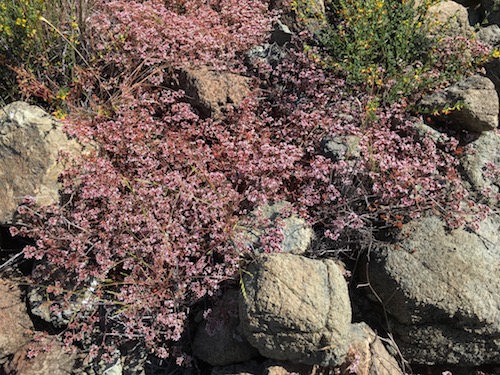
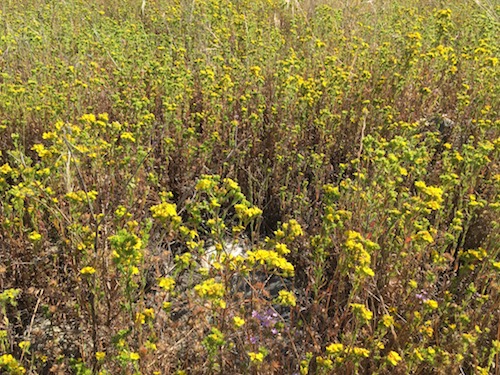
iPhone photos taken along the central California Coast about 3.9 miles north of the Piedras Blancas Light Station and west of Highway 1. The area had lots of flowers and some small displays. The grasses are coming up and starting to compete with the flowers. In some of the other areas we stopped the grasses were higher and often covering the wildflowers.
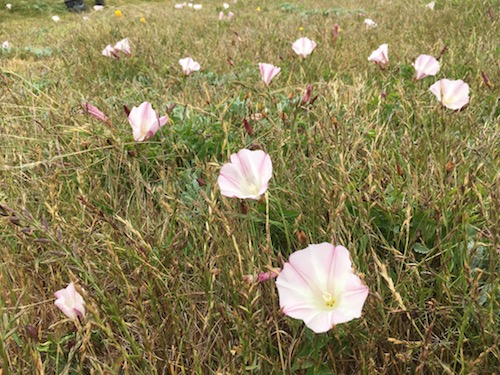
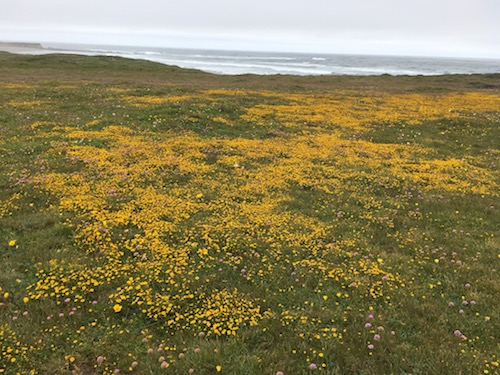
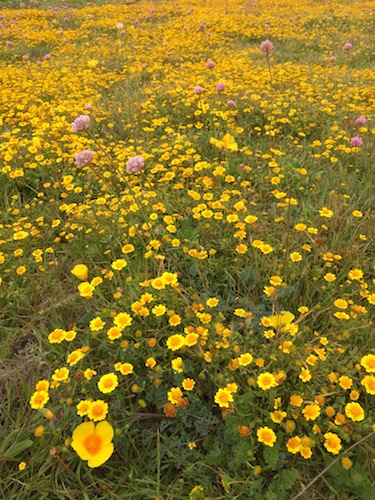
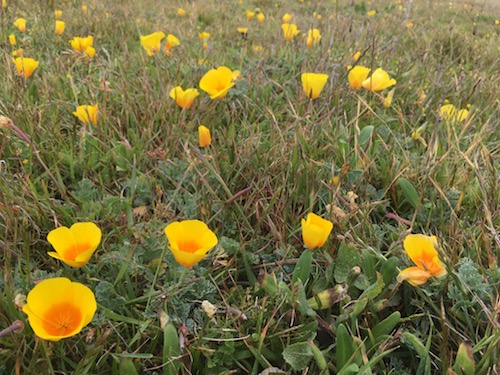
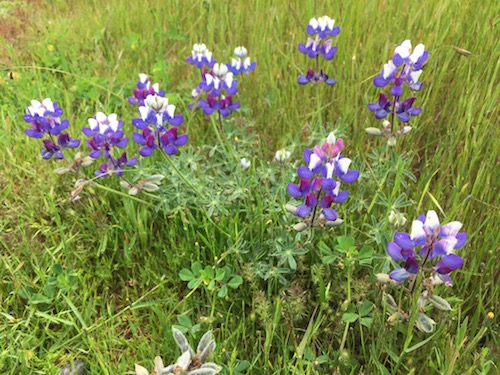
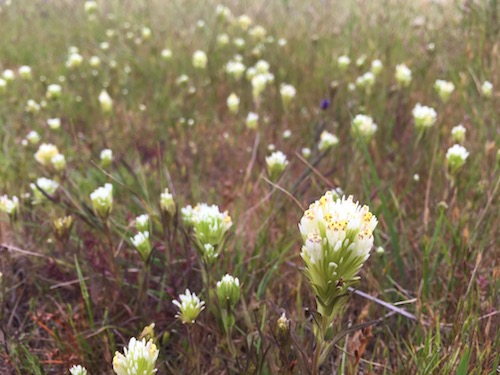
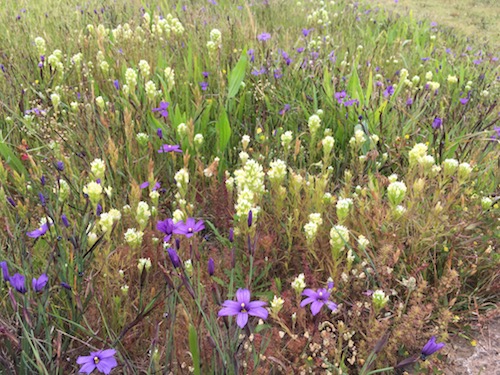
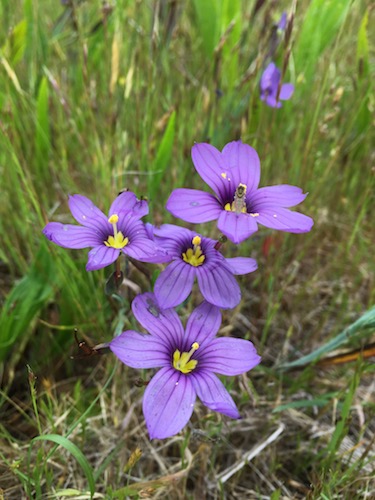
Theodore Payne Foundation posted its weekly wildflower report .
This week’s reports include
A few quick iPhone photos from Laguna Lake in San Luis Obispo. Saw my first Calochortus obispoensis
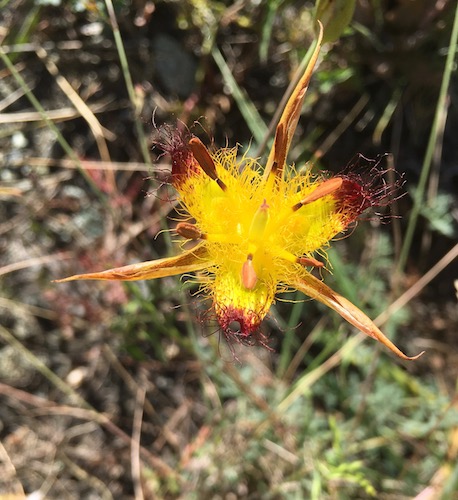
Calochortus obispoensis
Oregon Wildflowers reports on Columbia Hills/Dalles Mountain Ranch
I visited on Monday/Tuesday and both the lupine and balsamroot looked to be at peak all the way from the gravel road starting on hwy 14 up to and past the ranch up high, at the ranch itself and going up to Stacker Butte. Now`s the time to visit. A few notes: – Not sure how the last couple of hot days have affected it since, but it was the best lupine display I`ve seen there – different shades of purple, very vibrant. – I didn`t hike up Stacker but note the dirt road up to the trailhead from the ranch road has gotten very rutted heading up the hill, almost to the point of needing high clearance, 4WD. Almost. – In not so positive news, the area around the old car has really gotten trampled. Even from last year, there`s numerous trails on the hillside by the car, bare areas, and obvious areas where feet and tripods have done a number on the flowers. I`m afraid in another year or 2 it will just be one big bare patch the way visitation has exploded in that spot.
The Environmental News Network reports on a study of frogs’ unique night vision
The night vision of frogs and toads appears to be superior to that of all other animals. They have the ability to see colour even when it is so dark that humans are not able to see anything at all.
Read full story at Wildlife and Habitat Conservation News: Frogs have unique ability to see colour in the dark
Posted in Animals | Tags: Frog Vision
Sequoia and Kings Canyon National Parks report
The road to Cedar Grove is now open! One campground is open (Sentinel) but there are no services available yet. The lodge, restaurant, and visitor center will open in mid to late May. If you go now, make sure you bring snacks, water, maps, and other supplies you might need for the day.
On the way down to Cedar, be sure to stop and admire the beautiful wildflowers blooming near the road! They are amazing this time of year.
If you stop to see the flowers, make sure you pull completely off the road into a pull-out. Also, please do not pick any of the flowers, so that others may enjoy them too!
See photo on their Facebook page at Sequoia and Kings Canyon National Parks
Pacific Northwest Wildflowers has a list of wildflowers in bloom and bud, birds and other animals seen at Fort Rock State Natural Area in Oregon at Wildflowers of Fort Rock State Natural Area……..May 1, 2017
Henry Coe State Park has a new wildflower bloom report for May 3, 2017 at the Pine Ridge Association website with photos and a list of flowers now in bloom at: Henry W. Coe – Wildflower Guide.
Audubon Magazine reports
Researchers Identify the Hormone That Tells Migratory Birds to Stop Eating and Keep Moving
According to a new study, the same hormone that signals to humans we’ve eaten our fill triggers migrating birds to continue their trek.
Read story at Researchers Identify the Hormone That Tells Migratory Birds to Stop Eating and Keep Moving | Audubon
Posted in Birds | Tags: How Do Birds Know When To Migrate


 Natural History Wanderings