The New York Times

As a threat to wildlife, an amphibian fungus has become “the most deadly pathogen known to science.”

41 scientists published the first worldwide analysis of a fungal outbreak that’s been wiping out frogs for decades. The devastation turns out to be far worse than anyone had previously realized.

Read story at The Plague Killing Frogs Everywhere Is Far Worse Than Scientists Thought 

Posted by: Sandy Steinman | April 6, 2019

Coyote Hills Birds 4/6/19

Today we were hiking and birding with friends at Coyote Hills Regional Park. The birds were a little slow as some of the waterbirds and shorebirds have left for the season. We identified 23 species and heard several others that we were unable to id. We went to the Nectar garden where there were Hummingbirds among the native and exotic flowers. Butterflies were fairly scarce with the only sightings being a Painted Lady and a few Cabbage Whites.


This slideshow requires JavaScript.

click read more to see today’s bird list

Coyote Hills Regional Park, Alameda, California, US
Apr 6, 2019 9:30 AM – 11:30 AM
Protocol: Traveling
3.0 mile(s)
22 species (+1 other taxa)

Canada Goose  X
Cinnamon Teal  2
Northern Shoveler  1     male
American Wigeon  2
Mallard  X
Common Goldeneye  1     female
Wild Turkey  1     heard only
Pied-billed Grebe  3
Anna’s Hummingbird  1
American Coot  5
gull sp.  X
Double-crested Cormorant  1
Great Egret  1
Snowy Egret  2
Turkey Vulture  4
Red-tailed Hawk  1
Black Phoebe  2
California Scrub-Jay  1
Common Raven  2
Tree Swallow  X
Marsh Wren  X     heard only
Song Sparrow  2
Great-tailed Grackle  1


Posted by: Sandy Steinman | April 6, 2019

Texas Hill Country Wildflower 4/5/19

Texas Wildflower Report has an update on Hill Country Wildflowers

Based on recent input from some users and one of our veteran wildflower reporters, the Mason Area has improved some, but not as much as we all might have hoped. I am writing up a 2019 Wildflower Season Update to help explain why some areas are not performing to the level we had expected. That said there are still some really nice areas out there. I am including a list of roads below that might still be good for next week.

Rain is in the forecast for this weekend. That should help extend the blooms some, but above normal temperatures are also in the forecast which will tend to shorten the bloom. I would suggest that you get out and visit the areas east of Texas 16 soon and Mason County by the end of next week. There will be some roadsides beyond peak and some fields at peak.

For the Mason area my report from 3/29/2019 should still be valid and the most recent reports and updates from the rest of the Hill County are still good too. You can find my Mason County report at: http://www.wildflowerhaven.com/…/…/threadid/1463/scope/posts

For the Hill Country east of Mason County: Best roads right now and easiest to travel at: RR 2323 south from Llano, Texas 71 south from Llano, Texas 29 east from Llano, Texas 16 south to RR 1323 and Texas 152 southwest from Llano. Roads not doing well include: RR 965. Texas 71 west of Llano, Texas 16 north of Llano. The rest of the Hill Country reports are at: http://www.wildflowerhaven.com/Comm…/forumid/…/scope/threads . Just look for the most recent ones marked Hill Country.

And there are several visitor reports posted on this page at: https://www.facebook.com/TexasWildflowerRepo…/posts_to_page/


See wildflower bloom reports  with photos at Texas Wildflower Report


Posted by: Sandy Steinman | April 6, 2019

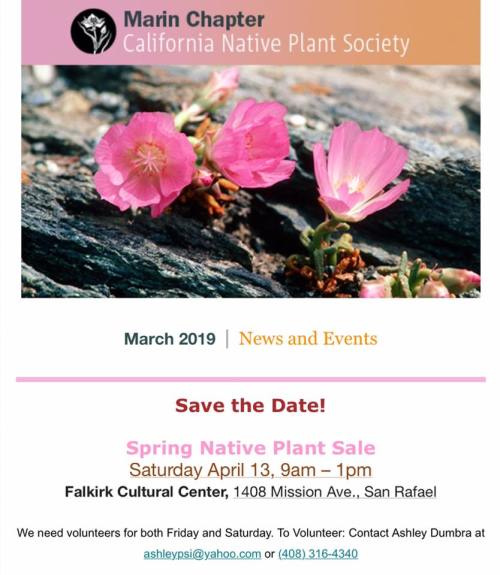
Marin CNPS Plant Sale 4/13/19

Posted by: Sandy Steinman | April 5, 2019

Mariposa Grove Road Opens April 12

Yosemite National Park announced

The Mariposa Grove Road and free shuttle will open for the season on Friday, April 12! Come prepared—up to two feet of snow remain on some sections of trails.

Check out Mariposa Grove information, trail descriptions, shuttle schedule, and more: https://www.nps.gov/yose/planyourvisit/mg.htm

Posted by: Sandy Steinman | April 5, 2019

Anza-Borrego Foundation’s Wildflower Updates 4/5/19

Wildflower Update; April 5, 2019

Our big, showy blooms have come and gone, but if you’re willing to go for a walk outside the Borrego Valley there is still a LOT to see! Hint: CACTUS!

Here is the current Wildflower Update from ABDSP, Updated April 3
Anza-Borrego Foundation Wildflowers Page, Updated April 4
Anza-Borrego Desert State Park Homepage (Includes Interpretive Activities Schedule, Wildflower Updates & Road Conditions)
Wildflower Hotline: 760-767-4684
ABF State Park Store: Open 7 days a week, 9 a.m. – 5 p.m. We have wildflower info, maps, guides, hats, and anything else you need for your adventure.
This weekend’s weather from NOAA: Know ahead and be prepared!

TIPS & NOTES for Flower-Seekers

  • Manage your expectations. What’s happening now is a gorgeous bloom of cactus and plants in the canyons and surrounding higher elevations.
  • The temperatures are rising. Water and sun protection are a must, even for the casual visitor. Be safe out there! 
  • The Visitor Center and Borrego Palm Canyon Trail are open every day, but when the parking lots are full, access is closed in order to prevent traffic jams. Visitors are then directed to the ABF State Park Store for information. When space becomes available, the roads into those two areas will be reopened.
  • Please be patient with and kind to our park staff, volunteers, and the people here in our town. We’re happy you’re here, and we’re doing our best to accommodate a large number of visitors.
  • Take only photos, leave only footprints. All park resources are protected, so please don’t pick the flowers or take anything home with you. We want everyone to be able to enjoy the flowers, and ensure there are seeds for future years!
  • It is your responsibility to know Park regulations. A few big ones include: dogs on leash are allowed on paved or dirt roads only; dogs are not allowed to be left alone in vehicles; no drones are allowed in Anza-Borrego Desert State Park.
Posted by: Sandy Steinman | April 5, 2019

Southern California Wildflower Reports 4/5/19

Theodore Payne posted its newest wildflower report. 

The Hotline is meant to help people enjoy the unique and beautiful nature of Southern California, without diminishing that resource in years to come. We encourage people to treat these floral treasures with the respect due to all living organisms.

Flower viewing etiquette is simple:

  • Stay on the paths
  • Stand on bare ground
  • Leave the flowers unharmed

This week’s update includes the following locations:
See report and photos at April 5, 201

  • Prisk Native Garden
  • Carrizo Plain National Monument
  • Antelope Valley California Poppy Preserve
  • Arthur B. Ripley Desert Woodland State Park
  • Los Angeles County Department of Parks & Recreation
    • Devil’s Punchbowl
    • Alpine Butter Wildlife Sanctuary
    • Jackrabbit Flat Wildlife Sanctuary
    • George R. Bones Wildlife Sanctuary 
    • Phacelia Wildlife Sanctuary
  • Descanso Gardens
  • Diamond Valley Lake
  • Harford Springs Reserve
  • Anza-Borrego Desert State Park
  • Red Rock Canyon State Park
  • Figueroa Mountain in the Los Padres National Forest
  • Placerita Canyon Nature Center
  • Rancho Santa Ana Botanic Garden
  • Environmental Nature Center
  • Elizabeth Learning Center

NATIVE PLANT & WILDFLOWER EVENTS:

THEODORE PAYNE FOUNDATION

16th Annual Native Plant Garden Tour

Saturday & Sunday, April 6 & 7
10:00am – 5:00 pm
Tickets and more information at http://www.theodorepayne.org

Prisk Native Garden Open House(s)
TWO successive Sundays, April 7th and April 14th, from 1:00 – 4:00 pm. Admission free. Donations accepted.
For further info: Mike Letteriello at letteriello@charter.net or 562-826-9266. No bathrooms. Palo Verde turnoff in Long Beach off the 405 Freeway.

Posted by: Sandy Steinman | April 5, 2019

Oregon Wildflowers: Mt. Pisgah Arboretum 4/4/19

Greg Vaughn reports

The lovely Oregon Fawn Lily is at peak bloom at Mount Pisgah Arboretum here in Oregon’s Willamette Valley. Camas are coming on strong and I saw the season’s first Oregon Iris today.

See photos at (1) Greg Vaughn Photography – Home

Posted by: Sandy Steinman | April 5, 2019

Texas Wildflower Viewing

Texas Wildflower Report has an update on Wildflower viewing in Texas

While it is not illegal to pick our state flower, there are laws safeguarding any resource within state public lands which include state parks, natural areas. wildlife management areas etc. And there are Texas laws protecting the rights-of-way along state maintained roads/highways . A good resource for how to enjoy our Texas wildflowers is from The Texas Department of Public Safety: www.dps.texas.gov/…/media_and_communicati…/2014/pr040414.htm

See wildflower bloom reports  with photos at Texas Wildflower Report


Posted by: Sandy Steinman | April 5, 2019

Rocky Pool and Bigleaf Pool Wildflower Guide

A new Chico Hiking Association flower guide for the Rocky Pool and Bigleaf Pool hikes have been published just in time as the snow melts and these hikes open up for the season. http://www.chicohiking.org/ValleyFoothill/fieldguides/Deer-Creek/Deer-Cr-Flower-Guide.pdf
Posted by: Sandy Steinman | April 4, 2019

Antelope Valley Wildflowers 4/4/19

Antelope Valley California Poppy Reserve Bloom update as of April 4, 2019:

As of April 4th, the blooming poppies are blanketing the reserve with their magnificent orange color.  Every flower and other plants that exist at the Poppy Reserve are currently blooming.  This is a great time to visit.  We are expecting the bloom to last through April.   If you are looking to find the exact location of a particular flower or plant, our staff can point you to the right trails when you arrive.

Please remember, visitors must stay on OFFICIAL TRAILS only; photos in the flowers are not allowed in the park. Walking in the poppies creates dirt patches and may result in a ticket. DO NOT walk where others have already damaged the habitat; it will compound the damage and leave a scar for years to come.

Commercial and student filming/photography requires a permit. No dogs, bikes on trails, drones, or picking flowers.

Poppies open up in mid morning, and curl up in the late afternoon/evening or if it’s cold, so check the weather forecast before arriving.  The weather can change suddenly and it is frequently windy here during the spring.  This is a DESERT grassland, so drink water often.  Note that it can be very windy here in the spring.

Current Photos

Posted by: Sandy Steinman | April 4, 2019

Oregon Wildflowers: Camassia Natural Area 4/4/19

Oregon Wildflowers reports on Camassia Natural Area

The bloom is in its early stages, but there are some things to see.

Blooming in the forest: Slender Toothwort (Cardamine pulcherrima), Oregon Fawn Lily (Erythronium oregonum), Western Trillium (Trillium ovatum), and shining Oregon-grape (Mahonia aquifolium).

Starting to bloom in the meadows are Rosy Plectritis (Plectritis congesta), Large-flowered Blue-eyed Mary (Collinsia grandiflora), and Western Saxifrage (Saxifraga occidentalis). The namesake wildflower (Camassia quamash) has not started to bloom yet, and only a few buds were visible today.

Posted by: Sandy Steinman | April 4, 2019

2019 Berkeley Bay Festival April 6

Saturday, April 6 @ 11:00 am4:00 pm  Free

Enjoy hands-on educational activities and learn about organizations helping to protect the Bay and its wildlife.

A variety of live music for all ages will play throughout the day and there will be an assortment of food vendors. Take a sailboat ride or paddle a Dragon Boat. Build with recycled materials in Adventure Playground.

All ages are welcome.

New this year will be a Bay wildlife-themed costume parade!

All Participating organizations will have fun hands-on activities, games or crafts!

Eat great food, listen to great music and acts!

Contact us:  Phone: 510-981-6720
Email: naturecenter@cityofberkeley.info
Address: 160 University Ave, Berkeley, CA 94710

We encourage public transportation (AC Transit 81 bus) and carpooling. Bike parking available

The LA Times reports

California regulators voted Tuesday to strengthen state safeguards for thousands of wetlands and streams that are about to lose federal protections in a Trump administration rollback of the Clean Water Act.

Nearly 90% of California’s historic wetlands have been filled in or plowed under, and the state has said it is vital to preserve what remains.

Read full story at California adopts new wetlands rules to protect them from Trump rollbacks – Los Angeles Times

Posted by: Sandy Steinman | April 3, 2019

California’s Monster Snow Year 

KQED reports on this year’s snow fall

This is the time of year—April 1—when the snowpack is typically at its peak and on Tuesday, the monthly manual survey revealed a snowpack at 162 percent of the long-term average, thanks to more than 30 atmospheric river storms that swept across the state over the winter.

Read full article California’s Monster Snow Year … ‘It’s Been a Wild Ride’ | KQED Science

Posted by: Sandy Steinman | April 3, 2019

Capay Valley Wildflowers: Pierce Canyon

Charlie Russell’s Wildflower Hikes has a new post for Pierce Canyon in the Capay Valley. It includes a detailed trail description, map, plant list and photos at Pierce Canyon Wildflowers

Posted by: Sandy Steinman | April 3, 2019

Homestead Valley Land Trust Wildflowers 4/2/19

Homestead Valley has a new wildflower update. See photos Homestead Valley April 2

NEW
– California buttercup, bright yellow and glossy is blooming in meadows.
– California goldfields blooms in colonies, carpeting meadows brilliant yellow.
– California plantain’s blooms with minute translucent petals.
– English plantain*, native of Eurasia, tall stalk is blooming with a white corolla.
– Fringe cups blooms in forests along streams on tall stalks with pale green flowers with distinctive fringe edges.
– Mule’s ear with its bright yellow sunflowers is blooming in the ridge meadow.
– Owl’s clover’s pink tufts have yellow and white details and is blooming on the knoll near the Panoramic gate.
– Poison hemlock*, native of Europe has a delicate white umbel and mottled red stems. Poisonous, use gloves when weeding.
– Red elderberry large shrub blooms with white clusters on the trail to Homestead Hill.
– Redwood sorrel has a bream bell flower and is blooming under the redwood near 435 Laverne.
– Silver lupine blooms purple on large silver leaved bushes up on the ridge.
– Wood rose, our native rose, is starting to bloom in the woods.

Read More…

Posted by: Sandy Steinman | April 3, 2019

Anza-Borrego Wildflowers 4/3/19

Anza Borrego State Park reports

While the “big show” is winding down, there are still places in the park to find wildflowers.

The Visitor Center and Hellhole Canyon areas are still in bloom, with very nice patches of desert dandelion, phacelia, and other annuals, as well as glorious brittlebush and chuparosa. Cacti in the Visitor Center Garden are exploding with different colors!

Start early if you want to hike in Borrego Palm Canyon, as the parking lot fills up very quickly! If you miss out in the morning, try later in the afternoon. The Alternate Trail starts from the trail up to the campfire center, and is loaded with amazing amounts of a wide variety of flowers. Feet will get wet on the Main Trail, due to high water at stream crossings. Keep your eyes and ears open for bighorn sheep on both trails!

A collection of metal statues lines Borrego Springs Road, which bends at its north end and becomes Henderson Canyon Road. Before heading east, this is a good place to get out and walk around a bit, enjoying the statues and the flowers.

Heading east on Henderson Canyon Road (site of 2017’s “SuperBloom”) will take you to a field yellow desert sunflowers, though they are starting to look dry. Lots of parking along the road.

The dirt road going into Lower Coyote Canyon is open to All-Wheel-Drive or 4WD vehicles only. The best flowers are located beyond Second Crossing, though ocotillos are blooming at Ocotillo Flats, across from Desert Gardens.

The “Ocotillo Forest” along Borrego Springs Road south of Christmas Circle is starting to bloom.

The Cactus Loop Trail, across the road from Tamarisk Grove campground, has hillsides coveredwith poppies, along with a variety of small “belly flowers” growing low. Try Yaqui Well Trail too, as well as the Narrows Earth Trail. The dirt road into Plum Canyon is lined with flowers. 2WD cars should stay to the right when the road forks. The entrance to Mine Wash has lots of yellow dandelions, and poppies on the hillside. 2WD vehicles should be OK as far as the vault toilet.

PLEASE NOTE: Highway 78 will be closed on Wednesday, April 3, between Highway S-2 and Borrego Springs Road, for road work.

For maps and directions, visit our website at http://www.parks.ca.gov/anzaborrego.For updates on blooming areas, call our Wildflower Hotline: 760-767-4684.

AREA MAP WITH WILDFLOWER VIEWING TIPS 4/3/19
Anza-Borrego Desert Natural History Association reports

Flower Reports 
For Borrego blooms in April, plan to take a walk or hike into the canyons or drive the dirt roads into these areas, mostly at higher elevations, as the wildflower bloom of annuals in the lower desert has mostly faded and is setting seed. April is a lovely month to visit, with still cool mornings and evenings, and not as busy as March.  

Read More…

Posted by: Sandy Steinman | April 3, 2019

Northern California Plant Guide

I recently looked at the new Falcon Press  Plants of Northern California: A field guide to the plants west of the Sierra Nevada by Eva Begley. It is an illustrated field guide to 528 easily accessible plant species (both native and alien). It covers the diversity of habitats in the area north of San Francisco and the Sacramento- San Joaquin river delta and west of the Sierra Nevada.

I was pleased to see that plants are organized by plant family. This system puts similar looking plants close to each other in the book. Also, for species that aren’t only one particular color, you don’t have to search several sections to find them. If you prefer to ID plants by color there is a listing of plants by color in the back of the book.

Included are clear descriptions with illustrations of basic plant life and structure.

The description for each species includes the common and scientific name; key plant ID characteristics of flowers, leaves and height; bloom period; elevation range; habitat and at least one and sometimes two or three good ID photos. There are also very interesting additional notes about plant history, ethnobotanical uses, similar species and other useful plant facts.

Posted by: Sandy Steinman | April 2, 2019

Lake Elsinore Poppy Bloom Related Car Accidents

The Desert Sun  reports

I-15 collision injures 7 near Lake Elsinore poppy super bloom

Two people were airlifted from the scene after suffering serious injuries. Five others were transported by paramedics, according to Cal Fire.

At least three collisions occurred last Sunday, March 24, according to Caltrans.

Read full story at I-15 collision injures 7 near Lake Elsinore poppy super bloom

Posted by: Sandy Steinman | April 2, 2019

Henry Coe Wildflower Update 4/2/19

Henry Coe State Park has a new wildflower bloom report  for March 29, 2019 at the Pine Ridge Association website with photos and a list of flowers now in bloom at: Henry W. Coe – Wildflower Guide.

New Website Link: Henry Coe has updated its website and changed the wildflower link. The new link is https://coepark.net/blooming 

Henry Coe State Park has a new wildflower bloom report  for April 2, 2019 at the Pine Ridge Association website with photos and a list of flowers now in bloom at: Henry W. Coe – Wildflower Guide.

New Website Link: Henry Coe has updated its website and changed the wildflower link. The new link is https://coepark.net/blooming 

Posted by: Sandy Steinman | April 2, 2019

Oregon Wildflowers: Catherine Creek 3/31/19

Oregon Wildflowers reports on Catherine Creek

The typical early bloomers (various lomatium species, Sisyrinchium douglasii/grass widows, Fritillaria pudica/yellow bell, crocidium, some death camas, etc., especially in the lower and middle elevation areas. The bloom should really explode in a couple of weeks. Also lupines and larkspur plants are starting to emerge, but flowers are a long way off. There are thousands of healthy looking lewisia rediva plants in the rocky areas besides (and sometimes in the middle of) the trails — but no sign of any blossoms starting yet. I`ve seen them in bloom in mid-April in previous years, but we may have to wait another month or so this year. Several small mimulus species and a fair number of small prairie stars are blooming in the rock wall on the north side of the road just east of the parking area. And a few camas plants are in bloom there, too. Some early camas plants are starting to bloom in the warmer areas of the paved trail south of the road, too. A number of fritillaria affinis/chocolate lily are close to blooming along the east side of the trail just north of the collapsed barn. Also, lots of meadowlarks and Lewis` woodpeckers were flying and singing. And osprey have returned to the area. Saw no bluebirds yet, though.

Posted by: Sandy Steinman | April 2, 2019

New Border Wall Would Cutoff Wildlife Movement

Defenders of Wildlife News Release

NEW BORDER WALL BUILT WITH MILITARY FUNDS WOULD CUTOFF WILDLIFE MOVEMENT

WASHINGTON (March 29, 2019) – According to a recently obtained letter, the Department of Homeland Security has requested billions of dollars in military funds from the Department of Defense to build additional miles of border wall. The February 25th request includes 213 miles of new and replacement wall, floodlights and surveillance equipment to be placed along California, New Mexico and Arizona.

Much of the proposed new wall will be constructed on national monuments, national wildlife refuges and other federal public lands essential for wildlife and their movement. One section of proposed new wall would be constructed across the Cabeza Prieta National Wildlife Refuge, which has been the cornerstone for recovery of the endangered Sonoran pronghorn. Another section of new wall will cut off a rare corridor for jaguar movement between the U.S. and Mexico.

Defenders of Wildlife has mapped out the project areas identified in the request. You can view them here.

Jamie Rappaport Clark, president and CEO of Defenders of Wildlife, issued this statement:

“This funding request is an egregious example of this administration’s attempts to divert military resources towards a manufactured crisis. The situation along our southern border does not constitute a national emergency. Our borderlands are full of thriving communities and abundant wildlife that will be irreversibly damaged by further border construction. We will keep fighting against President Trump’s abuse of his executive power.”

Posted by: Sandy Steinman | April 1, 2019

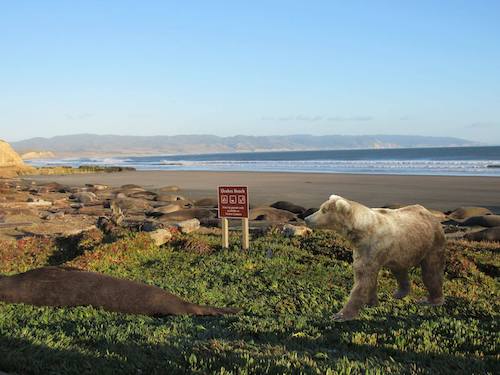
Grizzly Bears To Control Pt. Reyes Elephant Seal Population

Pt. Reyes National Seashore Reports:
Due to the elephant seal population expansion at Drakes Beach in front of the Ken Patrick Visitor Center, Point Reyes National Seashore begins today an elephant seal control program by re-introducing grizzly bears to their historic range along the coast. By bringing back a natural predator to the elephant seal, we are helping to restore the natural balance. The grizzly bears will be contained to only the Ken Patrick Visitor Center beach area and will only be around during non-visitor hours. Thank you.
Photo by NPS/April F. (sc/ak)

April Fools

Posted by: Sandy Steinman | April 1, 2019

Anza-Borrego Wildflowers Past Peak 4/1/19

Borrego Wildflowers reports

When will the low desert bloom peak? End of March and we are now past peak bloom.

Easy access flower sites:

WARNING, bloom below 2000 feet is certainly winding down and will not last for weeks.

The Coyote Canyon is now open for 4×4 and most cars can probably get to Desert Garden.
Between the citrus stand and the end of the asphalt: a nice field of Malacothrix glabrata | Desert dandelion.
At the end of the asphalt to the right Geraea canescens | Desert sunflower fields.
Along the dirt road fields of Malacothrix glabrata | Desert dandelion, Lupinus arizonicus | Arizona lupine, Geraea canescens | Desert sunflower and a great variety of other flowers.
Better fields are just beyond first crossing (water).
Close to the creek is disappointing this season, the rain and flash flood removed most of the wildflowers.

Read More…

Posted by: Sandy Steinman | April 1, 2019

 Marin Headlands Wildflowers 3/31/19

Marin CNPS Facebook has this posting for Marin Headlands

It is going OFF in the Headlands right now; entire hillsides covered in wildflowers big and small. The larger showier blooms are obvious, and gorgeous, of course, but if you pause on the trail and look closer you’ll discover a multitude (hundreds of thousands? millions?) of teeny-weeny flowers tucked into the low grasses: minute, almost microscopic little bursts of white, yellow, orange, red, blue, violet.He’s a few new arrivals in the 2019 Marin Headlands wildflower bloom (three of my faves), snapped on today’s trek around Hill 88—Narrow Leaf Mule’s Ear (I think?), Crimson Columbine, and oodles and oodles of Goldfields—plus some CA poppies and Forget-Me-Nots thrown in for good measure.

See photos at  (7) Marin Native Plants

Posted by: Sandy Steinman | April 1, 2019

Seeing More Hawks In Your Yard?

CornellLab of Ornithology reports

Raptors—especially Cooper’s Hawks and Sharp-shinned Hawks—have become a familiar presence at urban and suburban feeders around North America. But it wasn’t always this way.

In a 2017 retrospective of Project FeederWatch results, we noted that Cooper’s Hawks increased their presence fourfold at FeederWatch sites over the past two decades.

Posted by: Sandy Steinman | March 31, 2019

Table Mt. Wildflowers

Chico Hiking Association reports

Go Now, North Table Mountain is the place to be. Get your map, and flower guide, and hit the trails. http://www.chicohiking.org/ValleyFoothi…/Many-Waterfalls.htm

http://www.chicohiking.org/…/P…/Phantom%20Flower%20Guide.pdf

See photos at Chico Hiking Association

See other hiking guides at http://www.chicohiking.org 

Posted by: Sandy Steinman | March 31, 2019

Oregon Wildflowers: Tryon Creek State Park 3/28/19

Oregon Wildflowers reports on Tryon Creek State Park

Western Trillium (Trillium ovatum) are starting to bloom. They should look good for the next several weeks. Try to visit on a weekday if at all possible to avoid the crowds.

Posted by: Sandy Steinman | March 31, 2019

Homestead Valley Land Trust Wildflowers 3/30/19

Homestead Valley has a new wildflower update. See photos at Homestead Valley March 30 

NEW
– Fairy bells’ cream flowers bloom under their ladder of leaves so you have to look under to see the bells.
– Field madder*, native of the Mediterranean, is blooming in meadows with little pink star flowers.
– Pacific sanicle’s dark, glossy, lobed leaves line the forest trails and their tall flower spikes are blooming now with mustard clusters.
– Poison oak blooms with small white star flowers. One of the most common plants in the forest understory, its oil causes itchy allergic reactions in many people.

Read More…

« Newer Posts - Older Posts »

Categories