|
|
|
|
 Join the Smokies and the Smoky Mountain Field School for a free virtual 30-minute webinar on September 30th at 6:00 PM EST. Participants will have the opportunity to learn about the history of African Americans and upcoming projects in the park. Participants can register by using the link below:
Posted in Park, Talks | Tags: African Americans in the National Parks
Anthropocene writes about the problems with communication to the public about Climate Change.
People don’t know what climate experts are talking about
Simpler language and more context could aid public understanding of climate change
Members of the public have trouble understanding words and phrases that climate scientists often use, according to a new study. The confusion affects both people who accept the reality of climate change and climate change doubters.
If climate change is to be stopped, scientists can’t just communicate amongst themselves. They also need to make their findings understood by policymakers and the general public so that we can collectively take action. This need has led the Intergovernmental Panel on Climate Change (IPCC) and other climate-science organizations to step up their efforts at science communication.
Read more at People don’t know what climate experts are talking about
Posted in Environment | Tags: Climate change
Fall is plant season. See a list of upcoming Native Plant Sales and other native plant gardening information from the California Native Plant Society at Fall Native Planting Season
Posted in Garden | Tags: Native Plant Sales
The Guardian reports
The shutdown of traveling and socializing during the Covid-19 pandemic last year brought severe dislocation to many people, but if you were a bird during this time it was highly appealing, new research has found.
The distribution of 80% of studied bird species in North America changed during pandemic lockdowns last year, the study found, with most of these species increasing in abundance in and around urban areas that fell unusually quiet due to a sudden drop in traffic.
Posted in Birds | Tags: Impact Covid Urban Birds
A series of photos while walking through Albany, CA. Photos are of front yards. Early in the Pandemic I spent many days walking around the neighborhoods of Berkeley and Albany photographing front yards. You can see what is did during that time in the Flickr collection: Stay at Home Photo Project.
Here is what I did yesterday
Posted in Photography | Tags: Albany CA
Posted in Job Openings | Tags: Job Opening, Western National Parks Association
|
Posted in Wildflowers and Other Plants | Tags: Calflora
The Sacramento Bee reports
The KNP Complex fire has burned more than 42,000 acres, spreading as of Saturday from Sequoia National Park into the neighboring national forest, officials said.
Several fires were sparked in the park by lightning Sept. 9 and are now being fought as one “complex” set of blazes, growing by about 9,000 acres in 24 hours. Containment remained at 0%.
Read more Updates on Sequoia KNP, Windy fire evacuation, acreage, smoke | The Sacramento Bee
Posted in Park | Tags: Sequoia National Park Fire
The San Francisco Chronicle reports
On the super-remote southern end of the Lost Coast, the campground in Sinkyone Wilderness State Park — about a four-hour drive north of San Francisco — is only accessible through a steep, one-lane dirt road. The place is popular with weekend warriors who arrive in expensive 4x4s, recent visitors said, and proceed to build bonfires, set off fireworks, throw multi-day raves, off-road recklessly and camp on the beach — all of which are illegal.
Read more On the Lost Coast, a lawless Calif. state park has been overtaken by off-roading, fireworks, raves
Posted in Park | Tags: Lost Coast
National Parks Are Free This Saturday the 25th for National Public Lands Day.
Read article from the National Parks of benefits from being in nature at Nature Makes You… (U.S. National Park Service)
Posted in Park | Tags: National Public Lands Day.
USA Today has an article reporting what this fall foliage may look like across the U.S.
With autumn officially underway, it’s already time to talk about fall foliage, which is expected to evolve into a warm array of colors.
Read article atFall leaves forecast: It’s time to start leaf peeping
Posted in Fall Foliage | Tags: Fall Foliage Predictions
Management Intern Opportunity with the City of Oakland’s Environmental Services Division See job information at Announcement_ESD_2021
Posted in Job Openings | Tags: Management Intern
September 24 marks World Gorilla Day! This day is an opportunity to celebrate gorillas and take action to protect these remarkable African great apes. PASA – the largest association of wildlife centers in Africa – has members in Cameroon, Congo and Gabon which provide care and protection for gorillas in both sanctuary and rehabilitation settings. On this World Gorilla Day, we feature the work that these members do to rescue gorillas and protect their habitats. We also examine threats to gorillas and highlight what individuals can do to make a difference in the lives of these magnificent great apes.
Learn more at World Gorilla Day – PASA
Posted in Animals | Tags: World Gorilla Day
Two new Job Postings. Click for more info.
SLEWS Program Coordinator at Center for Land-Based Learning (Woodland, CA)
Posted in Class/Workshop, Job Openings | Tags: Job Openings
The BBC reports
Scientists say light pollution may be contributing to “worrying” declines in insects seen in recent decades.
In a UK study, artificial street lights were found to disrupt the behaviour of nocturnal moths, reducing caterpillars numbers by half.
Modern LED streetlights appeared to have the biggest impact.
There is growing evidence that insect populations are shrinking due to the likes of climate change, habitat loss and pesticides.
Posted in Animals, Environment | Tags: Light Pollution and Insect Loss
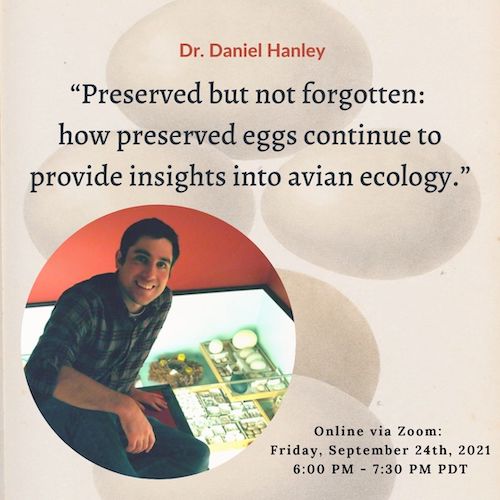
Posted in Birds | Tags: Avian Ecology, Bird Eggs
Bay Nature has an article on how trees communicate with each other
When people say that trees “talk” to each other, that’s a concept that rests, in part, on an extraordinary and microscopic process that depends on arbuscular mycorrhizal (AM) fungi, a distinct type of fungi and a subset of mycorrhizal relationships that form a very close and mutually beneficial relationship with plant roots. The fungi help take up important nutrients and water from the soil, passing them to plants in exchange for the sugars and fats plants make, thanks to photosynthesis. Weaving its way through soil and between root systems, an individual fungus can connect to many different plants and sometimes other fungi. In turn, each plant can connect with a variety of AM fungi at a time, creating what scientists call a “promiscuous relationship.” Picture that chain of connections growing in all directions and you realize there’s a massive and busy trading market just beneath our feet!
Read article at Listen Closely, the Trees are Talking – Bay Nature
Yesterday I accompanied Rusty Scalf who is monitoring the Vaux’ Swifts who roost in an unused Chimney in Marin County. Between approximately Aug. 15 and Oct. 15 Vaux’s Swifts migrate to their wintering area from central Mexico south through Central America. This chimney has become a stopover spot on their way south.
It is not uncommon for these swifts to use chimneys to roost at night, and once a population of swifts locates an appropriate chimney, they often return year after year. Groups of roosting swifts can range in size from just a few individuals to as many as 35,000 in some larger smokestacks. Yesterday Rusty counted approximately 15,800 going into the chimney.
See a video of some of the action at Video of Vaux’s Swifts flying into Chimney
Posted in Birds | Tags: Vaux's Swifts
| Register Today! |
After a century of extirpation, coyotes returned to the green spaces of San Francisco in the early 2000s. Twenty years later, a thriving population of Canis latrans resides in the city’s parks and forests. The upcoming documentary don’t feed the coyotes observes several years in the intertwined lives of these urban animals. It centers around a three-year-old coyote, fondly named Scout, and her territorial challenger, the scientifically dubbed 15F. Chronicling their lives through two starkly different researchers observing them, it’s about humans, the natural world, and the lines we’ve drawn between the two. And of course, not feeding the coyotes.
Following the screening of the film, Bay Nature will host a Q&A with filmmaker Nick Stone Schearer alongside Bay Area self-taught naturalist, Janet Kessler, and wildlife ecologist with Presidio Trust, Jonathan Young.
This virtual event is open to all with a suggested (but not required) donation of $20.
This film will not be available on the Bay Nature website after the talk, but when released this fall can be viewed at dontfeedthecoyotes.com.
Please be advised that this film contains a brief scene that might not be suitable for all audiences.
Posted in Animals | Tags: San Francisco Coyotes
from the International Rhino Foundation
World Rhino Day is a day of awareness for all five rhino species and the work being done to save them. Since 2011, World Rhino Day has been celebrated internationally on September 22nd – this year is the 10th anniversary! On World Rhino Day, the International Rhino Foundation celebrates rhinos and all those around the world who care about them. Join us on Team Rhino as we ‘keep the five alive.’
While every day of the year is World Rhino Day to us, on September 22nd we’ll be celebrating with special rhino events including our annual State of the Rhino address. We also have a limited edition World Rhino Day t-shirt available through September 30th, and have created shareables to help you spread awareness about rhinos.
Read more and learn about events at : World Rhino Day | International Rhino Foundation
Posted in Animals | Tags: World Rhino Day
The Fresno Bee reports
Large portions of a second California national park have now been closed due to the KNP Complex Fire, with more closures expected to come.
The fire continues to burn uncontained inside Sequoia National Park and has grown to 23,743 acres in just over a week since it started. That national park remains closed with evacuations ordered for nearby communities.
Red more at Kings Canyon National Park closures due to KNP Complex fire | The Fresno Bee
Posted in Park | Tags: Kings Canyon and Sequoia National Park, KNP Complex Fire
September 25, SATURDAY @ 1pm
Speaker: Susan Karasoff, Chapter Board Member
Zoom registration here
This talk was previously scheduled in August. Water conservation is essential in the design and management of California drought tolerant landscapes. Matching water supply to plant needs leads to drought tolerant landscape choices.
Local San Francisco native plants are beautiful, drought tolerant, adapted to our varied soils and co-evolved with our local pollinators.
We’ll discuss what to plant in San Francisco that need minimal water, including shallow rooted plants that thrive in pots.
CalFlora has a feature that allows you to create a flora for your county or region of interest. Read how it works at Create your own County or Regional Flora!
Posted in Wildflowers and Other Plants | Tags: Create your own local flora
Posted in Environment | Tags: Biological Control in Urban Parks
from the National Wildlife Association
About ten years ago, a neighborhood friend of mine told me with great enthusiasm about her adventures raising monarch butterflies. I was intrigued. I followed her lead and went to a small plant nursery that didn’t use pesticides and bought my first milkweeds. Sure enough, I quickly encountered caterpillars! Unlike my friend, I did not bring the caterpillars inside to raise. Instead, I left them to survive in the confines of my backyard. As the first caterpillars grew and turned into eating machines, it was quickly evident; I needed more milkweed! Soon I was up to 50+ plants. That number would increase every year, as the number of hungry caterpillars increased to approximately 80 at a time!
Around year three, I noticed a disturbing trend among the newly hatched monarchs. Many were unhealthy, deformed, weak, and unable to fly. What was happening!?! I was distressed to see these sick and dying monarchs, and I wanted to know if I had done something that contributed to this unhealthy population. I started doing research, and my distress grew as I read about OE (Ophryocystis elektroscirrha), a debilitating protozoan parasite that infects monarchs. What I learned next stopped me in my tracks: one of the main reasons OE spreads in coastal areas is the predominant use of tropical milkweed, a non-native plant species that doesn’t naturally die back in the winter. Tropical milkweed (Asclepias curassavica) can also interfere with monarch migration and reproduction. What?!? But this plant is so easy to grow and maintain for a non-plant person like me! What are my alternatives? And what can I do with the plants I currently have?
Posted in Butterflies, Garden | Tags: Milkweed, Monarch Butterflies
Golden Gate Audubon reports
There are too few victories for wildlife these days, but East Bay conservationists and their legislative allies just managed to save 3,100 acres of unique habitat in the hills of southeastern Alameda County.
State lawmakers and Governor Newsom agreed last week to turn the property known as Tesla Park into a permanent state park rather than an off-road vehicle recreation area.
Read more at Golden Gate Birder blog 09/15/2021
Posted in Animals, Environment, Park | Tags: Tesla Park
The Sacramento Bee reports
The Colony Fire and the Paradise Fire, two wildfires that together comprised the KNP Complex that’s burned for a week in Sequoia National Park, have merged into one fire and reached the edge of a historic grove of giant sequoia trees.
“The fire grew by about 6,000 acres (Friday).”
More than 400 firefighters are battling the wildfire, which is now estimated to encompass almost 18,000 acres.
Read full article at Update: KNP Complex fires merge, reach edge of Giant Forest in Sequoia National Park-Sacramento Bee
Posted in Park | Tags: Sequoia National Park Fire
The New York Times reports
Firefighters are swaddling giant sequoias in a flame-retardant foil in an effort to protect the ancient trees from wildfires that are raging through national parks in California, officials said.
Three wildfires, named Colony, Paradise and Windy, were ignited by lightning on Sept. 9. Since then, they have scorched thousands of acres of steep terrain, bringing them to the foot of some of the world’s oldest and largest trees in the Giant Sequoia National Monument of the Sequoia National Forest, and in Kings Canyon National Park in Central California.
Read more at Sequoias Are Being Wrapped in Foil Blankets to Protect Against Wildfires – The New York Times
Posted in Uncategorized
Center for Biological Diversity News Release
SAN FRANCISCO— An appeal by environmental groups forced the U.S. Bureau of Land Management late Tuesday to withdraw its decision allowing cattle grazing on public lands near California’s Mojave Desert. The area had been deemed permanently off limits to grazing under an earlier agreement to protect the federally threatened desert tortoise and other sensitive plants and animals.
“It’s shocking that we were forced to file an appeal to enforce a permanent retirement of grazing privileges,” said Ileene Anderson, a senior scientist at the Center for Biological Diversity. “The BLM was right to withdraw this unlawful decision. The plants and animals that depend on the fragile Mojave Desert for their survival need protection now more than ever.”
Posted in Uncategorized | Tags: BLM, Desert Tortoises



 Natural History Wanderings