Posted by: Sandy Steinman | February 5, 2018

Homestead Valley Land Trust Wildflowers 2/4/18

Homestead Valley Land Trust reports on February 4

NEW
– Manroot, a native vine with large maple-shaped leaves is blooming white as it climbs.
– Milkmaids, a pretty white flower with arugula-tasting leaves is blooming in forests.
– Oso berry, our native plum, is just starting to bloom on the Ridgewood Rock.
– Trilium are bright white in their bed of three green leaves on the forest floor.

Forests
Starting
– Indian warrior is coming up all over in the area – 15 right along the Homestead Trail – that we finished clearing a few months ago. A few blooms are showing their crimson colors but the scope of the patch will only become clear later in the season when the hillside blooms.
Peaking
– Fetid adder’s tongue, one of our most exotic blooms is blooming in large patches.
– Green wattle acacia tree native to Australia is starting to bloom with its bright yellow puff flowers.
– Scotch broom, native to Western Europe, one of the most aggressive invaders of our meadows is blooming with its yellow pea flowers. Pull it before it goes to seed if you can.
– Tasmanian blue gum, is blooming white high in the huge eucalyptus trees.
– Coast live oak blooms with pink tassels.
– California bay laurel, our most common native tree’s blooms have a delicate vanilla scent.

Forest edges
Starting
– Greene’s saxifrage’s small white flowers are opening on a moss covered shelf of the Ridgewood Rock.
– Pacific hounds tongue with its forget-me-not-looking flowers and large leaves is blooming now in oak meadows. There are also tons of emerging leaves promising a big year for this wildflower.
– Sourgrass*, native to South Africa, is blooming up on the ridge. Although fun to chew on for kids, this plant is a very successful non-native spreading in wet locations where natives might otherwise grow.
– Woodland strawberry blooms are starting now where there is sun, will persist for months in different habitats as they warm.

See map and photos at Homestead Valley Land Trust
 

Posted by: Sandy Steinman | February 4, 2018

Henry Coe Wildflower Update 2/4/18

Henry Coe State Park has a new wildflower bloom report  for February 4, 2018 at the Pine Ridge Association website with photos and a list of flowers now in bloom at: Henry W. Coe – Wildflower Guide.

Posted by: Sandy Steinman | February 4, 2018

Early Season Wildflower Photos 2/4/18

Today we went looking for early season wildflowers in the redwoods in Marin County. I especially wanted to find Slinkpods or Fetid Adder’s Tongue. Other earlier bloomers were Indian Warrior, Milkmaids, Woodland Strawberry and California Bay Laurel Trees. Also found were a number of mushrooms and Banana Slugs.

This slideshow requires JavaScript.

To learn more about Slinkpods or Fetid Adder’s Tongue the posting My Favorite Early Season Wildflower

Posted by: Sandy Steinman | February 4, 2018

Chile Created 10 Million Acres Of New National Parks

Mother Nature News reports

Chile has created two new national parks and expanded three others thanks to 1 million acres donated by former Patagonia CEO Kristine McDivitt Tompkins and another 9 million acres declared national parks by Chilean President Michelle Bachelet.

The total size is roughly the size of Switzerland.

The two new parks — Pumalín National Park and Patagonia National Park Chile — are already open to the public and are now permanently protected for visitors and the wildlife that live there.

The almost 43 percent expansion of national parks in Chile marks the culmination of a more than 20-year effort by McDivitt Tompkins and her now-deceased husband, Doug Tompkins, a founder of The North Face and Esprit clothing companies. The couple spent more than two decades acquiring and restoring land in southern Chile, like the Chacabuco Valley

Read full story  Chile just created 10 million acres of new national parks | MNN – Mother Nature Network

Posted by: Sandy Steinman | February 3, 2018

Birding MIller Knox Regional Park 2/3/18

I went to Miller Knox Regional Park in Pt. Richmond today hoping to see a herring run, but no such luck. The two highlights were a  large raft of a few hundred Double-crested Cormorants and two Eurasian Wigeons.

This slideshow requires JavaScript.

Although I missed the herring run others did not. Check out this posting from earlier today on https://ebird.org/view/checklist/S42465969

click read more to see my bird list

Posted by: Sandy Steinman | February 3, 2018

Yosemite Institutes Horsetail Falls Parking Reservation

The San Francisco Chronicle reports on Yosemite National Park decision to require permits for parking near Horsetail Falls. The permits are for parking only. You are still free to walk in to optimal viewing areas

For two weeks in February each year, Horsetail Falls on the east side of El Capitan glows a fiery orange at sunset. The annual event has gained such popularity among camera-toting visitors – it’s known to attract over 1,000 sightseers a year – Yosemite has instituted a new reservation system this year to quell traffic jams and pedestrian safety problems.

Those hoping to view the photogenic natural phenomenon must apply for a free, day parking permit on Eventbrite (click here). The permit grants access to parking on Northside Drive between the Yosemite Valley Lodge and El Capitan Crossover.

Read full story at You’ll need to book ahead to see Yosemite’s famous firefall this year

Posted by: Sandy Steinman | February 3, 2018

Trump administration takes aim at California desert protection plan

The LA Times reports

The Trump administration is threatening to scrap a major Obama-era agreement that sought to protect millions of acres of the California desert by placing sensitive areas off-limits to major solar- and wind-energy installations.

The Desert Renewable Energy Conservation Plan covers more than 10.8 million acres and was designed to guide energy facilities to parcels where they are least likely to cause environmental damage. The administration’s announcement that it will reconsider the plan touched off an immediate backlash in the West. The Trump administration’s action could also open up sensitive desert areas to off-road vehicles, mining and grazing.

Read full story at Trump administration takes aim at California desert protection plan

Posted by: Sandy Steinman | February 2, 2018

Desert Wildflower Updates 2/2/18

DesertUSA reports

A few wildflowers are starting to bloom in Death Valley and Anza Borrego area. Not much rain at the point and we will need more rain soon for a good bloom this year.

Anza Borrego – No more rain yet, A few wildflowers can found in the upper elevations of the park, along Grapevine Canyon and near the 2nd crossing in Coyote Canyon.
Anza-Borrego Desert Wildflowers: Species in bloom – has a good chart of the blooms for this season. See photo at https://www.desertusa.com/wildflo/ca_abdsp.html#ixzz561HKPXuS

Death Valley – yellow daisies on Hwy 178 Shoshone on Jan. 29, 2018 and they were the only flowers I saw out. Yesterday we were driving 7 miles south of the Badwater Visitor Lookout on Hwy. 178 and there was a small patch of the same yellow daisies. See photo at https://www.desertusa.com/wildflo/ca_dv.html#ixzz561HodvEX

Joshua Tree – There has not been much rain in the area, the outlook for wildflower is not good at this date. Joshua Trees and Yuccas will bloom in March and April of this year.

Mojave National Park – The season’s only significant weather system on Jan. 9th and 10th, cut through the Mojave National Preserve. This may be good spot to look for wildflowers in the next few weeks.

Posted by: Sandy Steinman | February 2, 2018

A Killer Whale That Can “Speak”

The BBC  reports

A killer whale that can mimic words such as “hello” and “bye bye” is thought to be the first of its kind to copy human speech.
The female learned to “speak” a handful of human words by copying a trainer at a marine park in France.
The animal’s repertoire includes the name “Amy” and “one, two, three”.
Whales and dolphins are among the few animals other than humans that can learn to produce a novel sound just by hearing it.

Read more at  The killer whale that can say ‘hello’ and ‘bye bye’ – BBC News

Posted by: Sandy Steinman | February 1, 2018

Edgewood Park Feburary Wildflowers

Friends of Edgewood Park have updated its website to show what plants are typically blooming in February. There are 85 photos of plants you might see. Explore plant locations, plant species, which plant blooms when, and answers to a host of other questions at  What’s Blooming This Month


Posted by: Sandy Steinman | February 1, 2018

26 California Counties Pass Resolutions Opposing Offshore Drilling

Center for Biological Diversity News Release

Marin County Passes Resolution Opposing Offshore Drilling, Joining 25 Other California Communities

Trump Plan to Expand Offshore Leasing Meets Strong Resistance in California

SAN RAFAEL, Calif.— The Marin County Board of Supervisors approved a resolution today opposing new drilling off the California coast and fracking in existing offshore oil and gas wells. The vote makes Marin County the 26th California jurisdiction to approve similar resolutions since April 2017, when President Trump announced plans to drastically expand offshore drilling.

The resolutions respond to the Trump administration’s proposal to open the Pacific Ocean to new oil leases for the first time in more than 30 years. The draft five-year offshore leasing plan released Jan. 4 would subject almost all federal waters to new offshore drilling, including the currently protected Arctic and Atlantic oceans and eastern Gulf of Mexico.

This week’s resolution was sponsored by Marin County Supervisor Dennis Rodoni and supported by Turtle Island Restoration Network and the Center for Biological Diversity, which has been supporting communities passing a series of California city resolutions opposing offshore drilling and fracking.

“Our oceans and coasts provide habitat to sea turtles, whales, seabirds and other wildlife that depend on a healthy ocean ecosystem,” said Cassie Burdyshaw, advocacy and policy director for Turtle Island Restoration Network, a Marin-based nonprofit. “These marine species already face threats from ships, ocean pollution and industrial fishing. We don’t want to put them at further risk.”

Trump’s plan would sell oil leases throughout federal waters off California starting in 2020. But Californians have been mobilizing to make their concerns heard with rallies throughout the state planned for Feb. 3 and a large march and protest before the plan’s Feb. 8 federal hearing in Sacramento. Details on those events can be found at http://www.endangeredoceans.org.

“Californians are uniting against Trump’s reckless assault on our coastal waters. Marin County and other California communities are forming a wall of opposition to Trump’s efforts to endanger coastal communities and wildlife,” said Blake Kopcho, an organizer with the Center. “Californians won’t stand aside and let him sully our beautiful coastline with oil spills and toxic fracking chemicals.”

The Marin County resolution calls for:

  • A ban on new drilling, fracking and other well stimulation in federal and state waters off the California coast;
  • No new federal oil and gas leases in the Pacific, Atlantic, Arctic oceans and the eastern Gulf of Mexico — areas currently protected from new leases; and
  • A rapid phaseout of all oil and gas extraction off the California coast on a schedule sufficient to respond to the climate crisis.

There are more than 30 offshore drilling platforms and hundreds of miles of underwater oil and gas pipelines off California’s coast. Operators want permits to frack offshore wells, using chemicals toxic to wildlife. Separate lawsuits filed by the state of California and the Center challenging the federal government’s approval of offshore fracking are pending in federal district court.

Posted by: Sandy Steinman | January 31, 2018

Road To Bodie Reopened

Mono County Tourism reports

The road to Bodie (SR 270) just reopened as of 1pm today.
The road is subject to close due to snow at any time. Always check road conditions before travel on the CalTrans website here: http://www.dot.ca.gov/cgi-bin/roads.cgi

Posted by: Sandy Steinman | January 31, 2018

February 2018 Birding Field Trips

February 2018 Golden Gate Audubon Birding Field Trips

For information on trips go to Golden Gate Audubon Field Trips

  • Tilden Nature Area, Tilden Regional Park, Berkeley Friday, February 2, 8:30 — 11:30 a.m. (First Friday bird walk)
  • Pickleweed Park, 50 Canal St., San Rafael Saturday, February 3, 9:00 a.m. — Noon
  • Lafayette Community Park, Lafayette Sunday, February 4th, 8:30 — 11:00 a.m.
  • San Francisco Botanical Garden Sunday, February 4, 8:00 — 10:30 a.m. (First Sunday bird walk)
  • Kennedy Grove Regional Rec. Area, 6531 San Pablo Dam Rd, El Sobrante Friday, February 9,  8:30 — 10:30 a.m.    (Second Friday bird walk)
  • UCSF Mt. Sutro Open Space Preserve. San Francisco Saturday, February 10, 8:30 — ~11:30 a.m.
  • Hilltop Lake, Richmond Wednesday, February 14, 9:00 — 10:45 a.m.
  • Corona Heights, San Francisco Friday, February 16, 8 — 10 a.m. (Third Friday bird walk)
  • Birds of Berkeley and the Great Backyard Bird Count (**Family Friendly Event**) Aquatic Park, Berkeley Saturday, February 17, 9:00 — 11:30 a.m.
     This field trip celebrates the release of Oliver’s forthcoming book Birds of Berkeley from Heyday Press. It also celebrates the Year of the Bird 2018, and the Great Backyard Bird Count. Signed copies of Oliver’s brand new book will be available for sale to participants. 10% of proceeds will be donated to GGAS.
  • Las Gallinas Storage Pond, San Rafael Sunday, February 18, 8:00 — 11:00 a.m.
  • Fort Mason Community Garden, San Francisco Sunday, February 18, 8:00 — 10:00 a.m. (Third Sunday bird walk)
  • Lake Merced, San Francisco Monday, February 19, 8:00 a.m. — noon
  • Middle Harbor Shoreline Park, 2777 Middle Harbor Road, Oakland Wednesday, February 21, 8:30 — 10:00 a.m. (Third Wednesday bird walk)
  • Livermore and Patterson Pass, Alameda County Saturday, February 24, 8:00 a.m. — 12:00 p.m.
  • Alameda Creek-Coyote Hills Regional Park by bicycle, Fremont Saturday, February 24, 10 a.m. – 3:00 p.m.
  • Staten Island and Cosumnes River Preserve in the Delta,  Optional overnight stay in Willows for Sacramento and Colusa NWRs Saturday, February 24 and Sunday, February 25
  • Lake Merritt and Lakeside Park, Oakland Wednesday, February 28, 9:30 a.m. – noon (Fourth Wednesday bird walk)

For more Bay Area birding  field trips through out the Bay Area click on the Mt. Diablo Audubon Society Calendar 

Posted by: Sandy Steinman | January 30, 2018

Birding Pt. Isabel Regional Shoreline 1/30/18

Today I went birding at Pt. Isabel for the King Tide, which was 7.2 Feet. I walked the Richmond Bay Trail from Rydin Rd. to a little past  the Meeker Slough cutoff on and the Meeker Slough Trail.  With the high tide I hope to see Ridgway’s Rail or Sora but didn’t see either. I may have heard a Ridgway’s Rail. Met several other birds along the way who pointed out a few birds I might have missed. I came up with 49 species. There was also a group of distant black birds that were probably either Red-wings or Starlings.  Highlights were seeing 3 Wilson’s Snipe on Island opposite the trail junction to Meeker’s Slough and watching a gull chase an Osprey. It was a very good day for waterbirds, less so for shorebirds as the tide was still fairly high even when I left. There were very large numbers of Scaup, Ruddy Ducks and Western Sandpipers further out on the bay. There were also a good number of Western and Clark’s Grebes, Canada Goose, Green-winged Teal, American Avocet, Gulls and White-crowned Sparrows.

This slideshow requires JavaScript.

Click read more to see my eBird list for today

Read More…

Posted by: Sandy Steinman | January 30, 2018

Where The Mojave Wildflowers Might Be This Year

The Las Vegas Review Journal reports

If you’re looking for wildflowers in the Mojave Desert this year, the best place to hunt — and maybe the only place — is along the course of a single storm that hit Las Vegas in early January.

After a “bone-dry” fall and winter, experts don’t expect much of a bloom across the desert in the coming months. The lone exception could be the roughly 50-mile-wide swath, stretching from Yucca Valley, California, up through Southern Nevada, that was soaked by the season’s only significant weather system on Jan. 9 and Jan. 10.

If there are any flowers at all, that’s where they’ll be, said Jim Andre, who tracks desert flora as director of the Granite Mountains Desert Research Center in California.

Read full story at Follow rainstorm path to find Mojave Desert wildflowers – Las Vegas Review-Journal

Posted by: Sandy Steinman | January 30, 2018

Amazing! EPA Reversal May Protect Alaskan Watershed

NPR reports

The Environmental Protection Agency said in a surprise announcement Friday that it is putting on hold a plan to do away with Obama-era proposals to restrict mining at a southwest Alaska watershed. But the EPA also said it would continue to consider permit applications from those hoping to extract copper and other minerals from the proposed Pebble Mine.

The proposed Pebble Mine is located about 200 miles southwest of Anchorage and roughly 100 miles upstream from the Bristol Bay watershed, one of the world’s most important sockeye salmon fisheries.

Read Full Story In Reversal, EPA Leaves Restrictions In Place While It Considers Alaska Mine Permits : NPR

Posted by: Sandy Steinman | January 30, 2018

February 2018 CNPS Field Trips

Bay Area California Native Plant Society Chapter February Field Trips:

Check the individual chapter websites for trip details and late postings.

Bristlecone (Mono, Inyo and NE Kern counties) http://bristleconecnps.org/index.php

East Bay CNPS http://www.ebcnps.org/

Marin CNPS http://www.marin.edu/cnps/
Sunday, February 25, 2011, 10 a.m. – 2 p.m.Early Serpentine Wildflowers of Mt. Burdell
Saturday February 10,  9:30 a.m.-3:30 p.m.Drake’s Estero Trail to Drake’s Head

Milo Baker (Sonoma county) http://www.cnpsmb.org/
Saturday, February 10, 2018 Sonoma Valley Regional Park- Fire Recovery
Tuesday, February 20, 2018 Mosses, etc (Bryophytes) at Howarth Park

Napa Valley http://www.napavalleycnps.org/

Santa Clara Valley http://www.cnps-scv.org/
Saturday, February 17  10:00am – 3:30pm Dirca Hike at San Francisco Peninsula Watershed, San Mateo County
Sunday, February 18, 2018, 10:00am-3:00pm  Coyote Valley Open Space Preserve, 550 Palm Ave, Morgan Hill Plant Communities of the South Bay: Plant Id Walks for Beginners
Sunday Feb 25 10am – 4pm Hazelnut Trail, Montara Mt., San Pedro Valley County Park (Pacifica)

Yerba Buena (San Francisco/Northern San Mateo) http://www.cnps-yerbabuena.org/
Saturday, February 17, 2018, 10am – 2pm  San Bruno Mountain Manzanitas

If you are interested in information on other chapters go to: http://www.cnps.org/cnps/chapters/

Posted by: Sandy Steinman | January 29, 2018

Regional Park Botanic Garden Photos 1/29/18

Today I photographed in the  Regional Parks Botanic Garden in Tilden Park in Berkeley. A few flowers besides the Manzanita are starting to bloom. It was a good day for photographing individual species of early season wildflowers. If you are looking for large numbers of flowers you will have to wait. You can see larger high quality photo at: https://www.flickr.com/photos/sandysteinman/albums/72157692058897394

This slideshow requires JavaScript.

Center for Biological Diversity News Release

Trump Infrastructure Proposal Would Bury Hundreds of Endangered Species

WASHINGTON— A leaked copy of President Donald Trump’s infrastructure proposal, which is expected to be announced at his State of the Union address, includes dozens of attacks on environmental safeguards, including six provisions that would gut critical provisions of the Endangered Species Act.

Trump’s proposal would deny imperiled plants and animals lifesaving protections by delaying their listing as endangered species, slowing safeguards for their critical habitat and decreasing citizen participation. The proposal would likely cause the extinction of hundreds of imperiled species.

Read More…

Posted by: Sandy Steinman | January 29, 2018

Henry Coe Wildflower Update 1/28/18

Henry Coe State Park has a new wildflower bloom report  for January 28, 2018 at the Pine Ridge Association website with photos and a list of flowers now in bloom at: Henry W. Coe – Wildflower Guide.

It includes Shooting Stars, Milkwaids, Johnny-Jump-Ups, Hound’s tongue and Chaparral Currant.

Posted by: Sandy Steinman | January 29, 2018

Jan. 31 Lunar Spectacular: Supermoon, Blue Moon, and Eclipse

EarthSky reports

January has two full supermoons. The 2nd one comes on January 31. As the 2nd full moon of the month, it carries the name Blue Moon. Plus, it’ll undergo an eclipse!

January 1, 2018, full supermoon over Seattle, Washington from Gary Peltz. See more photos of the January 1, 2018, supermoon.

A supermoon is a new or full moon closely coinciding with perigee – the moon’s closest point to Earth in its monthly orbit. An astrologer, Richard Nolle, coined the term supermoon over 30 years ago, but now many in astronomy use it as well. Supermoons have entered the popular culture (check out Sophie Hunger’s music video in this post, for example), and they can cause real physical effects, such as particularly high and low tides. According to the definition of supermoon coined by Nolle, the full moon of December was 2017’s only full supermoon. January 2018 will have two full moons – on January 1 and 31 – and both are supermoons. Follow the links below to learn more about supermoons.

When is the next supermoon?

What is a supermoon?

What did astronomers call these moons before “supermoons”?

Spring tides accompany the supermoons

Dates of closest full supermoons in past and future years

Posted by: Sandy Steinman | January 28, 2018

Homestead Valley Land Trust Wildflowers 1/28/18

Homestead Valley Land Trust reports on January 28

NEW
– Greene’s saxifrage’s small white flowers are opening on a moss covered shelf of the Ridgewood Rock.
– Pacific hounds tongue with its forget-me-not-looking flowers and large leaves is blooming now in oak meadows. There are also tons of emerging leaves promising a big year for this wildflower.
– Sourgrass*, native to South Africa, is blooming up on the ridge. Although fun to chew on for kids, this plant is a very successful non-native spreading in wet locations where natives might otherwise grow.
– Woodland strawberry blooms are starting now where there is sun, will persist for months in different habitats as they warm.

Forests
Starting
– Fetid adder’s tongue, one of our most exotic blooms is showing its first flowers now.
– Green wattle acacia tree native to Australia is starting to bloom with its bright yellow puff flowers.
– Indian warrior is coming up all over in the area – 15 right along the Homestead Trail – that we finished clearing a few months ago. A few blooms are showing their crimson colors but the scope of the patch will only become clear later in the season when the hillside blooms.
– Scotch broom, native to Western Europe, one of the most aggressive invaders of our meadows is blooming with its yellow pea flowers. Pull it before it goes to seed if you can.
– Tasmanian blue gum, is blooming white high in the huge eucalyptus trees.
– Coast live oak blooms with pink tassels.
– California bay laurel, our most common native tree’s blooms have a delicate vanilla scent.

See map and photos at Homestead Valley Land Trust


Posted by: Sandy Steinman | January 28, 2018

East Bay Birding 1/27/18

Yesterday I had a very enjoyable day birding with a number of my friends from the Master Birding Program. We went to Elsie Roemer Bird Sanctuary in Alameda and Garretson Pt., which is part of Martin Luther King Regional Shoreline in Oakland. We found over 40 species at each site.

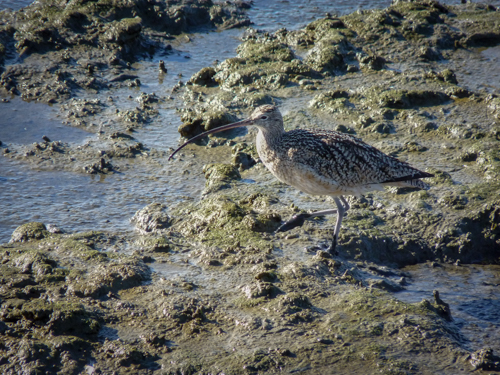
Elsie Roemer Bird Sanctuary is a salt marsh that is an excellent place to see shorebirds. The highlight at Elsie Roemer was seeing a group of about 30 Snowy Plovers on the beach. There were a couple of thousand Western Sandpipers flying in large groups and beautifully reflecting the light. There were more Long-billed Curlew than most of us usually see. Interestingly we saw Snowy Plover, Semi-palmated Plovers and Black-bellied plovers but no Killdeer. A few members saw a Ruddy Turnstone which unfortunately I missed.

At Garretson Point we were happy to see that the seasonal pond had water in it and Northern Pintail, Green-winged Teal, Northern Shovelers and American Wigeon. We heard but were unable to see three Ridgway’s Rails. A few group members also saw a Common Yellowthroat. We didn’t find Cinnamon Teal or Blue-winged Teal, which both have been reported here recently on eBird.

Much further out on the bay from both locations we could see what were probably 100’s or even 1000’s of waterbirds although all we could make out even with scopes was that many were scaup. Surprisingly scare today were Mallards; only two were seen at Garretson Pt. One other highlight of the day was the Cocoa Banana Bread.


Long-billed Curlew

Click read more to see bird lists

Read More…

Posted by: Sandy Steinman | January 28, 2018

Photographer’s Guide to Yosemite  Available For Android

Michael Frye’ s The Photographer’s Guide to Yosemite  is now  available for Android!

The Android version has all the same features as the iOS app, including in-depth descriptions of 40 locations, the locations filter to help you quickly find the best photo spots for any month and time of day, detailed maps and directions, photography tips, and much more. And it’s all fully functional without an internet connection.

Click the link to view the app in the Google Play Store:

https://play.google.com/store/apps/details?id=com.michaelfrye.yosemite

And by the way, a third of the proceeds from the sale of this app benefit the non-profit Yosemite Conservancy to help fund educational programs, restoration projects, and research in Yosemite National Park. So your purchase will help your photography and help Yosemite.

The softcover book version is available at: https://www.michaelfrye.com/bookstore/
Posted by: Sandy Steinman | January 27, 2018

Homestead Valley Land Trust Wildflowers 1/26/18

Homestead Valley Land Trust reports on January 26

NEW
– Indian warrior is coming up all over in the area – 15 right along the Homestead Trail – that we finished clearing a few months ago. A few blooms are showing their crimson colors but the scope of the patch will only become clear later in the season when the hillside blooms.

Forests
Starting
– Fetid adder’s tongue, one of our most exotic blooms is showing its first flowers now.
– Green wattle acacia tree native to Australia is starting to bloom with its bright yellow puff flowers.
– Scotch broom, native to Western Europe, one of the most aggressive invaders of our meadows is blooming with its yellow pea flowers. Pull it before it goes to seed if you can.
– Tasmanian blue gum, is blooming white high in the huge eucalyptus trees.
– Coast live oak blooms with pink tassels.
– California bay laurel, our most common native tree’s blooms have a delicate vanilla scent.

See map and photos at Homestead Valley Land Trust


Posted by: Sandy Steinman | January 27, 2018

Hundreds of U.K. & Ireland Wildflower Species Blooming Midwinter

The Guardian reports

intrepid botanists who discovered 532 species of wildflowers in bloom across Britain and Ireland around New Year’s Day.

According to the Botanical Society of Britain and Ireland (BSBI), which organises the annual New Year Plant Hunt, this rainbow of midwinter colour is a far cry from botanical textbooks of several decades ago which indicated only a few dozen species should be blooming in midwinter.

Read story at Hundreds of wildflower species found blooming in midwinter | Environment | The Guardian

Posted by: Sandy Steinman | January 26, 2018

Pt. Reyes Beach Closure

Pt. Reyes National Seashore announced

**Beach Closure Update** The elephant seals have continued to expand along Drakes Beach as we approach the peak of the breeding season. Starting Saturday, January 27, until March 15, Drakes Beach will be closed to public access starting from the edge of the beach near the right-hand side of the parking lot and continuing towards Chimney Rock.The original closure started earlier this season has been expanded to include the seals that have arrived on the beach more recently.


Posted by: Sandy Steinman | January 26, 2018

Can We Speed Up Creating Ancient Forests?

Anthropocene Magazine reports on is it possible we “Can we speed up the creation of ancient forests?”

Perhaps one percent of the forests that covered America just a few centuries ago still stand. The same can be said of Europe, North Africa and the Middle East. Earth in an age of human domination is woefully short of ancient woodlands, and many centuries if not millennia must pass before they rise again — unless, perhaps, ancientness can be engineered.

Read story at Can we speed up the creation of ancient forests? | Anthropocene

Posted by: Sandy Steinman | January 25, 2018

Being Antisocial Leads Marmots To Longer Life

The NY Times reports

For many mammals, a busy social life can be an important contributor to a long life. But some animals need more alone time than others, and failure to get it could be lethal, according to new research.

Consider the marmot. After spending 13 years tracking their interactions and life spans in Colorado, Daniel T. Blumstein, a biologist at the University of California, Los Angeles, and his colleagues found in a study published Wednesday in Proceedings of the Royal Society B that yellow-bellied marmots with more active social lives tended to die younger than those that avoided interactions.

Read full story at Being Antisocial Leads to a Longer Life. For Marmots. – The New York Times

Posted by: Sandy Steinman | January 24, 2018

Henry Coe Wildflower Update 1/23/18

Henry Coe State Park has a new wildflower bloom report  for January 23, 2018 at the Pine Ridge Association website with photos and a list of flowers now in bloom at: Henry W. Coe – Wildflower Guide.

« Newer Posts - Older Posts »

Categories