Posted by: Sandy Steinman | February 10, 2021

Mono Lake Committee Field Seminars

from Mono Lake Committee

We are currently planning a scaled-back Field Seminar season for this year—our goal is to offer virtual seminars this spring and a limited number of in-person seminars in the summer and fall. The schedule of virtual seminars is posted below and the schedule of in-person seminars will be posted here on March 15. Keeping participants, instructors, and our staff safe is our highest priority; we are developing guidelines and protocols for operating as safely as we can, and we will post those online in March. If you have questions, please contact the Field Seminar team by email or by calling (760) 647-6595. See listings at Field Seminars

The New York Times reports

In just the last half-century, humans have caused a staggering, worldwide drop in the number of sharks and rays that swim the open oceans, scientists have found in the first global assessment of its kind, published Wednesday in the journal Nature.

Oceanic sharks and rays have declined by 71 percent since 1970, mainly because of overfishing. The collapse is probably even more stark, the authors point out, because of incomplete data from some of the worst-hit regions and because fishing fleets were already expanding in the decades before they started their analysis.

Read full article at Shark Populations Are Crashing, With a ‘Very Small Window’ to Avert Disaster – The New York Times

Posted by: Sandy Steinman | February 9, 2021

Slinkpod or Fetid Adder’s Tongue Photos & Info

Fetid Adder’s Tongue or Slinkpod Scoliopus Biglovii  is my favorite early season wildflower. Yesterday I went out to look for it in Redwood Forests in Marin and once again enjoyed photographing it.

This slideshow requires JavaScript.

The name Bigelovii honors John Milton Bigelow, a surgeon and botanist from Ohio, who did a botanical collecting trip in Marin County in the spring of 1854 that made a significant contribution to the Marin flora.  Scoliopus means crooked foot and refers to the curving stalk of the flower. When the plant first appears in the spring, the flower stalks stand up straight, holding the flower above the two leaves which are still quite small. After the flower has been pollinated, the fruit or seed pod begins to swell and the flower parts fall off. The weight of the growing pod causes the slender stalk to bend over and touch the ground, thus the common name “slink pod”  The name “adder’s tongue”refers to the mottled leaves that have grown quite large after the flowers have fallen off and are visible  for months.  The “fetid” part of the name coming from the odor of the fresh flower which  is thought to attract pollinators. (source for information was Marin CNPS)

Where to see Scoliopus bigelovii in Marin County: John Thomas Howell in Marin Flora lists Sausalito, Muir Woods, Mount Tamalpais (Blithedale canyon, Cataract Gulch, Fish Grade), Bolinas Ridge, San Geronimo Ridge, and San Rafael Hills for Marin County locations. A beautiful place to see Scoliopus bigelovii here in Marin County is Muir Woods National Monument.Cascade Falls in Mill Valley is an easy place to see Scoliopus bigelovii. From downtown Mill Valley, take Throckmorton past the public library all the way to the end where it intersects Cascade. Turn right onto Cascade and watch for a small parking lot on the right with a wooden sign reading CASCADE FALLS.  Source: Marin CNPS: Scoliopus bigelovii

To see other locations go the Calflora at http://www.calflora.org/cgi-bin/species_query.cgi?where-taxon=Scoliopus+bigelovii 


From the Anza- Borrego Foundation

After the devastating fire in Borrego Palm Canyon’s First Grove one year ago on January 18, the native Californian fan palms are recovering and making a promising comeback.

The initial images emerging after the fire were disheartening. Many of us, including Park staff on the Natural Resources Team, feared the worst immediately after the event. Yet, nature is resilient, and after just a few weeks, new palm fronds emerged on the native fan palms, Washingtonia filifera. Now, a year later, it appears that all of them may have survived which will be more rigorously assessed by the Park’s biologists and environmental scientists in the coming months.

The Borrego Palm Canyon trail had been closed for 10 months to assist with initial recovery and is now open as a modified loop trail that leads to an overlook but not inside the grove itself.

As Senior Environmental Scientist Danny McCamish shares, “The soil under the palms was completely burnt and is now extremely vulnerable to erosion from the creek bed and heavy flooding events and also susceptible to establishment of non-native undergrowth. We are actively working on removing non-native plants and stabilizing the soil to aid in the generation of a carbon layer that will help the palms’ root system with continued recovery and robust health. We thank the general public for following our guidelines to assist with the stabilization and regeneration efforts to preserve this iconic palm grove for all future generations.”

Click HERE to watch a one-minute video of the initial fire-fighting efforts by ground and air crews on January 18, 2020 and the grove a year later (video by Sicco Rood/Steele Burnand Anza-Borrego Desert Research Center).

Posted by: Sandy Steinman | February 8, 2021

Job Openings

Aquatic Biologist I Fisheries/Hydrology, Korbel  https://secure3.entertimeonline.com/ta/6110531.careers?CareersSearch 

Posted by: Sandy Steinman | February 8, 2021

San Luis Obispo CNPS YouTube channel

We now have a YouTube channel where you can view chapter meetings you may have missed or revisit programs you enjoyed. https://www.youtube.com/channel/UCNjrsrrwy14IzB3-tMn_7nw
When fieldtrips resume, we may add a playlist for videos created in the field and the same with workshops. If you have video skills and would like to help me manage the YouTube channel, send a note to info.cnpsslo@gmail.com.
Posted by: Sandy Steinman | February 8, 2021

Wildlife of Big Bend on PBS 2/10/20

Nature — Big Bend: The Wild Frontier of Texas premiers nationwide Wednesday, February 10 at 8 p.m. on PBS (check local listings), pbs.org/nature, and the PBS Video app.
The film features Big Bend’s remarkable Black Bears – pioneers who came across the Mexican desert and were the first to reclaim Texas after decades of hunting and persecution. Witness in super slow motion the magnificent courtship display of the Lucifer Hummingbird and the extraordinary Pallid Bat stalking its insect prey on the desert floor at night. Observe male Bighorn Sheep fighting for dominance and the unique way beavers keep themselves groomed. Watch the Elf Owl, the smallest owl in the world, hunt food for its chicks. And catch a glimpse of the first-ever footage of Anna’s Hummingbirds nesting in Big Bend.
Posted by: Sandy Steinman | February 8, 2021

JAMES MCNEIL WHISTLER’S  ANACAPA ISLAND SEAGULLS 

ARTIST JAMES MCNEIL WHISTLER’S  ANACAPA ISLAND SEAGULLS PREDATE HIS MOTHER’S PORTRAIT BY 17 YEARS

James Abbott McNeil Whistler (1834-1903)
It was in 1854 that a young James Whistler sought a job as an engraver working in the cartographic section of the U.S. Coast Survey in Washington, D.C.  He was but 20 years old, and he was hired. According to reports: “Working for the government in those days was a free-and easy business, and the boys sent the messenger out every afternoon for a can of grog. Whistler was one of the ringleaders. Again and again the head men reprimanded him, but they needed him.” And he needed the pay—$1.50 a day.

Whistler did his job well, drawing maps, coastline charts and geodetic sketches. But the artist in him couldn’t resist embellishing his handiwork with mermaids, sea serpents and even smiling spouting whales. Admonished for a final time, he was told in no uncertain terms that if he “ever again desecrated perfectly good maps with animal life he could consider himself discharged.”

View of the Eastern extremity of Anacapa Island from the Southwest (1854)
Along came Whistler’s View of the Eastern extremity of Anacapa Island from the Southwest — complete with sea gulls — and there went his government job. Whistler famously proclaimed: “Surely the birds don’t detract from the sketch. Anacapa Island couldn’t look as blank as that map did before I added the birds!” In 1855 Whistler resigned in disgust. He never visited Anacapa Island.

Two years later (1856) the Coast Survey reprinted his East Anacapa Island view without the seagulls, however clouds were added. The above copy was hand-tinted. [Note: Although historic records call these birds were called “Sea Gulls,” to this Curiosity Correspondent they look more like Pelicans flying in formation. Both Gulls and Pelicans nest at Anacapa Island.]

In the 1980s, when the last of the U.S. Government reprints of Whistler’s View of the Eastern extremity of Anacapa Island from the Southwest (1854) unexpectedly became available, the Santa Cruz Island Foundation purchased them all.

While supplies last, we will send a Whistler Anacapa Island map with each $50 donation to our Acquisitions Fund (limited one per person). Most suitable for framing, and a great gift with an interesting history! This government reprint map of View of the Eastern extremity of Anacapa Island from the Southwest (1854) page size is 8.5 by 10 inches.

Special thanks to California Islands enthusiast Stuart Wilson, All 8 Club Member #184, for suggesting this topic!

Posted by: Sandy Steinman | February 7, 2021

Berkeley Street Photos February 5 and 6, 2021

Photographed in the North Berkeley Flatlands on February 5 and 6, 2021.

This is part of my continuing project,  the “Stay at Home Photo Project”.  It includes many street photos from Berkeley and Albany as well as photos from the UC Berkeley campus, my yard and neighbors’ yards  You can see larger higher quality versions of many of the photos at Flickr in my collection Stay at Home Photo Project .

This slideshow requires JavaScript.

Posted by: Sandy Steinman | February 7, 2021

Klamath Mountains Winter Webinar Series 1/7 to 3/11/21

Klamath Mountains Winter Webinar Series from Backcountry Press  Thursdays 7-8 pm PT | Jan. 7 – March 11, 2021

all sessions will be recorded

The Klamath Mountains, a region of northwest California and southwest Oregon about the size of Virginia, is a complex and fascinating place in terms of its Natural History. For the last five years several handfuls of experts in their fields have been collaborating to share the stories of this region in one definitive volume, due in print summer 2021: The Klamath Mountains: A Natural History. We have called upon this stellar collection of co-authors to offer you this 10-part class.

Posted by: Sandy Steinman | February 7, 2021

Today is Superb Owl Sunday and You Can’t Tell Us Otherwise

from Audubon

Today is Superb Owl Sunday and You Can’t Tell Us Otherwise

While the rest of the nation eagerly anticipates the big game, Audubon sees today a little differently. By moving just one letter, today becomes Superb Owl Sunday—our favorite unofficial bird holiday.

Whether barred, snowy, or screech, owls are some of the most fascinating birds around. Big yellow eyes, razor-sharp beak and talons, and incredible camouflage skills. In fact, their ability to hide is so great that most birders rely on their signature call to identify who’s whooo.

Kick off your game day with this handy guide to 5 North American owl species and their most common calls. We promise you won’t fumble your next owl ID.

Learn More
Posted by: Sandy Steinman | February 7, 2021

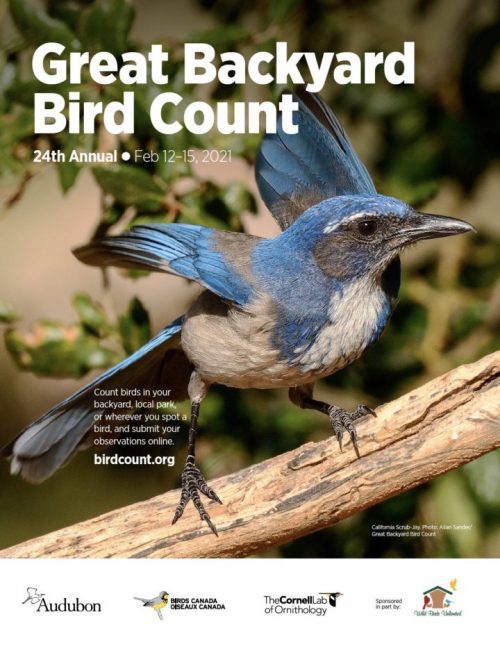
2021 Great Backyard Bird Count 2/12 to 2/15

Watching birds is a safe and enjoyable activity we can do during the Covid global pandemic. For the 2021 Great Backyard Bird Count, we strongly urge participants to comply with all current country, province, state, First People’s lands, or municipal Covid-19 regulations and guidelines. This includes, but is not limited to, social distancing while bird watching and wearing a mask when birding with others.

Participating is easy, fun to do alone, or with others, and can be done anywhere you find birds. Simply watch birds for 15 minutes or more, at least once over the four days, February 12-15, 2021, and tell us what you see!

Pick the best tool to use for sharing your birds sightings:

For more information go to  the Great Backyard Bird Count

Posted by: Sandy Steinman | February 6, 2021

Job Opportunity: Ventura County Donor Database Specialist

from Ventura Botanical Gardens

Ventura Botanical Gardens is seeking a well rounded nonprofit professional with 3-5 years of comprehensive database experience to join our growing team. The Donor Database Specialist will play a key role in ensuring the integrity of our data systems in order to serve Garden members and donors. Will consider full or part-time.

Job Description: The Donor Database Specialist’s primary responsibilities will center on the maintenance of VBG’s donor database and responding to donor needs.

The Donor Database Specialist must have excellent phone skills and enjoy working with the public and is expected to provide excellent customer service to all donors.

Experience working with and providing leadership to volunteers is desired.

This position will report to the Director of Development and work closely with a variety of Garden staff and volunteers, in particular Membership associates.

To apply, email a cover letter and resume to acampbell@venturabotanicalgardens.com. Please add in the email subject line Donor Database Specialist.

Read More…

Posted by: Sandy Steinman | February 6, 2021

Winter Raptor Identification Course

The Western Foundation of Vertebrate Zoology Presents:

Winter Raptor Identification Course

Online February 17th, 24th and March 3rd, 2021 from 6:00 to 8:30pm

Please join us for our Winter Raptor Identification Course, held online by WFVZ Science Education Coordinator Paul Grindrod.

Get your tickets here!!

Posted by: Sandy Steinman | February 6, 2021

Migrating Birds: A Naturalist Talk 2/9/21

Migrating Birds: A Naturalist Talk with the East Bay Regional Park District

Tuesday, February 9, 2021 at 6:30 PM PST

Event by Oakland Main Library, East Bay Regional Park District and Oakland Public Library

To register, email engagement@oaklandlibrary.org. Or watch live on Facebook by visiting the Oakland Library Facebook page.

from Los Padres ForestWatch

Washington, DC – Today, the Biden administration signed an executive order that places a moratorium on new leasing of federal land and mineral estate for fossil fuel extraction pending a comprehensive review of the federal leasing program. The order would halt new leasing for oil and gas drilling and fracking on national forests, parks, monuments, wildlife refuges, and other federal public lands. The order includes Los Padres National Forest and Carrizo Plain National Monument, already impacted by federal oil development, as well as the 1.2 million acres of land and mineral estate across the Central Coast that the Bureau of Land Management began leasing for oil drilling and fracking in December.

Read full article at Biden Administration Pauses Federal Fossil Fuel Leasing and Commits to Land Protection

Posted by: Sandy Steinman | February 5, 2021

UC Botanical Garden Programs and Workshops

See the  upcoming Feb. programs and links to past program at  Seasonal Programs & Workshops – UC Botanical Garden

Posted by: Sandy Steinman | February 5, 2021

Audubon Bird News Text Alerts

Text Updates from Audubon: Be the First to Know When Bird News Breaks
At a time when two-thirds of North American birds are threatened by climate change, it is critical that Audubon spread the word to our supporters as soon as the opportunity to take action appears.

Sign up for text updates from Audubonan easy way to be the first to know when your help is needed to protect birds. We’ll send you a text when news breaks about threats facing birds and our environment, along with fascinating bird facts, special events, opportunities to participate in community science projects, and other ways to help birds too.

And right now, when you join our list you’ll receive a link to download exclusive phone wallpapers featuring Audubon’s beautiful bird photography and designs. 

Birds tell us it’s time to act—and that means we need to stay connected. With text updates from Audubon, you can stand up for the birds we all love while on the fly. Sign up today!

Sign Me Up
Posted by: Sandy Steinman | February 5, 2021

Job Opportunity: Plant Genetics Lab Technician

SANTA BARBARA BOTANIC GARDEN POSITION DESCRIPTION: Laboratory Technician

The Laboratory Technician assists with a wide range of lab and office work supporting the inventory, conservation, and restoration of California’s flora and ecological communities. Occasional field work may also be required. This full-time (40 hours per week), non-exempt position reports to the Conservation Geneticist.

Read More…

Posted by: Sandy Steinman | February 5, 2021

Regional Parks Botanic Garden to Reopen Feb. 18 & New Classes

Updated
The Regional Parks Botanic Garden in Tilden Park will reopen February 18. Reservations are required, and can be made starting February 6 on the District website: https://www.ebparks.org/parks/tilden/botanic_garden.htm
The Botanic Garden will be open to visitors on Saturday, Sunday, Tuesday, and Thursday from 8:30am to 4:30pm. It is a botanic garden of California Native Plants.
*     *     *     *    *    *    *    *     *     *     *     *     *     *     *
List of the Garden’s Spring Classes now online at: https://nativeplants.org/…/classes-field-trips-workshops/
Posted by: Sandy Steinman | February 5, 2021

Webinar: How to Participate in the Great Backyard Bird Count

Watch Birds and Share the Joy: How to Participate in the Great Backyard Bird Count

Webinar: Tuesday, February 9, 2021, 12:00–1:00 pm ET

Every February, people of all backgrounds all around the world spend time watching and counting birds for the Great Backyard Bird Count (GBBC). And when the latest science shows that two-thirds of North American birds are threatened by climate change, there is no better time to get involved.

Join the count running from February 12–15, and celebrate the birds near you while contributing to the science that helps us protect the places they need. To learn more about how to participate, tune into our conversation with project coordinators from the Cornell Lab of Ornithology, Audubon, and Birds Canada next Tuesday, February 9 at 12 p.m. ET on Facebook Live. If you don’t already follow us on Facebook, click below to like our page.

We hope to see you next week!

Watch on Facebook
Posted by: Sandy Steinman | February 5, 2021

Antelope Valley California Poppy Bloom

Do you want to check on the progress of the bloom at the Poppy Reserve? You can monitor the wildflower’s via our live webcam.
Posted by: Sandy Steinman | February 5, 2021

Bay Area Climate Change Hotspots

NBC Bay Area reports Ten places where climate change touches the Bay Area.  See story  with videos at  Bay Area Climate Change Hotspots – NBC Bay Area

from the National Parks Conservation Association

Staff and visitors must now wear masks in federal buildings and facilities, as well as at outdoor attractions where distancing isn’t possible. NPCA urges everyone to respect COVID-safe practices and travel with extreme care.

Read more  Mask Requirement at National Parks Offers Opportunities to Adventure Responsibly · National Parks Conservation Association

Posted by: Sandy Steinman | February 4, 2021

2021 Great Backyard Bird Count Feb. 12 to 15

To learn about and participate in the Great Backyard Bird Count go to Backyard Bird Count

Posted by: Sandy Steinman | February 3, 2021

Biden Moves to Dial Down America’s Soaring Methane Emissions 

The Revelator reports

Experts say the new administration can jumpstart climate protections by taking on rising methane emissions, but it won’t be easy or quick.

Methane — an invisible and odorless gas — makes up just a tiny trace of the Earth’s atmosphere and survives in the air for only about 10 years before degrading. Yet NASA scientists say this humble molecule has driven one-quarter of human-caused global warming to date.

“Methane is the second-most important heat-trapping pollutant after carbon dioxide, but it packs a bigger wallop in the near term,” says David Doniger, senior strategic director of Climate and Clean Energy at the Natural Resources Defense Council, and a former member of White House Council on Environmental Quality.

Read full article at  Biden Moves to Dial Down America’s Soaring Methane Emissions • The Revelator

Posted by: Sandy Steinman | February 2, 2021

Job Opportunity: Full-Time Mid-Senior Level Biologist

Full-Time Mid-Senior Level Biologist – Sacramento or Placer County

Applicants please apply through our website: http://www.helixepi.com/careers/current-openings/
HELIX Environmental Planning, Inc. (HELIX), a growing, employee-owned California-based environmental consulting and planning firm, is seeking a motivated Biologist with critical thinking skills and a strong work ethic to join our Sacramento County office in Folsom or our Placer County office in Roseville.HELIX provides CEQA/NEPA, biological, cultural resource management, habitat restoration, regulatory permitting, environmental compliance monitoring, acoustics and noise control, air quality and greenhouse gas, and GIS services to both the public and private sectors.
Read More…
Posted by: Sandy Steinman | February 2, 2021

UC – Berkeley Botanical Garden Photos from 1/31/21

Photos from a visit to the UC-Berkeley Botanical Garden on January 31, 2021.

The garden is currently open daily to the public from eleven to five by reservation .  Garden members can enter at ten. There is an entrance fee (free for garden members) and paid parking.  For more information and to make reservations  go to UC-Botanical Garden.

This is part of my continuing pandemic project,  the “Stay at Home Photo Project”.  It includes many street photos from Berkeley and Albany as well as photos from the UC Berkeley campus, my yard, local botanic gardens, and neighbors’ yards  You can see larger higher quality versions of many of the photos at Flickr in my collection Stay at Home Photo Project.

This slideshow requires JavaScript.

Posted by: Sandy Steinman | February 2, 2021

Beyond Blooms with Saxon Holt 

Posted by: Sandy Steinman | February 2, 2021

Clean Energy and Social Justice

The Revelator reports on making sure clean energy does not reinforce systems of social injustice

Switching to renewables won’t solve the inequities already baked into our system, says energy and environmental law expert Shalanda Baker. We need a different approach.

…she realized that in the pursuit of clean energy and climate solutions, we were on course to replicate many of the same injustices of the fossil fuel economy.

Read story at  Justice First: How to Make the Clean Energy Transition Equitable • The Revelator

« Newer Posts - Older Posts »

Categories