Posted by: Sandy Steinman | September 6, 2021

New species of ancient four-legged whale discovered in Egypt 

The BBC reports

Scientists in Egypt have identified a new species of four-legged whale that lived around 43 million years ago.

The fossil of the amphibious Phiomicetus anubis was originally discovered in Egypt’s Western Desert.

Read more at  New species of ancient four-legged whale discovered in Egypt – BBC News

Posted by: Sandy Steinman | September 5, 2021

Half of Lassen has burned from Dixie Fire

The San Francisco Chronicle reports

Lassen Volcanic National Park is still on fire. The second largest conflagration in California history, the Dixie Fire, has now spread over more than half of the park, with nearly 65,000 of the park’s 106,452 acres burned.

And while it’s too soon to assess the damage, initial reports and photographs show that some structures and areas of the park are in pretty bad shape, while others remain pristine and standing.

Seeing what the inside of Lassen looks like now can be upsetting, but park officials emphasize that the entire region was once covered in volcanic ash and rock, and that the resilient park will eventually recover.

Read our story and see the photographs of the park here.

Posted by: Sandy Steinman | September 5, 2021

2021 California Biodiversity Day is Sept. 7

California Biodiversity Day takes place on September 7th of each year, marking the anniversary of the launch of the California Biodiversity Initiative in 2018. This annual event celebrates our state’s exceptional biodiversity, while also encouraging actions to protect it. This year, we are excited to have many partners joining us to host California Biodiversity Day events from September 4 to September 12. Please check out the events at California Biodiversity Day 2021.

Posted by: Sandy Steinman | September 5, 2021

Santa Barbara Maritime Museum Exhibit

from Santa Barbara Maritime Museum

SCAPE Online Art Exhibit and Sale Extended through September 15

Good news!  SBMM has extended the online SCAPE original artwork exhibit and sale through September 15, so you have two more weeks to purchase a lovely original piece of art from local Santa Barbara artists.  Visit sbmm.org for more information and to buy fine art and support the Museum.

Posted by: Sandy Steinman | September 4, 2021

Plant the Native Plants that Support the Most Wildlife

from the National Wildlife Federation

Check out our new Eco Region Keystone Host Plant Lists from Dr. Doug Tallamy and pollinator conservationist, Jarrod Fowler. These native plants are critical to the food web as they support higher numbers of wildlife species completing their life cycle. Without keystone plants in the landscape, butterflies, native bees, and birds will not thrive.
Find your state on the eco region map and click on the list of the best native plants for butterflies, moths, and pollen specialist bees in your area.

Posted by: Sandy Steinman | September 3, 2021

One in three trees face extinction in wild, says new report

The BBC reports 

At least 30% of the world’s tree species face extinction in the wild, according to a new assessment.

They range from well-known oaks and magnolias to tropical timber trees.

Experts say 17,500 tree species are at risk – twice the number of threatened mammals, birds, amphibians and reptiles combined.

Read more at One in three trees face extinction in wild, says new report – BBC News

Center for Biological Diversity News Release

Feds Announce Lease Sale as Louisiana Reels From Impacts of Hurricane Ida

WASHINGTON— Immediately following the Biden administration’s decision to offer more than 80 million acres of the Gulf of Mexico for oil and gas leasing, environmental and Gulf groups today filed a challenge to the lease sale in court.

Earthjustice filed the lawsuit in federal court in the District of Columbia on behalf of Healthy Gulf, Sierra Club, Friends of the Earth and the Center for Biological Diversity. It was filed against Secretary of the Interior Deb Haaland and the Bureau of Ocean Energy Management following the notice of lease sale 257.

Read More…

Posted by: Sandy Steinman | September 1, 2021

What’s Open & What’s Closed in Mono County

Forest Service Closure Information To better provide public and firefighter safety due to the ongoing California wildfire crisis, the USDA Forest Service has temporarily closed the national forests in the Pacific Southwest Region from August 31, 2021 at 11:59pm through September 17, 2021 at 11:59pm. This closure affects the Inyo National Forest in Mono County. Read the press release https://assets.simpleviewinc.com/simpleview/image/upload/v1/clients/monocounty/Humbolldt_Toiyabe_News_Release_307353df-0704-4a48-a41b-a1204dcdf0b6.pdf


Read more about what it open and closed in Mono County at USFS Closure Information

Posted by: Sandy Steinman | September 1, 2021

California Academy of Sciences Virtual Programs For Kids

Meet Academy educators online from your home or classroom via interactive livestreams for K-8 students. at Take a Virtual Field Trip with our Distance Learning Programs!| California Academy of Sciences

Posted by: Sandy Steinman | September 1, 2021

Regional Parks Botanic Garden Photos 8/30/21

Photos from a visit to the Regional Parks Botanic Garden in Tilden Park in Berkeley on August 30, 2021

The Regional Parks Botanic Garden is a botanic garden of California native plants. 

This slideshow requires JavaScript.

You  can see other photos from the Regional Parks Botanic Garden by several photographers on the garden’s Flickr group page at Regional Parks Botanic Garden.


Center for Biological Diversity News Release

WASHINGTON— Three neonicotinoid insecticides likely harm all of the country’s 38 protected amphibians and roughly three fourths of all other endangered plants and animals, according to long-anticipated studies released today by the U.S. Environmental Protection Agency.

Neonicotinoids are the most popular insecticides used in the United States. Hundreds of studies have shown they play a major role in population-level declines of bees, birds, butterflies and freshwater invertebrates. Today’s draft biological evaluations represent the first time the EPA has evaluated the chemicals’ potential to harm the nation’s most imperiled plants and animals.

Read More…

Posted by: Sandy Steinman | August 31, 2021

UC Berkeley Botanical Garden September Events

See the UC  Berkeley Botanical Garden  calendar of events for September at  UC Berkeley Events Calendar | Botanical Garden

There are a number of talks on Oaks and a virtual butterfly walk.

Posted by: Sandy Steinman | August 31, 2021

The West on Fire Podcasts in Sept. & Oct.

from the Huntington

The West on Fire, explores the West’s relationship with fire, and how it has shaped both our past and present. Topics include fire practices in Indigenous communities, the history of Black firefighters in Los Angeles, smoke and urban air quality, farmworker community health during wildfires, post-wildfire debris flow, the origins and endurance of Smokey Bear, incarcerated firefighters, and more. Learn more at  Podcast: Western Edition > Huntington-USC Institute on California and the West > USC Dana and David Dornsife College of Letters, Arts and Sciences

Posted by: Sandy Steinman | August 31, 2021

What is a Fire Tornado?

NPR  reports

Recent, intense wildfire seasons are helping scientists understand the apocalyptic swirls of smoke, wind and flame known as fire tornadoes. They’re working to determine if the fiery phenomena are occurring more often as fires grow more intense and the conditions that create them more frequent. Read about the data they’ve gathered so far or listen to the story.

Vox writes about  the drought on the Colorado River and the impact on animals

The 20-plus-year drought in the American West hit a new extreme this week as the US government declared a water shortage on the Colorado River for the first time in history.

The megadrought is threatening wildlife, and state agencies are pouring in resources to keep important species alive — in some cases, by flying water in helicopters to remote, artificial watering holes where bears, sheep, and other thirsty animals seek relief.

Read story at  The Colorado River faces an extreme drought. What does that mean for animals? – Vox

Posted by: Sandy Steinman | August 30, 2021

California national forests ordered closed to prevent fires

The Sacramento Bee reports

With fires raging across the state, the USDA Forest Service is closing all 20 million acres of California’s national forests to public access for two weeks beginning Tuesday.

In an announcement Monday, the Forest Service said the closure will extend through at least Sept. 17.

“I have made the difficult decision to temporarily close all (California) National Forests in order to better provide public and firefighter safety due to extreme fire conditions throughout the state, and strained firefighting resources throughout the country,” California’s regional forester, Jennifer M. Eberlien, said

This closure starts at noon Tuesday.

Those caught entering Forest Service lands — including developed campgrounds, hiking trails and recreation sites — typically face fines of up to $5,000 for violating closure orders.

Read more at California national forests ordered closed to prevent fires | The Sacramento Bee

Posted by: Sandy Steinman | August 30, 2021

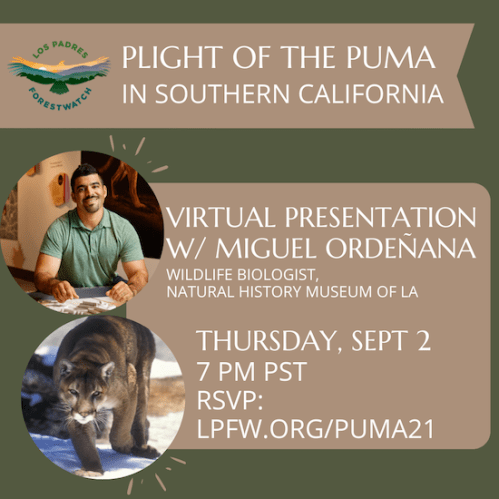
Plight of the Puma

In celebration of National Wildlife Day, Join Los Padres ForestWatch as we host an exciting virtual presentation and Q&A, ‘Plight of the Puma: In Southern California” with Miguel Ordeñana, Community Science Senior Manager & Wildlife Biologist with the Natural History Museum of Los Angeles County.

Posted by: Sandy Steinman | August 30, 2021

How wildfire restored a Yosemite watershed

from UC Berkeley

For nearly half a century, lightning-sparked blazes in Yosemite’s Illilouette Creek Basin have rippled across the landscape — closely monitored, but largely unchecked.

Their flames might explode into plumes of heat that burn whole hillsides at once, or sit smoldering in the underbrush for months.The result is approximately 60 square miles of forest that look remarkably different from other parts of the Sierra Nevada: Instead of dense, wall-to-wall tree cover — the outcome of more than a century of fire suppression — the landscape is broken up by patches of grassland, shrubland and wet meadows filled with wildflowers more abundant than in other parts of the forest. These gaps in the canopy are often punctuated by the blackened husks of burned trunks or the fresh green of young pines.

Read more at : How wildfire restored a Yosemite watershed | Berkeley News

Posted by: Sandy Steinman | August 29, 2021

Events in Golden Gate National Parks

See a list of all  events for Golden Gate National Parks at  Events in the Parks | Golden Gate National Parks Conservancy

Posted by: Sandy Steinman | August 29, 2021

Cannabis farms irrigating with groundwater may affect stream flows

UC Berkeley Rausser College of Natural Resources reports

Environmental advocates have expressed concern that cannabis farms are diverting water from rivers and streams, which could harm fish and other wildlife.

Read story at  Cannabis farms irrigating with groundwater may affect stream flows | UC Berkeley Rausser College of Natural Resources

Posted by: Sandy Steinman | August 28, 2021

At Orchards and Vineyards, Birds Are Outperforming Pesticides

CornellLab of Ornithology  writes about using birds as an environmentally friends alternative to the pesticides

Across America and beyond, farm­ers and vineyard and orchard owners are enlisting wild birds—from raptors to songbirds—in a sustainable battle against pests. They erect nest boxes, install raptor perches, or plant inviting native cover—all of which offer less expensive natural pest control than other traditional methods.

Birds are environmentally benign, while poisons are not. And pest-controlling birds stay on the job, while pesti­cides must be reapplied, and the effect of bird-scaring balloons, hawk silhouettes, and propane cannons quickly wears off.

Read article at At Orchards and Vineyards, Birds Are Outperforming Pesticides | All About Birds All About Birds

Center for Biological Diversity News Release

Chico Project Would Pave Over Vernal Pools, Threaten Endangered Species

SACRAMENTO, Calif.— The Center for Biological Diversity sued the U.S. Army Corps of Engineers and the U.S. Fish and Wildlife Service today for approving a mixed-use development in Northern California and failing to protect endangered species habitat.

Today’s lawsuit challenges the permitting of the Stonegate development, a 314-acre residential and commercial project that would destroy vernal pool habitat near Chico. The site is home to imperiled species like the vernal pool fairy shrimp, vernal pool tadpole shrimp and the endangered flower known as Butte County meadowfoam.

Read More…

Posted by: Sandy Steinman | August 26, 2021

Newsom Recall Could Mean a Seismic Shift for Conservation 

BayNature article on possible impact of recall election

California Governor Gavin Newsom’s recall election in mid-September, should he lose, will very likely terminate the floundering politician’s career. A late-term gubernatorial replacement would also mean a potentially major shift in California environmental policies. If voters yank Newsom, a Democrat, from office, he is likely to be replaced by a Republican. The leading candidate, Larry Elder, is a far-right conservative and libertarian who calls climate change a “religion.”

Newsom and his supporters warn that replacing him with Elder, best known as a talk show host, risks rollbacks of state fracking bans and executive orders targeting greenhouse gas emission reductions, fuel efficiency, and biodiversity conservation. The agenda of a new administration could, they say, be a disaster for California’s environmental policies and role as an international environmental leader – and would come on the heels of the United Nations’ report warning of cataclysmic and inevitable climate change and the need to curb emissions.

“A new governor right now could scuttle everything,” says Daniel Gluesenkamp, executive director of the California Institute for Biodiversity and former executive director of the California Native Plant Society.

Read more at  Newsom Recall Could Mean a Seismic Shift for Conservation – Bay Nature
Posted by: Sandy Steinman | August 26, 2021

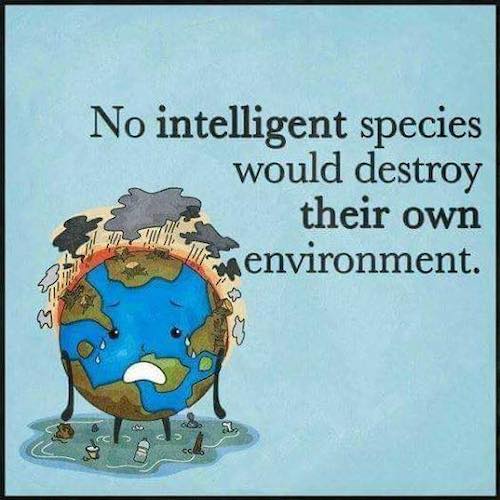
What Intelligent Species Destroys Its Own Environment?

Posted by: Sandy Steinman | August 26, 2021

How Do Oak Trees Survive Fire?

Bay Nature writes about how oaks survive fires

healthy oaks do usually survive most fires. And thank goodness—they are among my favorite trees. Oaks are not the oldest, widest, largest, or tallest trees, but wherever they occur, they tend to dominate both in the forest and in scrubland. Oaks cover approximately one-third of California’s 33 million acres of forest.

Read more at  Ask the Naturalist | How Do Oak Trees Survive Fire? – Bay Nature

Greeting’s native plant enthusiasts!

The California Department of Fish and Wildlife’s Native Plant Program has received three new Sr. Environmental Scientist Specialist full-time positions to support the conservation and recovery of native plant species. Each position will have a distinct position number and RPA Number; therefore, you will need a separate and complete application package to apply for each position you are interested in. The positions are as follows:

Read More…

Posted by: Sandy Steinman | August 25, 2021

Happy Birthday National Park Service!

On this day in 1916, President Woodrow Wilson signed the National Park Service Organic Act which created the National Park Service. This new federal bureau within the Department of the Interior was responsible for protecting the 35 national parks and monuments then managed by the department.
Today, the National Park Service (NPS) manages 423 individual units covering about 85 million acres in all 50 states, the District of Columbia, and US territories!
Most people are familiar with the term “National Park”, but of the 423 units, only 63 are National Parks. There are at least 19 naming designations for other sites within the NPS. Examples of other naming designations include National Monuments and National Seashores.
For a full list of all 423 National Park Service sites and the different designations, visit this page: https://www.nps.gov/aboutus/national-park-system.htm.
Posted by: Sandy Steinman | August 25, 2021

Closing the Tree Equity Divide 

The Revelator reports on A project in Los Angeles could help communities that lack tree canopy and provide a much-needed tool to protect residents from dangerous temperatures.

As heat wave after heat wave scorches the West this summer, it may feel like there’s no escape from the record-breaking temperatures. But mounting research shows one way to help beat the heat: Urban communities with more tree cover fare much better than those that lack a green canopy.

This lack of “tree equity” strongly correlates with race and income. A study of more than 3,000 communities across the United States determined that poor communities with a majority of people of color tend to have less green infrastructure and fewer trees than well-to-do, white areas.

Read more at  Closing the Tree Equity Divide • The Revelator

The LA Times reports on efforts to save endangered species from total extinction

Globally, more than a million plants and animals face extinction due to habitat loss, climate change and other factors related to human activity, and this alarming loss of biodiversity is only accelerating. In California, conservationists and biologists have identified scores of species in potential peril, including many icons of the state’s beloved wildlands — chinook salmongiant sequoiasJoshua treesdesert tortoisesCalifornia red-legged frogsgray whales.

Now, a hellish summer of extreme fire activity, drought and heat are again pushing some species to the brink of oblivion. Seized by a newfound urgency, state and federal biologists, research institutions, conservation organizations and zoos have been racing to save the most threatened species with a bold campaign of emergency translocations, captive breeding programs and seed banks. Some have likened the effort to a modern-day Noah’s Ark.

Read full article at California builds ‘Noah’s Ark’ as extinction looms – Los Angeles Times

Posted by: Sandy Steinman | August 23, 2021

Happy Black In National Parks Week

Happy #BlackInNationalParksWeek!

Black In National Parks week creator Nicole Jackson and James Edward Mills of The Joy Trip Project shared their thoughts on the role people of color have played in the management of public land on The Takeaway

« Newer Posts - Older Posts »

Categories