Posted by: Sandy Steinman | April 1, 2024

Theodore Payne Foundation Upcoming Classes and Workshops

See upcoming Theodore Payne Foundation Classes and Workshops at Theodore Payne Foundation Events | Eventbrite

Posted by: Sandy Steinman | April 1, 2024

How smart is a javelina?

from the National Park Service
Research on animal intelligence has increased in past years. We now know that pigs are self-aware and experience emotions. But what about their peccary cousins? According to the San Diego Zoo, animal biologists have determined that the javelina is about as smart as a dog, dolphin, or elephant. Exactly what that means, however, is open to interpretation. But consider this—the javelina spends a little time in the early morning, and a little more time at sunset “working”- searching for food and eating it. The rest of the time they wallow in shady spots with their family and friends. Maybe they know something we don’t!
To learn more, visit Hoofed Mammals – Organ Pipe Cactus National Monument (U.S. National Park Service) (nps.gov)

Posted by: Sandy Steinman | March 31, 2024

Garden Photos

Photos from my neighbor’s garden and mine.

This slideshow requires JavaScript.

Posted by: Sandy Steinman | March 31, 2024

Job Openings

 Staff Botanist/Staff Wildlife Biologist, Throughout California

 Botany Intern, Los Padres National Forest

Botany / Restoration seasonals – CA State Parks – Sierra District – Grass Valley

Posted by: Sandy Steinman | March 31, 2024

Upcoming Anza Borrego Desert Natural History Association Events

See the upcoming calendar of Upcoming Anza Borrego Desert Natural History Association Events at Activity Calendar

Posted by: Sandy Steinman | March 31, 2024

Mammals battle for life in new David Attenborough series

The BBC reports

Arctic foxes are turning to cannibalism as they struggle to find food in a warmer world.

That’s one of the never-before-captured behaviours in Sir David Attenborough’s latest series – Mammals.

It focuses on how these animals are adapting to a world rapidly changed by the most dominant mammal – us.

Read more Mammals battle for life in new David Attenborough series


The New York Times reports

A fertilizer spill in Iowa this month wiped out much of the aquatic life across a 60-mile stretch of rivers in two states, officials said, leaving an estimated 789,000 fish dead in one of the region’s most ecologically devastating chemical spills in recent years.

Read more at Iowa Fertilizer Spill Kills Nearly All Fish Across 60-Mile Stretch of Rivers

Posted by: Sandy Steinman | March 30, 2024

8 National Park Gardens to Delight the Senses 

from the National Parks Conservation Association

If you’re looking for some color and fragrance this spring and summer, gardens in national parks are — or soon will be — abloom.

Read on at  8 National Park Gardens to Delight the Senses · National Parks Conservation Association

Smithsonia Magazine reports a study that may help save killer whales

All killer whales are currently categorized as a single species, but a new study may change that. Researchers suggest in the journal Royal Society Open Science that two populations of killer whales, resident and Bigg’s killer whales, should be recognized as separate species, distinct from both each other and the rest of killer whales.

Read or  Two New Species of Killer Whale Should Be Recognized, Study Says | Smart News| Smithsonian Magazine

The Guardian reports

In 2004, Donald Davis and fellow scientists at the University of Texas made an alarming discovery: 43 foods, mostly vegetables, showed a marked decrease in nutrients between the mid and late 20th century.

Nutrient loss has continued since that study. More recent research has documented the declining nutrient value in some staple crops due to rising atmospheric carbon dioxide (CO2) levels; a 2018 study that tested rice found that higher CO2 levels reduced its protein, iron and zinc content.

Read more Vegetables are losing their nutrients. Can the decline be reversed? | Vegetables | The Guardian

The New York Times reports

Indigenous leaders of New Zealand, Tahiti and the Cook Islands signed a treaty that recognizes whales as legal persons. Conservationists hope it will lead to legal protections.

— Read on www.nytimes.com/2024/03/29/world/australia/whale-personhood-polynesia-maori.html

Posted by: Sandy Steinman | March 29, 2024

Job Openings: Botany / Restoration seasonals

CA State Parks is hiring up to 2 Forestry Aides (seasonal) stationed in Grass Valley, CA. Duties are invasive plant removal and botanical surveys. Come join State Parks and work in the beautiful Sierra foothills and around Lake Tahoe.

Read more at  Botany / Restoration seasonals – CA State Parks – Sierra District – Grass Valley – CNPS Forums

Posted by: Sandy Steinman | March 29, 2024

World Nature Photography awards 2024

The Guardian reports

The World Nature Photography award winners have been announced from a pool of entries from all corners of the globe – including a baby elephant in Kenya and an owl-like plant in Thailand. The top award and cash prize of $1,000 went to Tracey Lund from the UK for her image of two gannets under the water off the coast of the Shetland Islands. Lund and her fellow winners were drawn from thousands of images

See photos and read more at From a graceful turn to a dangerous toy: the World Nature Photography awards 2024 – in pictures | Art and design | The Guardian

Posted by: Sandy Steinman | March 29, 2024

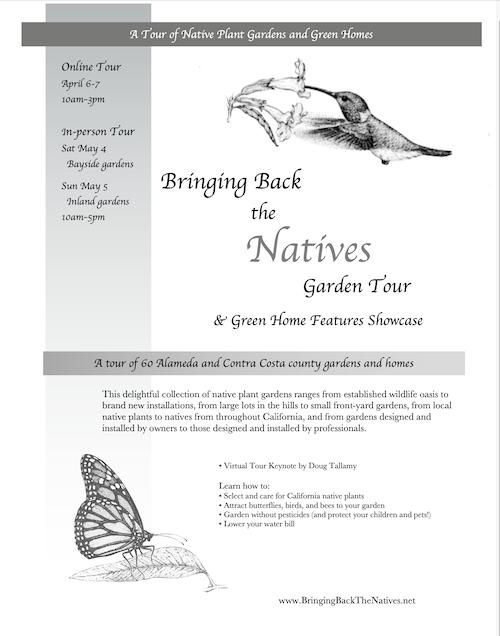
Bring Back the Natives Garden Tour

Posted by: Sandy Steinman | March 29, 2024

Biden administration restores threatened species protections

NPR reports

The Biden administration on Thursday restored rules to protect imperiled plants and animals that had been rolled back under former President Donald Trump.

Among the changes, the U.S. Fish and Wildlife Service will reinstate a decades-old regulation that mandates blanket protections for species newly classified as threatened. That means officials won’t have to craft time-intensive plans to shield each individual species while protections are pending, as has been done recently with North American wolverines in the Rocky Mountains, alligator snapping turtles in the southeastern U.S. and spotted owls in California.

Read more at  Biden administration restores threatened species protections : NPR

Posted by: Sandy Steinman | March 28, 2024

Golden Gate National Parks Conservancy Upcoming Events

See all Golden Gate National Parks Conservancy Upcoming Events at see all upcoming events

Posted by: Sandy Steinman | March 28, 2024

Bird Flu Spreads to Dairy Cows In Multiple States

Healthline  reports

  • Sick dairy cows from Kansas and Texas have tested positive for bird flu.
  • Federal and state veterinary and public health officials have been investigating an illness affecting cows in Texas, Kansas and New Mexico.
  • There is currently no concern about the safety of the commercial milk supply or risks to consumers, USDA officials said.

Read more at Bird Flu Spreads to Dairy Cows In Multiple States, What to Know

Posted by: Sandy Steinman | March 28, 2024

Job Openings

from the Xerces Society

We’re hiring! Feel free to take a look and share with your network. All applications must be submitted through our online application portal.


Posted by: Sandy Steinman | March 28, 2024

Wildlife Crossings Can Mend a Landscape

from the Sierra Club

The United States can learn a lot from the Netherlands, which has the longest wildlife crossing in the world to allow animals to roam freely without the risk of becoming roadkill. Despite being one of the most densely populated countries in the world, the Netherlands has nearly 3,000 crossings in place that reduce habitat fragmentation and improve connectivity for wildlife like red foxes, roe deer, wild boar, otters, badgers, and more. America’s landscapes could follow suit with $350 million allocated for wildlife crossings via the Infrastructure Investment and Jobs Act of 2021.

Find out why this infrastructure is crucial in supporting wildlife and reconnecting landscapes.

Posted by: Sandy Steinman | March 27, 2024

Theodore Payne’s Poppy Days Spring Sale, March 29th–30th

Join us for our Poppy Days Spring Sale, this Friday & Saturday, March 29th & 30th. We’ll have a vibrant selection of beautiful spring wildflowers such tidy tips, sun cups, California poppies, gilias, and many more!

Members receive a 15% discount and non-members receive a 10% discount on all plants, seeds, bulbs, and TPF gear.

Posted by: Sandy Steinman | March 27, 2024

Maturango Museum Annual Wildflower Exhibit 

Every spring the Maturango Museum hosts the annual Wildflower Exhibit during which visitors can see the wide variety and abundance of wildflowers that grow in the Indian Wells Valley and surrounding canyons. Collectors with the proper BLM permits spend multiple days gathering the wildflowers which are placed into bottles or vases then set onto tables

Read more at #Annual Wildflower Exhibit 2024 | Maturango Museum

Xerce Society reports

Migratory western monarchs underwent a 28% seasonal decrease this winter before dispersing from overwintering sites. Learn more

Posted by: Sandy Steinman | March 27, 2024

Building a Climate-resistant California State Park System

from California State Parks
Introducing California’s Trailblazing Report on Climate Resilience in California’s state parks!
For over a year, we’ve been hard at work with the latest climate research to inform a comprehensive report on climate resilience in California’s state parks. Collaborating with our team, partners, and conservation experts, we delved into the impacts of climate change on state parks and explored strategies to protect them. The result? Building a Climate-Resilient California State Park System: Preserving Parks for Future Generations.
The report not only underscores the severity of the climate crisis but also illuminates actionable solutions. Please join us in exploring and advocating for more climate-resilient state parks. Together, let’s ensure these treasured parklands endure for generations to come.
READ THE FULL REPORT HERE: 🔗 calparks.org/climatereport.
Posted by: Sandy Steinman | March 26, 2024

Tuleyome’s March Nature and You Zoom lecture 3/28/24

from Tuleyome

Tuleyome’s March Nature and You lecture is coming up on Thursday March 28th! The talk will take place via Zoom at 7pm and will be given by Dr. Ross Brennan, Director of the UC Davis Quail Ridge Reserve.

The UC Davis Quail Ridge Reserve protects 2,500 acres of relatively undisturbed wilderness on a peninsula jutting into Lake Berryessa. The Reserve is used primarily for a wide range of ecological, botanical, and zoological research.

In his talk, Dr. Brennan will give an overview of Quail Ridge and will discuss some recent and ongoing research projects at the site.

RSVP here to receive the Zoom link on Thursday. We hope to see you there!

The LA Times reports

A vast burn scar unfolds in drone footage of a landscape seared by massive wildfires north of Lake Tahoe. But amid the expanses of torched trees and gray soil, an unburnt island of lush green emerges.

The patch of greenery was painstakingly engineered. A creek had been dammed, creating ponds that slowed the flow of water so the surrounding earth had more time to sop it up. A weblike system of canals helped spread that moisture through the floodplain. Trees that had been encroaching on the wetlands were felled.

But it wasn’t a team of firefighters or conservationists who performed this work. It was a crew of semiaquatic rodents whose wetland-building skills have seen them gain popularity as a natural way to mitigate wildfires.

A movement is afoot to restore beavers to the state’s waterways, many of which have suffered from their absence.

Read more at Yes, beavers can help stop wildfires. And more places in California are embracing them

Posted by: Sandy Steinman | March 26, 2024

What Scientists Learned from the Oldest Wild Platypus Ever Found

The New York Times reports

Studying the tiny animal, a 23-year-old found in a creek in Australia, offered hope for the threatened species and clues for how to help them survive.

Read more at What Scientists Learned from the Oldest Wild Platypus Ever Found

Posted by: Sandy Steinman | March 25, 2024

Garden Photos 3/25/24

Photos from my garden today.

This slideshow requires JavaScript.

The Guardian reports

In late 2023, 70-year-old birder Peter Kaestner was within striking distance of a goal that had never been accomplished: seeing more than 10,000 different species of birds in the wild.

Such a record had previously been unthinkable, but with new technology facilitating rare bird sightings, improved DNA testing identifying a growing number of bird species, and public listing platforms making it easier to keep track of and share findings, more super-birders are inching towards the five digits.

Just as Kaestner approached the finish line for his record 10,000 birds, though, a previously unknown competitor by the name Jason Mann flew in out of nowhere to snatch the record out from under him.

The mystery birder seemed to have uploaded a backlog of thousands of species he had seen over several decades to now-defunct birding site Surfbirds.com, listing more than 9,000 birds over the course of a few months in a move that took Kaestner and others by surprise.

Read How birdwatching’s biggest record threw its online community into chaos | Birds | The Guardian

Posted by: Sandy Steinman | March 25, 2024

Scientists uncover the internal magnetic compass of ants

ZME Science  reports

If you’re an ant living in the desert, things are often rough. It’s not just the extreme heat and the scarcity of food that’s problematic, it’s also finding your way. How do you make your way back to your nest when everything around you pretty much looks the same?

A few years ago, researchers discovered that deserts ants (of the Cataglyphis genus) possess rare abilities that enable them to orient themselves to the Earth’s magnetic field. But how do they do it? They only have around 1 million neurons (compared to our 100 billion) — so, where is their internal compass?

Read more at  Scientists uncover the internal magnetic compass of ants

Fox40 reports on tips for Wildflower visiting this season. Two key ones are Stay on Marked and Groomed Trail and Do Not Pick the Flowers

It looks like California is experiencing another super bloom and for those planning a visit to one of these beautiful wonders, it is important to know some basic etiquette.

During 2023’s superbloom, many people risked damaging future blooms and the health of wild lands by walking into the flower fields, sitting on flowers and other damaging actions.This year, wildland property owners and caretakers have some requests for those visiting the blooms to ensure a future filled with more of these marvelous displays of nature.

Read more at Basic etiquette when visiting the California super bloom

« Newer Posts - Older Posts »

Categories