Posted by: Sandy Steinman | November 11, 2020

Sounds of silence in nature are good for humans and animals

Anthropocene reports

According to a new study in People and Nature, though, there is still something to be said for human silence. Researchers seeking to improve the soundscape of Muir Woods National Monument in California found that reducing anthropogenic noise made visitors happier and more tuned into the wildlife around them. And it was easy to quiet people down—they simply put up signs that asked nicely.

Read article at : Sounds of silence in nature are good for humans and animals

Posted by: Sandy Steinman | November 10, 2020

Zoom Presentation on Oaks 11/12/20


Who’s Who among the Oaks?
A free talk by author and naturalist Kate Marianchild  sponsored by CNPS, Sanhedrin chapter.
Thursday, November 12, 2020
7:00 – 8:30 pm.
Zoom: https://cnps-org.zoom.us/j/99846630931
Meeting ID: 998 4663 0931

Have you ever wondered what kinds of oaks dot California’s hills and line our fertile valleys, providing our state’s most wildlife-rich habitats? Well, help is at hand. In a talk filled with humor and fun memory aids, author and naturalist Kate Marianchild will teach us to identify northern California’s oaks by their acorns, cups, leaves, and galls. With acorns in hand, you will learn how to distinguish a valley oak from an Oregon oak and a canyon live oak from a coast live oak. Kate will also share some cool facts about oaks, including their co-evolutionary relationships with California scrub-jays and caterpillars. The one-hour talk will be followed by Q&A.

Read More…

Posted by: Sandy Steinman | November 10, 2020

9 Things the Biden Administration Could Do Quickly on the Environment

The New York Times reports on quirky actions the Biden administration could do on the Environment at  9 Things the Biden Administration Could Do Quickly on the Environment – The New York Times

Posted by: Sandy Steinman | November 10, 2020

California Academy of Sciences Webinars

 At 10 am on select mornings, Academy experts bring you discoveries, insights, and stories from around the world, spanning a wide range of subjects through live, informal presentations followed by Q&As with the viewing audience. Streamed simultaneously to our YouTube and Facebook pages, these mini-classes are for everyone (because each one of us is a brain). Sincerely yours, the Academy.

See list of webinars and links at Academy Breakfast Club (Livestreamed)

Posted by: Sandy Steinman | November 10, 2020

Gentoo penguins are four species, not one

The  BBC reports

Scientists are calling for a shake-up of the penguin kingdom, saying the gentoo penguin is four species, not one.

According to new evidence, the birds are slightly different in shape and size, and can be told apart by their DNA.

Counting them as separate species will help in conservation, they argue, making it easier to monitor declines.

Read more at Gentoo penguins are four species, not one – BBC News

Posted by: Sandy Steinman | November 9, 2020

UC – Berkeley Botanical Garden Photos 11/7/20

Photos from a visit to the UC-Berkeley Botanical Garden on November 7. The garden is currently open daily from noon to five by reservation.  There is an entrance fee (free for garden members) and paid parking.  For more information and to make reservations  go to UC-Botanical Garden.

This slideshow requires JavaScript.

Posted by: Sandy Steinman | November 9, 2020

Biden Will Face Major Limits To His Ambitious Climate Plans

NPR   reports

In his campaign for president, Joe Biden proposed the most aggressive plan to tackle climate change of any major party nominee and made climate justice part of his closing argument. But his goal of making the U.S. carbon neutral by 2050 relies on major action from a Democrat-controlled Congress, which does not appear likely — or is at least not certain, pending the outcome of two runoff Senate races in Georgia in January.

Read more at Biden Will Face Major Limits To His Ambitious Climate Plans | Nevada Public Radio

Posted by: Sandy Steinman | November 9, 2020

Early Season Sierra Nevada Snow Report

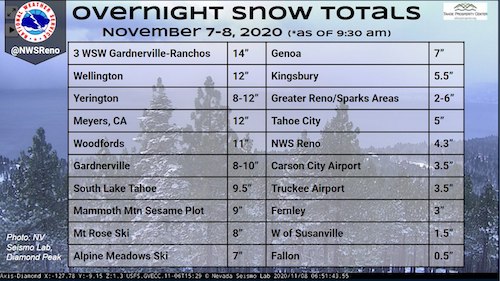
Here are a sampling of the preliminary overnight snow totals for the Sierra and western Nevada region from November 7-8. Additional snow was falling at the time of report in some locations, so totals may increase.
For an overview of storm reports as of 9:30 this morning: https://bit.ly/3k527zC. More snow showers will be possible through the rest of the day, especially near and south of US-50 and south of larger lakes due to lake effect snow bands.


Posted by: Sandy Steinman | November 9, 2020

Record better bird sounds on your smartphone

CornellLab of Ornithology smartphone recording tips for birders

Whether you’re documenting a rare bird song or identifying a mystery species, your smartphone is a valuable tool for capturing bird sounds in the field. The Macaulay Library has some useful tips to help you get the most out of your smartphone’s built-in microphone. Next time you’re outside try recording bird sounds with these suggestions – especially if you live near any of ML’s target audio species. 

Read our smartphone recording tips

Posted by: Sandy Steinman | November 8, 2020

ZOOM PROGRAM: Houseplant Care and Maintenance 11/12/20

   from UC Botanical Garden

ZOOM PROGRAM: Houseplant Care and Maintenance with UCBG Horticulturist

November 12 | 3-4 p.m. 

Eric Hupperts is a houseplant enthusiast. He is also a horticulturist at UCBG caring for the Asian Collection, which includes favorites such as begonias, gingers, and rhododendrons. As a child, Eric was enthralled with the family houseplant, a dragon tree (Dracaena marginata) that provided a gateway into the world of nature. Decades later, that same dragon tree continues to greet Eric whenever he visits home.

In this program you’ll get the special opportunity to chat with Eric all about houseplants! Learn and explore the various facets of caring for successful houseplants, touching on topics such as plant selection, long term care including repotting, and how to create your very own Integrated Pest Management plan to deal with those pesky plant pests. Join us for this hour of houseplant glory.

Registration required:  $20/$15 UCBG Members

Registration info: Register online or by calling 510-664-7606

Event Contact:  CA, gardenprograms@berkeley.edu, 510-664-7606

Access Coordinator:  Mary Mrowka,  gardenprograms@berkeley.edu,  510-664-7606

Posted by: Sandy Steinman | November 8, 2020

Upcoming & Past CNPS Zoom Presentations

November 9, 6 pm Growing Native Plants Panel Discussion – Redbud Chapter

November 10, 6 pm Act Locally Now. 5 Ways You Can Protect Walker Ridge – CNPS

November 10, 7 pm WELCOMING WILDLIFE into the DESIGNED LANDSCAPE, with Carol Bornstein – LA/SMM Chapter

November 11, 7 pm “Saving Humboldt’s Big Lagoon Bog.” with Joseph Saler – North Coast Chapter

November 17, 7 pm Beauty and the Beast: California Wildflowers and Climate Change – San Diego Chapter

November 17, 7 pm Homegrown Habitat: Connecting and Enhancing Habitat One Yard at a Time – El Dorado Chapter
Sign-up for their eNews to receive Zoom link

DEC.
December 2, 7 pm
Maidu Plans for Returned Land – Humbug Valley & Big Meadows, Placer County – Mt. Lassen Chapter

RECORDED PAST EVENTS

Social Justice and Diversity in Conservation:
Juneteenth: Let’s Take It Outside Virtual Town Hall
A Dialogue on Intersectional Environmentalism – Latino Outdoors
“What We Can Learn From Our Past to Move Toward an Equitable Future” – CNRA Speaker Series
Native plant ecologist Justin Luong on academia and LGBTQ+ Representation in STEM – podcast
Diversity in Plant Sciences: Panel discussion led by Naomi Fraga – California Botanic Garden
Resilient Parks, Resilient Californians with Sec. Wade Crowfoot – Cal Parks Foundation
Poppy Hour: A Conversation with Hop Hopkins – Theodore Payne Foundation 

See more and registration details here: https://www.cnps.org/event/virtual-native-plant-events

Posted by: Sandy Steinman | November 7, 2020

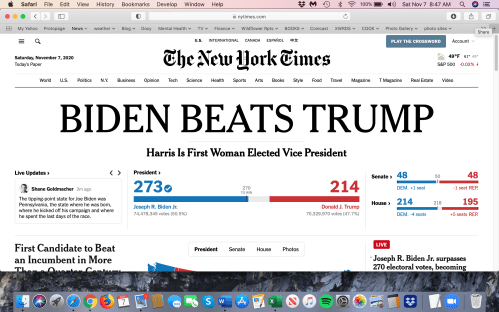
BIDEN WINS U.S. PRESIDENCY


Posted by: Sandy Steinman | November 7, 2020

Pesticide Atrazine Likely Harms More Than 1,000 Endangered Species

Center for Biological Diversity News Release

EPA: Widely Used Pesticide Atrazine Likely Harms More Than 1,000 Endangered Species

Finding Comes Two Months After Agency Reapproved Herbicide for 15 Years

WASHINGTON— The Environmental Protection Agency released an assessment today finding that the endocrine-disrupting pesticide atrazine is likely to harm more than 1,000 of the nation’s most endangered plants and animals.

The finding is a result of the agency’s first-ever nationwide assessment of an herbicide’s harm to protected species, an analysis that’s required by the Endangered Species Act.

The assessment’s release comes just two months after the EPA reapproved the pesticide’s use for another 15 years.


“Finally the EPA has been forced to acknowledge atrazine’s far-reaching harms,” said Nathan Donley, a senior scientist at the Center for Biological Diversity. ”This alarming assessment leaves no doubt that this hideously dangerous pesticide should be banned in the U.S., just as it is across much of the world.”

Atrazine is a widespread pollutant of groundwater and drinking water, has been linked to increased risk of cancer and reproductive problems in people, and can chemically castrate male frogs at extremely low concentrations, including those allowed in drinking water.

Despite being banned in more than 35 countries, including the entire European Union, it remains the second-most used herbicide in the United States after glyphosate.

Today’s draft assessment is part of a legal agreement between the Center and the EPA. It found that atrazine is likely to harm 1,013 protected species, or 56% of all endangered plants and animals in the nation. Species harmed include the highly endangered whooping crane, California red-legged frog and San Joaquin kit fox.

The risk of ongoing widespread harm was found despite major changes to the pesticide’s use restrictions announced by the EPA in September that effectively ban atrazine in Hawaii, on forests, on Christmas tree farms and along roadsides. For endangered species found outside the proposed ban areas, the finding of harm was nearly 100%.

Today’s draft assessment was conducted using a guidance document finalized earlier this year by the Trump administration, dubbed the “Revised Methods,” that disregarded the recommendations of the National Academy of Sciences and ignored the mandate of the Endangered Species Act to give imperiled wildlife and plants the benefit of the doubt when evaluating the range of impacts caused by exposure to pesticides.

By using this new guidance — which precludes consideration of downstream runoff of pesticides into water bodies where endangered aquatic species, like fish and snails, live — the EPA has likely underestimated the true severity of the risk many species face from atrazine exposure.

Atrazine is widely present in U.S. surface waters and drinking-water supplies. Earlier this year the EPA granted a request from atrazine’s maker, Syngenta, to suspend monitoring atrazine in waterways for 2020. The EPA had denied Syngenta’s previous request to stop monitoring atrazine in waterways, because it “…has continued to show atrazine concentrations of potential ecological concern in the most vulnerable watersheds, even when stewardship programs are employed.”

“With this troubling finding, even the EPA has been forced to acknowledge the unacceptable harm caused by atrazine,” said Donley. “It’s beyond me how it can still be approved for such widespread use across this country.”

Draft evaluations for pesticides very similar to atrazine, simazine and propazine, were also released today.

In September the Trump EPA announced it would be reapproving atrazine for the next 15 years, eliminating longstanding safeguards for children’s health, and allowing 50% more atrazine to end up in U.S. waterways. The Center for Food Safety, Center for Biological Diversity and a coalition of public-interest groups sued to challenge that decision last week.
Read More…

Posted by: Sandy Steinman | November 6, 2020

Sierra Mountain Pass Update

-Tioga Pass will close at 5:30 pm on November 5. This is to coincide with Yosemite National Park’s closure of Tioga Road at 6:00 pm.
-Monitor Pass and Sonora Pass will close at 10:00 am on November 6.
Posted by: Sandy Steinman | November 6, 2020

Native Plant Research Scholarships

The Santa Clara Valley Chapter of the California Native Plant Society is offering scholarships to students doing research on native plants or plant community conservation, plant ecology, plant community restoration, plant systematics, or other related botanical studies of native plants that grow in habitats in the San Francisco Bay Area as well as Central and Northern California.
Academic scholarships of $1,500 for graduate student research and a $1,000 scholarship for undergraduate student research are available. Evaluation of applications will focus on the stated purpose of the research, experimental design, relationship to native plant and native habitat conservation, and overall impression of the research project. The deadline to submit your application is November 22, 2020.
For more information and an application, visit the CNPS Santa Clara Valley Chapter’s website at http://cnps-scv.org/…/327-scholarships-instructions…
Posted by: Sandy Steinman | November 6, 2020

Major Win For Wildlife

WildEarth Guardians report

In a major win for wildlife in Montana, WildEarth Guardians settled our lawsuit against the U.S. Department of Agriculture’s Wildlife Services in May, after the federal program agreed to severely curtail its slaughter of native wildlife and the use of cruel tools such as snares, traps, and poisons in Montana.

Read more at Settlement brings Wildlife Services’ killing program out of the shadows in Montana | WildEarth Guardians

Posted by: Sandy Steinman | November 5, 2020

CNPS Zoom Presentations This Week

Thursday, Nov. 5, 7 pm From the field to the freezer: A snapshot of the Santa Barbara Botanic Garden’s seed conservation program – with Heather Schneider of Santa Barbara Botanic Garden and California Native Plant Society, San Luis Obispo County

Thursday, Nov. 5, 7:30 pm Mycorrhizae: The Mutualistic (usually) Relationship between Fungi and PlantYerba Buena Chapter of the California Native Plant Society

Saturday, Nov. 7, 12 pm The Role of Herbaria in Preserving California’s Unique Botanical Heritage with Hannah Kang – Redbud Chapter – California Native Plant Society

See more and registration details here: https://www.cnps.org/event/virtual-native-plant-events

Posted by: Sandy Steinman | November 5, 2020

A Beautiful Botanical Animation

Botanical Animation “Story of Flowers”
Produced by AMKK
Directed by Azuma Makoto
Illustration by Katie Scott
Animation by James Paulley

This “Botanical Animation” is an independent art project from AMKK, who create various works of art using flowers and plants.
The animation was developed for kids to show the life cycle of flowers. Azuma made the original story and requested London-based illustrator and animator Katie and James breathe life into the animation with their beautiful work.

Story:
Many different flowers are growing beautifully and strongly in this world. Taking their roots in the earth, sprouting, blooming, pollination by birds and insects, living on in spite of rain, wind and storms.
They pass on the baton of life, rebirth and decay.
Everything is so in a continuous, endless cycle. This is the story and message of this animation.
Katie’s delicate and lively illustration spreads to fill the screen and everybody, both kids and adults can enjoy this 4 minute animation.

from Yosemite National Park

Tioga Road (continuation of Highway 120 through the park) and Glacier Point Road will temporarily close on Thursday, November 5, at 6 pm in anticipation of snow. We will evaluate conditions on Monday for possible reopening. (Based on the forecast, we don’t expect this to result in a closure for the winter.)
If you are visiting this weekend, expect rainy and/or snowy weather, and that means it’s time to pack your tire chains (https://go.nps.gov/chains).
Check current road conditions by calling 209/372-0200 (then 1, 1).
Posted by: Sandy Steinman | November 4, 2020

Birds, But No Monarchs At Aquatic Park – Photos 11/3/20

We did an a short early morning walk to look for Monarch Butterflies at Aquatic Park in Berkeley today.  We didn’t find any in the usual spots or anywhere else, which was surprising as we frequently seeing them when walking around town the last several weeks.

There were many birds on the water including Buffleheads, Coots, Mallards, Double-crested Cormorants,  Pied-billed Grebe and Gulls . We saw a large number of Snowy Egrets as well as Great Egrets, and a Great Blue Heron. There were many Lesser Goldfinches and Anna’s Hummingbirds in the trees.

This slideshow requires JavaScript.

click read more to see today’s bird list

Read More…

Posted by: Sandy Steinman | November 4, 2020

U.S. Leaving Paris Climate Agreement

NPR reports

The United States will formally leave the Paris Agreement on Wednesday, no matter who wins the election. Of the nearly 200 nations that signed the agreement, the U.S. is the only one to walk away from its promises to reduce greenhouse gas emissions.

Read more U.S. Leaving Paris Climate Agreement : NPR

Posted by: Sandy Steinman | November 4, 2020

California Moves To Protect Joshua Trees

National Parks Conservation Association News Release

The California Fish and Game Commission unanimously approved temporary California Endangered Species Act (CESA) protections today for western Joshua trees.

Desert conservation took a critical step forward today, as the California Fish and Game Commission voted 4-0 to grant temporary California Endangered Species Act (CESA) protections for western Joshua trees.

Today’s vote advances the western Joshua tree to candidate status in the listing process under CESA. State officials now have a year to study the western Joshua tree’s outlook for survival and make a final decision whether to grant permanent Threatened status to the species. If California does grant protected status to the western Joshua tree in 2021, it will be the first use of CESA to protect a species mainly threatened by climate change.

Read More…

Posted by: Sandy Steinman | November 4, 2020

Oswit Canyon open to public after long fight from conservationists

The Desert Sun  reports

More than four years of efforts to spare Oswit Canyon from residential development has culminated in the $7.15 million sale of roughly 114 acres in south Palm Springs to a group of conservationists who rallied to preserve the land as open space.

Read more at Oswit Canyon open to public after long fight from conservationists

Posted by: Sandy Steinman | November 3, 2020

UC – Berkeley Botanical Garden Photos 11/2/20

Photos from a visit to the UC-Berkeley Botanical Garden on November 2. The garden is currently open daily from noon to five by reservation.  There is an entrance fee (free for garden members) and paid parking.  For more information and to make reservations  go to UC-Botanical Garden.

This slideshow requires JavaScript.

Posted by: Sandy Steinman | November 3, 2020

VOTE

from Audubon

It’s Election Day in America. Beyond the presidential race, there are countless state and local elections happening nationwide that will have a big impact on our communities and our birds.

So, if you are voting in-person today, grab a mask, your most comfortable sneakers, and a pair of binoculars—in case you need to bird while in line. But if you are one of the millions who have already voted, thank you, and be sure to share our voting resources with the rest of your flock.

Remember: Birds can’t vote, but we can.

Vote For the Birds

The Revelator  reports

Collisions between whales and ships have increased, but an effort to hear, see and predict whale behavior could help reduce fatalities.

Read more at  Cargo Vessels Are Killing More Whales — and a New Effort Aims to Save Them • The Revelator

Posted by: Sandy Steinman | November 2, 2020

Webinar: Ecological History of the Bay Area and California 11/9/20

from Marin CNPS Chapter
The Ecological History of the Bay Area and California
Monday November 9, 7:30 pm via Zoom
Laura Cunningham

What was California like 500 years ago, with native bunchgrasses, fields blanketed in wildflowers, vernal pools, giant grizzlies, herds of tule elk and pronghorn antelope, rivers filled with salmon, and condors soaring overhead?

Attend our November chapter meeting with author and artist Laura Cunningham for a presentation about the ecological history of the Bay Area and California to find out! Twenty years of research went into her 2010 book, A State of Change: Forgotten Landscapes of California, also illustrated with Laura’s paintings. She will present an hour-long slideshow of her artwork for the book, which reconstructs what our region and state as a whole looked like before European arrival, including oak woodlands, grasslands, Native American culture, and fire ecology.

To access Zoom meeting request  being added to the chapter mailing list
Posted by: Sandy Steinman | November 2, 2020

Webinar: Fungal/Plant Relationships 11/5/20

from Yerba Buena CNPS Chapter

Mycorrhizae: The Mutualistic (usually) Relationship between Fungi and Plants

November 5, THURSDAY, 7:30pm Speaker: J.R. Blair

Get the Zoom meeting link here

Most plants, about 90% of all species, maintain a symbiotic relationship with fungi at the roots. Those relationships are called mycorrhizae and are usually mutualistic; that is, both members of the relationship benefit, although there are exceptions to that rule. J.R. Blair will introduce the mycorrhizal relationship, discuss the benefits that the plant and fungal partner receive, and present the various types found in nature. He will also talk about some of the more recent scientific revelations of this fascinating biological phenomenon.

Read More…

Posted by: Sandy Steinman | November 2, 2020

High-altitude shorebird migration

The Royal Society B: Biological Sciences reports on a study op High-altitude shorebird migration in the absence of topographical barriers: avoiding high air temperatures and searching for profitable winds | in theProceedings of the Royal Society B: Biological Sciences

We found that godwits flew at altitudes above 5000 m during 21% of all migratory flights, and reached maximum flight altitudes of nearly 6000 m.

Read about the study at : High-altitude shorebird migration in the absence of topographical barriers: avoiding high air temperatures and searching for profitable winds | Proceedings of the Royal Society B: Biological Sciences

Posted by: Sandy Steinman | November 1, 2020

Yosemite Day Use Reservations No Longer Required

from Yosemite National Park

While reservations are no longer required to drive into the park, we continue to urge you to follow CDC guidance to prevent the spread of infectious diseases by maintaining a safe distance between yourself and other groups; wearing a cloth face covering when social distancing cannot be maintained; washing your hands often with soap and water for at least 20 seconds; avoiding touching your eyes, nose, and mouth; covering your mouth and nose when you cough or sneeze; and most importantly, staying home if you feel sick.

Read More…

« Newer Posts - Older Posts »

Categories