The New York Times reported
Two new studies add to the evidence that human activity, from fishing to urban development, is driving the evolution of wild animals.
Read story at Honey, We Shrunk the Cod
The New York Times reported
Two new studies add to the evidence that human activity, from fishing to urban development, is driving the evolution of wild animals.
Read story at Honey, We Shrunk the Cod
Posted in Animals | Tags: Cod, Human Activity Is Driving the Evolution of Wild Animals
The Berkeley News reported
The Museum of Vertebrate Zoology has one of the largest collections of eggs in North America, and it’s vital to researchers worldwide.
Read more Got eggs? This UC Berkeley museum has tens of thousands. – Berkeley News
Posted in Uncategorized | Tags: Museum Egg Collections
Smithsonian reported
Dubbed “allokelping,” it might be a unique cultural phenomenon that’s as endangered as the orca population itself
Posted in Animals | Tags: Killer Whales
The New York Times reported
New research painted a more accurate picture of the megafauna that spread widely around the Americas before they went extinct.
Read story at Scientists Reveal the Hairy Truth About Giant Ground Sloths
Excerpt from New York Times article Madre Fire Grows to 70,800 Acres, Prompting Evacuations in California
The fire tore across the western side of the Carrizo Plain National Monument, according to Cal Fire, burning through at least 11,500 acres of the natural preserve that is home to rare plant species and draws visitors in the spring to its wildfire blooms.
Fires can benefit wildflowers by helping native species germinate and killing off invasive plants that compete with flowers for sunlight, water and nutrients. Often vibrant displays occur in years after fires. But if a fire burns too hot, it can eliminate the seed bank of the native plants and leave an area exposed to invasions of nonnative plants.
“The hope would be that fire would benefit the landscape but we won’t know until after the fire is out,” said Philip Oviatt, a spokesman for the national monument.
— Read full article at www.nytimes.com/2025/07/03/us/madre-wildfire-san-luis-obispo-california.html
Posted in Environment, Park | Tags: Carrizo Plain, Madre Fire
The New York Times reported
A “roll cloud” spotted off the coast of Portugal looked like something out of a movie. Here’s the science behind it.
Read on and see video at www.nytimes.com/2025/07/03/weather/roll-cloud-portugal-heat-wave.html
Posted in Environment | Tags: Roll Clouds
NPR reported
Mosquitoes are the deadliest animal on the planet, and some of them may be on the rise. At least in listener Abigail Krich-Starr’s area, that’s due to warmer, wetter weather — which, yes, is linked to climate change. But it doesn’t stop there: Ecologists and entomologists say increased heat could also alter mosquito behavior, shift their natural habitat, and even change how pathogens incubate and spread inside their bodies.
Read on www.npr.org/2025/06/24/1266983858/weather-climate-mosquito-repellent-worse
Posted in Animals | Tags: Mosquitoes
The Sacramento Bee reported
A humpback whale put on a show of strength and energy as it breached over 150 times near Monterey Bay on California’s coast. Boaters also saw a fin whale.
Read on an see photos at www.sacbee.com/news/california/article310003980.html
Posted in Animals | Tags: Fin Whales, Humpback Whales
The Sacramento Bee reported
Sacramento is a crucial pit stop in the migration of monarch butterflies across Northern California. Recently, local monarch enthusiasts have introduced tropical milkweed — a source of food for the butterflies — into their gardens to support the beloved insect’s journey. Despite strong messaging against tropical milkweed by some butterfly conservationists, UC Davis researchers show that the plant neither helps nor harms monarchs in California.
Read more Tropical milkweed may not harm monarchs in Northern CA | Sacramento Bee
Posted in Butterflies, Wildflowers and Other Plants
|
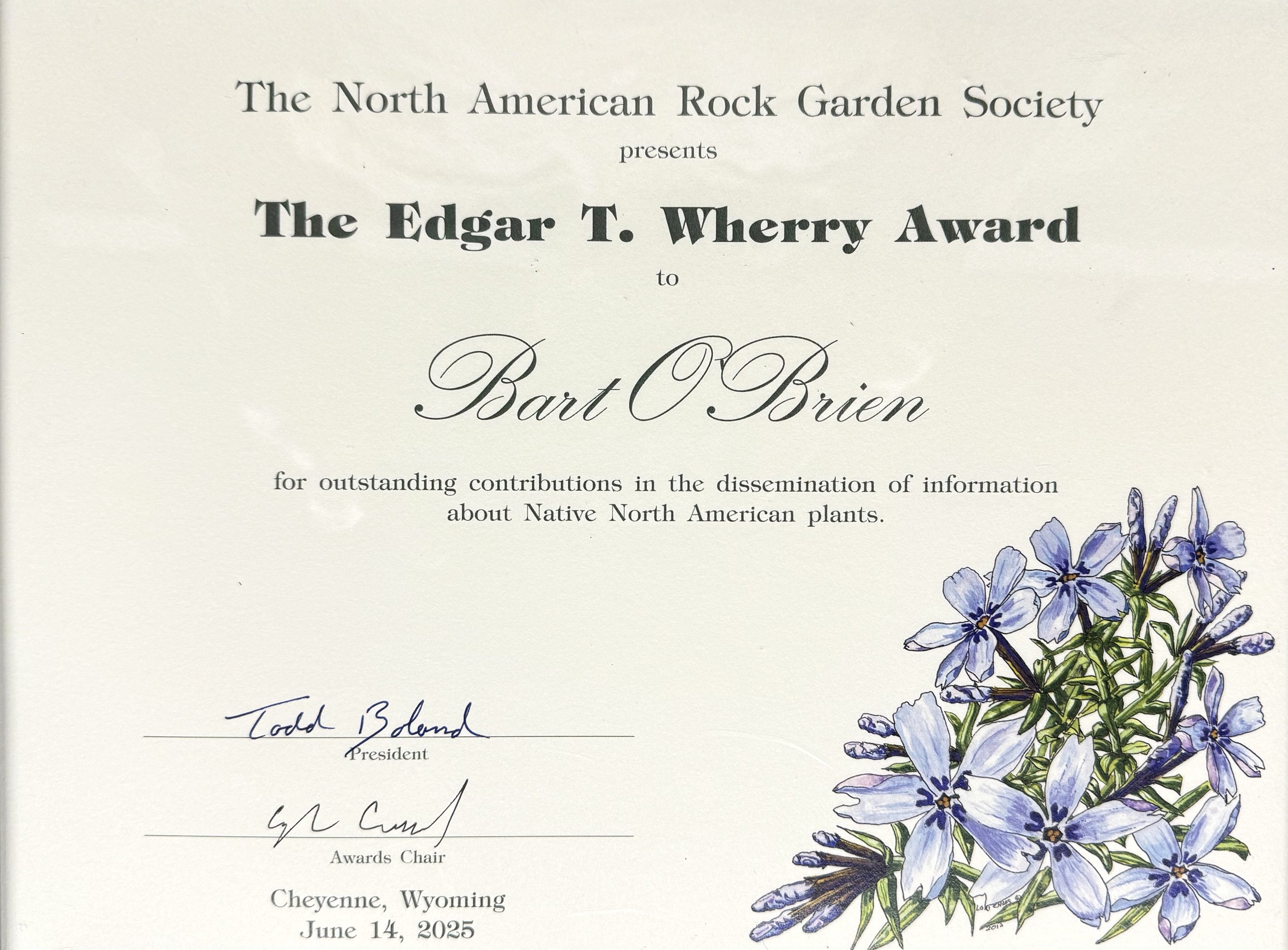
from the East BayRegional Parks Botanic Garden Garden Director Bart O’Brien Receives the Edgar T. Wherry AwardThe North American Rock Garden Society has just honored Botanic Garden Director Bart O’Brien with the Edgar T. Wherry Award. |
|
|
In over 40 years as a horticulturalist, Bart has communicated his knowledge of and enthusiasm for native plants in myriad articles, newsletters, and talks. He also served as the editor of Fremontia (now Artemisia) from 2006 to 2009 and is the coauthor of three popular general-interest books: California Native Plants for the Garden; Reimagining the California Lawn: Water-Conserving Plants, Practices, and Designs; and the bilingual (Spanish and English) Care and Maintenance of Southern California Native Plant Gardens. Congratulations, Bart, on this impressive award! |
Posted in Garden | Tags: Bart O’Brien, Edgar T. Wherry Award, North American Rock Garden Society
Boston Herald reported
A North Shore whale watch is having a heck of a start to the season.
The 7 Seas Whale Watch out of Gloucester is on a heater so far, seeing more and more great white sharks in the northern waters.
After a trip on Sunday, the whale watch has now spotted five great white sharks so far this season.
Read more Massachusetts whale watch is on a heater seeing white sharks
Posted in Animals | Tags: Great White Sharks, Whale Watching
Discover Wildlife reported
Last seen alive in 1893, scientists have rediscovered two populations of the elusive animal in the high streams of the Andes.
A frog species thought to have vanished for over 130 years has been rediscovered in Chile, marking a momentous breakthrough for conservationists.
First described in 1902 (based on specimens collected in 1893), the elusive Alsodes vittatus had evaded all attempts to re-find it – until now.
Read more at Rare creature lost for 130 years found hiding in Chilean mountains | Discover Wildlife
Posted in Animals | Tags: Alsodes vittatus
Head to Tilden’s Regional Parks Botanic Garden for July Butterfly Walks. Enjoy free guided walks around the Botanic Garden during peak butterfly spotting season. Sunday, July 20 and Wednesday, July 23, from 1 to 2 p.m. and 2:15 to 3:15 p.m. Registration begins July 1. More info
These walks are very popular and fill up quickly.
Posted in Butterflies, Walks & Hikes | Tags: Butterfly Walks, East Bay Regional Parks Botanic Garden
See the calendar of upcoming events of the California Native Plants Society at https://www.cnps.org/events
Posted in Talks | Tags: Upcoming CNPS Events
See upcoming events calendar for the East Bay Regional Parks at https://www.ebparks.org/calendar
Posted in Park, Walks & Hikes | Tags: East Bay Regional Parks
Science Alert reported
Three newly-discovered species of deep sea ‘spiders’ farm methane-eating bacteria on their own bodies in a symbiosis quite unlike anything seen before.
Unlike animals like ourselves, who are fed by a solar-powered food chain, those that live in the deep sea have to get creative with their energy sources. Sunlight is scattered and absorbed as it travels through ocean water, and never reaches depths beyond 1,000 meters (around 3,300 feet).
Read more New Discovery of Deep Sea ‘Spiders’ Is Unlike Anything We’ve Seen Before : ScienceAlert
Posted in Animals | Tags: Deep Sea Spiders
Join Bay Nature Magazine and Occidental Arts & Ecology Center co-directors Kate Lundquist and Brock Dolman for a virtual talk about beavers on Wednesday, July 9 12 -1pm.
Read more at Bay Nature Institute
| Issue Two of the Desert Researcher Magazine is here!
We’re excited to share the latest issue of The Desert Researcher Magazine, a unique collaboration between Anza-Borrego Foundation, Anza-Borrego Desert State Park, and Steele/Burnand Anza-Borrego Desert Research Center, UC Irvine. This publication offers rare, behind-the-scenes access to the scientific research happening in Anza-Borrego Desert State Park, the largest state park in California and a living laboratory of desert biodiversity. Why does this research matter? Because it informs how we protect the Park’s fragile ecosystems, wildlife corridors, and cultural resources in the face of climate change, development pressures, and increasing human use. From studying fossil beds to monitoring bighorn sheep, these projects directly shape the future of desert conservation. What makes The Desert Researcher special? It features exclusive insights directly from researchers, available nowhere else, making this your direct line to the science that’s shaping the future of California’s desert landscapes. |
|
Posted in Desert | Tags: Desert Researcher Magazine
from Marin CNPS
Guest Speaker: Caroline Martorano, CNPS Coordinator of California Native Seed Strategy
Monday, July 14 at 7:30 pm
The California Seed Strategy was initiated in June 2022 to improve availability of locally and genetically appropriate native seeds for ecological restoration in California. CNPS led a steering committee to publish the Strategy in December 2023 and is now in the implementation phase. CNPS is facilitating five new regional working groups with over 200 participants overall to share information and resources across organizational boundaries and within ecological boundaries. A Seed Transfer Advisory Group made up of California plant genetics and seed-based restoration subject matter experts was formed to help develop recommendations to protect local genetic diversity.
Caroline Martorano is the Stewardship Specialist for the California Native Plant Society and is a coordinator for the California Native Seed Strategy.
Posted in Talks, Wildflowers and Other Plants | Tags: California Seed Strategy
The New York Times reported
As official research positions are lost to budget cuts, the work of citizen scientists to preserve federal forests is becoming more valuable.
Red more Weed Manager of the Year: One Man’s Quest to Save the Sonoran Desert
Posted in Desert, Environment | Tags: Desert Preservation
The Good News Network reported
In a creative use of big data, a survey has found that of the 3,119 US counties, 1,836 experienced growth and expansion of tree cover, with a high concentration among prairie and Mid-West areas.
from Xerces Society
Monarch butterflies (Danaus plexippus) are perhaps the most well-known and beloved butterflies in North America. Seen from coast to coast, their arrival in northern states and Canadian provinces is viewed by many as a welcome sign of the change in seasons from spring to summer. However, the monarchs in different parts of North America might not be quite the same! Read on to discover what makes eastern monarchs different from western ones, and how we can help them.
Read more Everything You Need to Know About Eastern Monarchs and How to Help Them | Xerces Society
Posted in Butterflies | Tags: Eastern Monarchs
The Guardian
Since 1999, Armando López Pocol and his team of volunteers have bucked the trend for deforestation, regenerating the landscape of the highlands with their Chico Mendes project
Posted in Environment, Wildflowers and Other Plants | Tags: Regreening Guatemala
Be aware if you are planning to visit the parks this weekend, there may be closures or delays on Highway 198 due to an ongoing wildfire near Three Rivers. Consider traveling on Hwy 180 through the Big Stump entrance of Kings Canyon to avoid this area. Watch for updates from Tulare County Fire Department.
Posted in Drives, Park | Tags: Kings Canyon Road Conditions
From California State Parks Foundation
Good news! 🎉
The Legislature has passed a budget that restores funding for the California State Library Parks Pass — and it’s now headed to the Governor’s desk to be signed.
This is a big step toward protecting park access for all Californians. Thank you to everyone who raised their voice to keep this vital program
Posted in Park | Tags: California State Library Parks Pass Program
Birds and Blooms is a free website for identifying and attracting birds and growing plants for pollinators. The emphasis is especially on backyard birding and gardening.
Check it out at Birds and Blooms – Americas #1 Backyard Birding and Gardening Magazine
Mono Lake Committee reported
Water that should be flowing to Mono Lake began leaving the Mono Basin and flowing instead toward Los Angeles on June 17 when the Los Angeles Department of Water & Power (DWP) began exporting stream diversions into the Los Angeles Aqueduct.
DWP started exports early this year, which is unusual; it plans to make certain it can export the maximum allowed volume of 16,000 acre-feet by the end of the runoff year (March 31, 2026).
Read on www.monolake.org/today/dwp-exporting-water-away-from-the-mono-basin/
Posted in Environment | Tags: Mono Basin Water
The Good New Network reported
Though officially classified as vulnerable, no credible sighting of the Asian short-clawed otter, the smallest species of its kind, has been made in almost 200 years.
So when forestry officials in Nepal found an injured, juvenile otter at the confluence of two major rivers last November, they never imagined that their actions might determine the fate of the world’s smallest otter.
Fortunately, they sent images to the scientific community in the region, who realized that the animal had reappeared, having not been seen since 1839.
Posted in Animals | Tags: Asian short-clawed otter
See all Golden Gate National Parks Conservancy Upcoming Events at see all upcoming events
Posted in Park | Tags: Golden Gate National Parks Conservancy Events
The Good News Network reports
From a country that’s typically in the news for hurting whales comes the story of a mass-stranding event with a happy ending.
Around 60 pilot whales, known locally as grindhvalur, were found stranded on Ólafsfjörður beach last Sunday.
Locals and emergency crews rushed to the remote area in a desperate effort to save the mammals, and by approximately 7:00 p.m. local time, rescue teams had successfully moved the whales from the shoreline back into open water.
Read more Dozens of Whales Saved by Locals After Mass Stranding on Icelandic Beach
Posted in Animals | Tags: Whale Strandijngs, Whales



 Natural History Wanderings