Posted by: Sandy Steinman | December 29, 2019

Scientists: Earth Endangered by New Strain of Fact-Resistant Humans

The Borowitz Report writes political satire as news pieces. Too often they seem too close to reality such as this one  “Scientists: Earth Endangered by New Strain of Fact-Resistant Humans”

Scientists have discovered a powerful new strain of fact-resistant humans who are threatening the ability of Earth to sustain life, a sobering new study reports.

Read full satire piece at  Scientists: Earth Endangered by New Strain of Fact-Resistant Humans | The New Yorker

Posted by: Sandy Steinman | December 28, 2019

 Migrant species do well in warm and wet UK in 2019

The BBC reports

It’s been a good year for migrant butterflies, moths and dragonflies in the UK, according to a review of 2019 by the National Trust.

The charity says warm and wet weather saw the biggest influx of painted lady butterflies in a decade.

But the impacts of drought and wildfires in some parts mean it’s not been a good year for natterjack toads and water voles.

The fires saw the habitats of mountain hares impacted as well.

Read more at  Climate change: Migrant species do well in warm and wet UK in 2019 – BBC News

Posted by: Sandy Steinman | December 27, 2019

World’s oldest fossil trees uncovered in New York

The BBC reports

The earliest fossilised trees, dating back 386 million years, have been found at an abandoned quarry in New York.

Scientists believe the forest they belonged to was so vast it originally stretched beyond Pennsylvania.

This discovery in Cairo, New York, is thought to be two or three million years older than what was previously the world’s oldest forest at Gilboa, also in New York State.

Read more at  World’s oldest fossil trees uncovered in New York – BBC News

Posted by: Sandy Steinman | December 26, 2019

Mono Lake Committee’s summer seasonal job openings

We’re hiring! Mono Lake Committee’s summer seasonal job openings are posted

by Rose, Education Director

Have you always wanted to spend a summer living and working at Mono Lake? This may be your chance!

We will begin accepting applications for the 2020 seasonal staff positions on January 1, 2020. Photo by Miranda Norlin.

The Mono Lake Committee is looking for passionate individuals to join our team for the busy 2020 summer season. This is your opportunity to share your love for Mono Lake and gain great experience working with a successful environmental non-profit.

Take a look at the seasonal staff job postings, which include positions leading interpretive tours, helping visitors in the Information Center & Bookstore, canoeing on Mono Lake, working with our Outdoor Education Center program, and more.

If you have always wanted to work at Mono Lake, this is your chance! Photo by Ava Stavros.

The Mono Lake Committee values a diverse, inclusive, and equitable workplace where all employees and volunteers feel respected and appreciated. We are committed to a nondiscriminatory approach and provide equal opportunity for employment and advancement in all of our departments.

We will accept applications starting on January 1, 2020 and positions fill quickly. To apply, please send cover letter and resume to the staff member listed on the job description. Please feel free to contact me, Education Director Rose Nelson, with any questions via email.
 

Reuters reports

Energy companies and other businesses that accidentally kill migratory birds will no longer be criminally prosecuted, the Trump administration said Friday in a decision hailed by industry but denounced by environmental groups.

Read more at Accidentally killing migratory birds not a crime, Trump administration says – Reuters

Posted by: Sandy Steinman | December 25, 2019

Annular solar eclipse on December 26

EarthSky reports

2019’s only annular eclipse – the third and final solar eclipse of this year – falls on December 26. It’s visible along a narrow path in the world’s Eastern Hemisphere. Like a total solar eclipse, an annular solar eclipse happens when the new moon moves directly in front of the sun. During a total solar eclipse, the new moon completely covers over the solar disk. During an annular eclipse, the lunar disk is too small to totally cover over the sun, so an annulus – or thin ring of the sun’s surface – surrounds the new moon silhouette.

The narrow annular eclipse path (in red) starts at sunrise at left ,over Saudi Arabia. and ends at sunset at right over the North Pacific ocean. The annular eclipse takes 3 1/3 hours to traverse this 8,000 mile (12,900 km) path. At any one point on the path, however, the maximum duration of the annular eclipse is only 3 2/3 minutes. Visit EclipseWise.com for an extended version of the above map, or see TimeAndDate.com for a detailed map and local eclipse times.

Read more at  Annular solar eclipse on December 26 | Tonight | EarthSky

Posted by: Sandy Steinman | December 25, 2019

California Academy of Sciences Identifies 71 New Species

ScienceDaily reports Scientists at the California Academy of Sciences describe 71 new species in 2019

From geckos to goblin spiders, flowering plants, and Mediterranean ants — spanning five continents and three oceans — these 71 new species described by Academy scientists grow Earth’s tree of life.

Read full article  Scientists at the California Academy of Sciences describe 71 new species in 2019 — ScienceDaily

Posted by: Sandy Steinman | December 24, 2019

Yellowstone Geyser On Eruption Streak

NPR reports

Yellowstone National Park’s Steamboat Geyser has been on a real eruption streak lately. The geyser can shoot water more than 300 feet into the air, and this year it has erupted more than 45 times. Scientists are trying to understand what triggered this unusual streak of activity. (Listening time, 4:36)

Posted by: Sandy Steinman | December 24, 2019

Pt. Reyes Winter Shuttle Bus Schedule

It’s winter and that means northern elephant seals and gray whales at Point Reyes National Seashore! That also means a lot of visitors and in order to reduce traffic congestion, shuttle buses will be in operation.

$7 shuttle bus tickets are available at the Kenneth C. Patrick Visitor Center at Drakes Beach from 9:30 am to ~3 pm. Shuttles buses will run on weekends and federal holiday Mondays from Saturday Dec 28 until late March or mid-April 2020.

Please note that Sir Francis Drake Blvd will be closed at the South Beach junction from 9 am until ~5:45 pm while the shuttle buses are in operation.

Here’s to a fun and enjoyable sealson of whale watching and seal seeing! Look for Winter Wildlife volunteer docents in red vests to learn more about these magnificent marine mammals!

For more details and information, please check the park website: https://www.nps.gov/pore/planyourvisit/shuttle.htm

Posted by: Sandy Steinman | December 24, 2019

How Trump Administration Has Harmed The National Parks

National Parks Conservation Association  reports on home the Trump administration has been destructive to U.S. National Parks

It’s been a tough year for national parks. The Trump administration has undermined, degraded, and outright attacked the laws and agencies that protect our public lands. These are the “lowlights.”See the full list at www.npca.org/TrumpPolicy

Posted by: Sandy Steinman | December 23, 2019

Mormon Meadows in the Bodie Hills Protected

Eastern Sierra Land Trust announced

We have some great news to share today: Mormon Meadows in the Bodie Hills is protected forever, thanks to our friends at The Wilderness Land Trust!👏👏

https://bit.ly/35wcZ2U

We’ll be working alongside them to restore and care for the wildlife habitat here, which hosts Bi-State sage-grouse, pronghorn, black bear, and so much more. The land will eventually be transferred to public ownership, under the Bureau of Land Management.

Thank you to every single member of the Eastern Sierra land conservation community who makes this important work possible 🙌.

Posted by: Sandy Steinman | December 23, 2019

Vegetation Science position

California Native Plant Society has an opening for a Vegetation Intern to work on the coast in Mendocino/Northern Sonoma Counties. The Intern will work with CNPS vegetation and rare plant scientists to explore and understand California’s plants and plant communities primarily in Mendocino and Sonoma counties. This is a part‐time to full-time Vegetation Science position directly supervised by both the Vegetation Program staff and the Dorothy King Young Chapter vegetation chairs. The position includes at least 6 months of work, beginning mid to late February 2020, and the position may be extended beyond summer depending on funding.
https://www.cnps.org/…/…/12/job-rice_veg_intern-20191220.pdf

Posted by: Sandy Steinman | December 23, 2019

Barge With 600 Gallons of Diesel Sinks Off Galápagos Islands

The New York Times reports

Hundreds of gallons of diesel fuel sank into the waters off the Galápagos Islands on Sunday after a crane toppled onto a barge and caused it to overturn, the authorities in Ecuador said, prompting an emergency cleanup in one of the world’s most revered natural destinations.

The authorities said that 600 gallons were on the barge when it sank off San Cristóbal Island, threatening the nearby environment. They declared an emergency and said they had ordered an investigation.

read more at Barge With 600 Gallons of Diesel Sinks Off Galápagos Islands – The New York Times

Posted by: Sandy Steinman | December 22, 2019

 Portola Valley, CA Commits To Native Plants and Landscaping |

The Town’s Conservation Committee recently reviewed and updated the Native Plant List and Discouraged Plant List for Portola Valley, and they will soon be incorporated into the Town’s Design Guidelines. Landscape design in Portola Valley should seek to preserve the qualities of the natural environment through the use of native plant materials and landscaping plans that provide a blended transition to adjacent open areas.

Read more at Native Plants and Landscaping | Portola Valley, CA

Posted by: Sandy Steinman | December 21, 2019

Solstice sun at southernmost point 

Happy Winter Solstice

EarthSky reports

You might think of the solstice as a day, but it’s really a moment. The December solstice happens at 4:19 UTC on December 22, 2019. That time – the moment of solstice – marks the sun’s southernmost point in our sky for this year.

Read more at  Solstice sun at southernmost point | Tonight | EarthSky

Posted by: Sandy Steinman | December 21, 2019

‘Catastrophic’ Wildfires Continue To Rage Across Australia

NPR  reports

A large portion of Australia is on fire after weeks of extreme heat, strong winds and drought that have created ideal conditions for hundreds of bushfires to thrive across the country. Several fires have been burning since November, particularly in the eastern state of New South Wales.

Read more ‘Catastrophic’ Wildfires Continue To Rage Across Australia | Nevada Public Radio

Posted by: Sandy Steinman | December 21, 2019

Dutch Court Orders Leaders to Take Climate Action

The New York Times reports

The Supreme Court of the Netherlands on Friday ordered the government to cut the nation’s greenhouse gas emissions by 25 percent from 1990 levels by the end of 2020. It was the first time a nation has been required by its courts to take action against climate change.

Read more at In ‘Strongest’ Climate Ruling Yet, Dutch Court Orders Leaders to Take Action – The New York Times


Posted by: Sandy Steinman | December 20, 2019

Tips For Winter Bird Feeding

Cornell Lab of Ornithology has the following article for winter bird feeding

Feeding Birds This Winter? We’ve Got You Covered

With the right feeder setup, winter can be one of the best—and coziest—seasons for bird watching. Here’s a starter pack of our most popular articles on the how, why, and what to do:

Posted by: Sandy Steinman | December 19, 2019

Henry Coe Wildflower Update 12/16/19

Henry Coe State Park still has wildflowers in bloom. See what is currently flowering at the Pine Ridge Association website with photos and a list of flowers now in bloom at: Henry W. Coe – Wildflower Guide.


Posted by: Sandy Steinman | December 19, 2019

Sea otter population in the SF Bay could skyrocket

The S. F. Chronicle reports

There’s hope for the endangered southern sea otter population, according to a study out of Sonoma State University that predicts the population could more than triple from about 3,000 to 10,000 if the animals were to repopulate the San Francisco Bay.

But there’s one big — and honestly pretty terrifying — obstacle for the fuzzy otters to contend with: great white sharks near the Golden Gate Bridge.

Read full story at  The sea otter population in the SF Bay could skyrocket. If they can get past ‘the gauntlet,’ that is – SFGate

Posted by: Sandy Steinman | December 18, 2019

2019 Oakland Christmas Bird Count – Preliminary Results

Here is a preliminary report for the annual Oakland Christmas Bird Count. The group for the area had a record high (since 1974) 184 species, seven more than our recent 20-year average. We had over 250 people out counting.

Posted by: Sandy Steinman | December 18, 2019

Botanist Job Opportunities

Calling all botanists in search of work next summer! Do you have solid knowledge of Pacific Northwest plant families? Can you use a dichotomous key for plant identification?

If so, apply now for vegetation monitoring field crew positions at the GS-5 bio-tech, GS-6 assistant crew lead, and GS-7 crew lead levels with the NPS Klamath Inventory and Monitoring Network. These jobs are based in Ashland, Oregon.

Positions are only open until December 20 or until 150 people apply, whichever comes first, so don’t delay. We’re looking for folks who don’t mind lots of travel, enjoy camping, and are available from May to Sept 2020.

The field crew works 8 (consecutive) days on and 6 days off, collecting data at long-term monitoring plots in two beautiful places: Lava Beds National Monument and Redwood National Park. This team does NOT do invasive plant control (using herbicides). #findyourpark

Please contact Sean Smith with any questions: sean_b_smith@nps.gov. To learn more or apply, go to https://www.usajobs.gov/ search for “552493200”.

EarthJustice News Release

More than 400,000 people and dozens of local tribal, government, business, and national recreation groups have flooded the U.S. Forest Service with comments opposing its plan to undo safeguards that prevent clearcutting and road building in Alaska’s Tongass National Forest. The comment period ends Tuesday.

Read more at  Trump Administration Blasted for Plan to Allow Old-growth Clearcutting in Alaska’s Tongass National Forest | Earthjustice

Center for Biological Diversity News Release

 The California Fish and Game Commission today approved California Endangered Species Act protections for five of six populations of the foothill yellow-legged frog, a species that has disappeared from more than 50% of its historic habitat in the state. The decision responds to a 2016 petition by the Center for Biological Diversity.

Posted by: Sandy Steinman | December 16, 2019

Border Wall’s Impact On National Parks

The New York Times has an opinion piece on the impact of the border wall on national parks and wildlife

President Trump’s barrier is threatening species and reshaping entire fragile ecosystems.

The 30-foot walls that are taking their place are easily scalable by humans but completely impenetrable by most wild animals. The new construction also poses grave flooding hazards and requires the draining of precious desert groundwater, threatening to permanently reshape entire ecosystems.

Red full article at Opinion | The Border Wall Is Rising Up Across Our National Parks – The New York Times

Posted by: Sandy Steinman | December 15, 2019

Christmas Bird Count

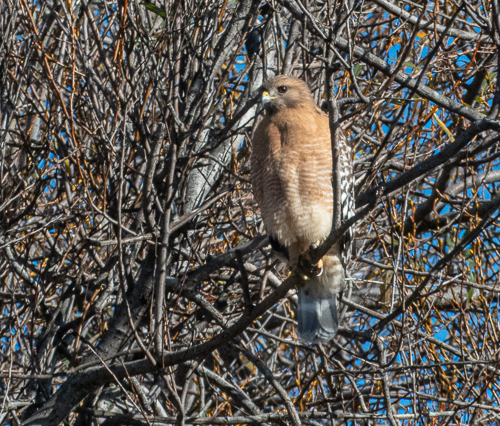
Red-Shouldered Hawk

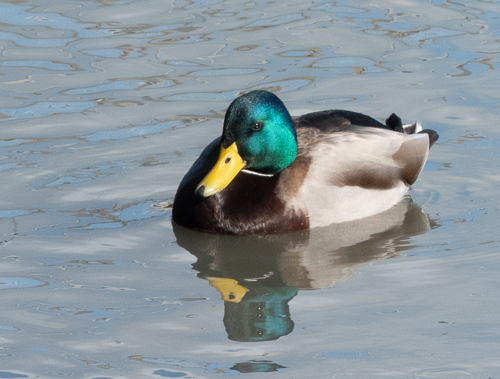
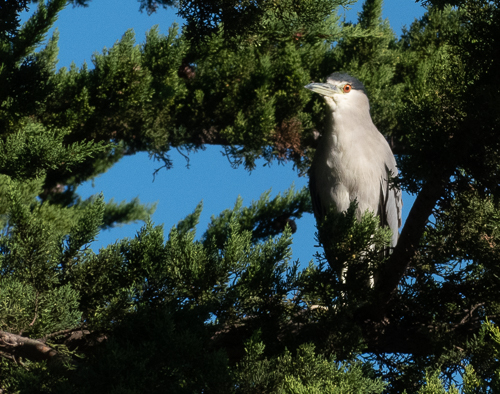
Today I spent the day doing the Oakland Christmas Bird Count. I mainly worked on the Berkeley waterfront (six eBird Hotspots) and also a neighborhood walk. To get an idea of what I saw today you can see my eBird lists.

Black-crowned Night-heron

Sea Breeze Market Cove https://ebird.org/checklist/S62354512 

Berkeley Beach-Brickyard to Pt. Emery https://ebird.org/checklist/S62354521

Frontage Rd., Berkeley https://ebird.org/checklist/S62354530

McLaughlin Eastshore State Park, Berkeley https://ebird.org/checklist/S62356597

Berkeley Pier https://ebird.org/checklist/S62354536

Berkeley Marina https://ebird.org/checklist/S62354542 

Cedar-Rose Park https://ebird.org/checklist/S62347940

Mallard


Posted by: Sandy Steinman | December 15, 2019

Deadly Mosquitoes Are Killing Off Hawaii’s Rare Forest Birds

Honolulu Civil Beat reports

Scientists are racing to eradicate disease-carrying mosquitoes from forests, but to some a solution still feels like forever away.

Only 17 forest bird species are left in the islands, down from more than 50 that evolved here over thousands of years, according to the Audubon Society. And nearly all of those that persist appear poised for extinction in this century as threats to their survival intensify with the onset of climate change.

Over time, Hawaii’s mountaintop forests have become the birds’ last refuge. That’s because this high-elevation habitat has historically been too cool to host the birds’ most severe threat: mosquitoes carrying avian malaria.

Read full story at  Deadly Mosquitoes Are Killing Off Hawaii’s Rare Forest Birds

Posted by: Sandy Steinman | December 14, 2019

US national parks face ‘crisis’ over invasive animal species 

The BBC reports

Invasive animal species represent a crisis for United States national parks, experts have said, in a call for widespread, systemic action.More than half of national parks are threatened by invasive animal species, but the threat has gone unaddressed, according to a new paper.

Read story at  US national parks face ‘crisis’ over invasive animal species – BBC News

Posted by: Sandy Steinman | December 13, 2019

Last Year’s Christmas Bird Count Results

The Results Are In: The 119th Christmas Bird Count
As we eagerly await the start of Audubon’s 120th Christmas Bird Count tomorrow, let’s take a closer look at the results from last year’s count. While the frigid temperatures may have presented a challenge for the birds, participants turned out in record numbers—over 2,600 counts across the hemisphere! Whatever the weather this year, join us in celebrating the tradition that brings us together at the holidays in the name of science.

Posted by: Sandy Steinman | December 13, 2019

2019 Geminid Meteor Shower Peaks Dec. 14 or 15

EarthSky reports

The annual Geminid meteor shower is expected to reach its peak this weekend – though under the glaring light of the almost-full waning gibbous moon. The peak morning is likely to be Saturday, December 14, 2019 – or, possibly, Sunday, December 15, 2019. But the morning of December 13 might offer some meteors, too. These colorful meteors tend to be bright, so you might see as many as 20 or so Geminids per hour, despite the moonlight. On a dark night, free of moonlight, you can easily spot 50 or more meteors per hour. On an optimum night for the Geminids, it’s possible to see 150 meteors per hour … but that won’t happen this year, under the moonlight.

Also know that – although this is one shower you can successfully watch in the (late) evening – the best viewing is typically around 2 a.m., no matter where you are on Earth.

« Newer Posts - Older Posts »

Categories